
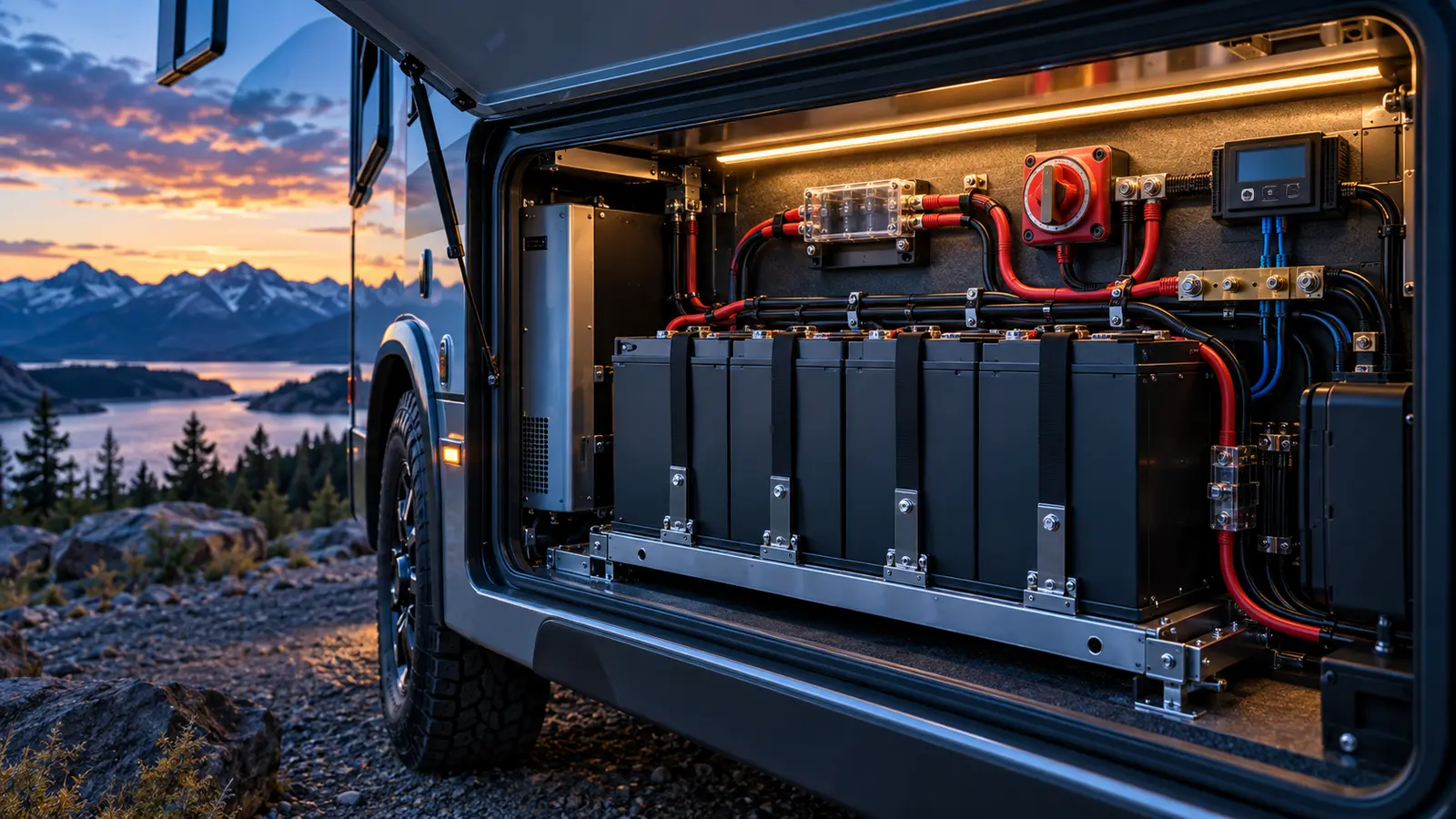
The best lithium battery for an RV is usually a LiFePO4 system sized for the owner’s energy use, inverter current, climate, and charging sources. The right answer may be one 100Ah drop-in battery for a weekend trailer, two 100Ah heated batteries for a four-season camper, or a professionally integrated 400Ah bank with an external BMS for a full-time rig.
This guide focuses on choosing the complete battery architecture rather than ranking ten near-identical boxes. For specific 100Ah product comparisons, use Van Volt Pro’s dedicated 100Ah guide; this article addresses the broader upgrade decision and helps prevent keyword overlap between the two resources.
best lithium battery for rv: Quick recommendations by RV type
| RV use | Sensible starting point | Why |
|---|---|---|
| Weekend trailer, modest loads | 100Ah LFP | About 1.28kWh nameplate; light and simple |
| Couples’ travel trailer with fridge and work devices | 200Ah LFP | Better overnight and poor-weather margin |
| Four-season RV | Heated or conditioned 200Ah+ LFP | Low-temperature charging needs a controlled plan |
| Full-time van with electric cooking | 300–400Ah LFP or 24V equivalent | High daily energy and inverter current |
| Large integrated motorhome system | External-BMS modular bank | Coordinated load/charger control and detailed monitoring |
These are starting points. Calculate the actual daily watt-hours before ordering.
Why LiFePO4 is the RV default
LiFePO4 is a lithium-ion chemistry with a strong fit for repeated deep-cycle use. Compared with lead-acid, a properly designed LFP system can provide more practical usable energy per rated amp-hour, flatter voltage under load, less weight, and no watering.
Compared with higher-energy nickel-based lithium-ion chemistries, LFP gives up some energy density but generally offers stronger thermal stability and long cycle-life potential. That tradeoff makes sense in an RV, where the battery is carried by a vehicle and may be cycled for years.
The chemistry label does not replace installation safety. An LFP bank still has enough fault energy to melt metal or start a wiring fire.
Step 1: Calculate daily energy
| Load | Example daily Wh |
|---|---|
| 12V refrigerator | 360Wh |
| Furnace fan in cool weather | 240Wh |
| Lights and water pump | 100Wh |
| Laptops and phones | 250Wh |
| Router, camera, small devices | 120Wh |
| Inverter standby/conversion | 100Wh |
| Illustrative total | 1,170Wh/day |
Add reserve for weather, aging, and measurement error. At 20%, the target becomes 1,404Wh/day.
At 12.8V:
1,404Wh / 12.8V = about 110Ah
A single 100Ah battery would have little margin in this example. A 200Ah bank is the more comfortable class if charging is not guaranteed every day.
Step 2: Decide how many days of autonomy matter
Use:
Required Wh = daily Wh x days / usable planning factor
For 1,170Wh/day, two days, and a 0.85 factor:
1,170 x 2 / 0.85 = about 2,753Wh
At 12.8V, that is about 215Ah. A 300Ah bank offers more practical reserve. If the RV drives daily and has strong alternator charging, less storage may work. If it stays under trees for a week, storage and non-solar charging matter more.
Step 3: Check current, not only capacity
A 200Ah battery bank can still be a poor inverter match if its BMS current limit is too low.
Planning equation:
DC amps = AC watts / (battery voltage x inverter efficiency)
For a 2,000W inverter load at 12V and 90% efficiency:
2,000 / (12 x 0.90) = about 185A
Add other DC loads and surge. A single battery with a 100A BMS cannot support that use simply because the battery contains enough watt-hours. Two approved batteries in parallel may share current, but current-sharing depends on identical batteries, equal-resistance wiring, state of charge, temperature, and manufacturer rules.
Internal-BMS drop-in or external-BMS system?
Internal-BMS batteries
Each battery protects itself and exposes normal positive/negative terminals. This is the simplest architecture for many trailers and vans.
Best when:
- Bank size is modest
- The manufacturer approves the desired series/parallel layout
- Charger shutdown by hard BMS disconnect is acceptable
- Simple service and replacement matter
External-BMS systems
Cells or batteries report to a central BMS that can signal chargers and loads to stop before a disconnect. Victron Lithium NG, for example, is designed to work with a compatible external BMS and exposes cell-level voltage and temperature data.
Best when:
- The bank is large or professionally integrated
- Multiple charge sources need coordinated control
- Cell-level visibility and network integration matter
- The owner accepts more components and commissioning
Do not mix these architectures casually. An external-BMS battery is not a drop-in replacement by itself.
Heated battery or conditioned compartment?
LiFePO4 charging is restricted below the battery’s specified temperature. A battery may still discharge below that threshold.
There are three credible strategies:
- Integrated self-heating: Convenient, but it consumes energy and follows model-specific activation logic.
- Conditioned compartment: Uses the RV’s thermal envelope to keep the bank within range.
- Charge-source control: The BMS or temperature sensor disables alternator, solar, and shore charging when the bank is too cold.
Many robust systems combine the second and third. Verify that all charging sources obey the cutoff; a battery that blocks only one charger is not fully protected.
Capacity classes in real use
100Ah class
About 1.28kWh nameplate at 12.8V. Good for lighting, fan, pump, devices, and careful refrigerator use. It can support a modest inverter within BMS limits. It is easy to lift and replace.
200Ah class
About 2.56kWh. A strong general-purpose RV size for a refrigerator, furnace fan, remote work, and occasional AC use. Can be one large battery or two matched 100Ah units.
300–400Ah class
About 3.84–5.12kWh. Suitable for full-time travel, electric cooking, longer autonomy, and larger inverters. At 12V, high current becomes significant; a 24V design may reduce cable and busbar demands.
500Ah and above
This is an engineered power system, not a simple battery swap. Charge sources, fault current, enclosure, ventilation, service disconnects, AC distribution, and weight placement deserve professional design.
Battery form factor and mounting
Group 24, Group 27, Group 31, and GC2-style labels help with tray compatibility but do not guarantee fit. Measure:
- Case length, width, and height including terminals
- Hold-down method
- Terminal location and stud size
- Cable bend radius
- Access for torque and service
- Orientation allowed by the manufacturer
- Clearance for heat, vents, and communication cables
Secure every battery for vehicle movement. Do not rely on its own weight or a loose plastic box.
Charging-system audit
Alternator
A lithium bank can accept substantial current for long periods. Use a DC-to-DC charger when required to control alternator load and provide the correct battery profile. Confirm the charger’s input demand at idle and cruise.
Solar
Program the MPPT controller for the battery maker’s voltage and timing. Check combined charge current on bright days when alternator or shore charging may also be active.
Shore converter
An old lead-acid converter may not be ideal. Check bulk, absorption, float, equalization, and restart behavior. A compatible profile can be more important than the word “lithium” on the case.
Inverter/charger
Set charge current, voltage stages, low-voltage cutoff, and temperature/BMS control according to both manuals. Test transfer and shutdown behavior before travel.
Monitoring
Bluetooth inside a battery is convenient for cell and BMS information. A shunt-based monitor measures the entire bank’s net current when every charger and load is wired through it. The two views complement each other.
For useful state-of-charge estimates:
- Enter actual bank capacity
- Set charged voltage and tail-current parameters correctly
- Synchronize only when the battery is genuinely full under the monitor’s definition
- Keep charger and load negatives on the system side of the shunt
- Review history for unexplained overnight consumption
Cycle life and warranty
Do not compare cycle numbers without their conditions. Look for depth of discharge, test rate, temperature, and remaining-capacity threshold. Calendar aging and time at high temperature also matter.
For warranty, check:
- Full replacement versus prorated coverage
- Registration and proof-of-purchase requirements
- Commercial/full-time use exclusions
- Approved charging and installation conditions
- Shipping responsibility
- Transferability
- Local service and diagnostic process
An expensive battery with responsive support may be better value than a cheaper product that cannot be serviced.
Recommended selection framework
Score each candidate from 1 to 5:
| Criterion | Suggested weight |
|---|---|
| Capacity fit | 20% |
| Continuous/surge current fit | 20% |
| Low-temperature strategy | 15% |
| Charger/system compatibility | 15% |
| Documentation and support | 10% |
| Physical fit and weight | 10% |
| Monitoring and integration | 5% |
| Warranty terms | 5% |
This prevents a low sale price or a single cycle-life claim from dominating the decision.
What to verify on a product page and manual
A trustworthy comparison needs more than amp-hours and warranty years. Download the current manual and record:
- Nominal and maximum charging voltage
- Recommended bulk/absorption and float settings
- Continuous and peak charge/discharge current
- Peak-current duration and reset behavior
- Low- and high-temperature charge/discharge cutoffs
- Heater activation thresholds and energy source
- Series and parallel limits
- Terminal torque and orientation
- Storage state of charge and temperature
- Communication protocol and supported devices
- IP rating and prohibited environments
- Required external fuse and disconnect
If those details are missing, ask the seller in writing. A product with fewer advertised features but a clear manual is easier to integrate safely.
Three complete upgrade examples
Light weekend trailer
- One documented 100Ah internal-BMS LFP battery
- 500–1,000W inverter, only if BMS current allows
- Lithium-compatible converter or verified existing profile
- 20–30A solar controller and modest array
- Main fuse, disconnect, shunt, and branch distribution
The objective is low weight and dependable basic loads, not electric heating.
Full-time work van
- 200–300Ah LFP bank
- 1,500–2,000W pure sine inverter
- Roof solar plus approved alternator charging
- Bluetooth battery data plus whole-system shunt
- Conditioned compartment or active cold-charge control
The design balances daily recovery with enough storage for one poor solar day.
High-power motorhome
- 400Ah or larger bank, possibly 24V
- Coordinated external BMS or professionally integrated drop-in bank
- Inverter/charger with shore transfer
- Multiple controlled charge sources
- High-interrupting-capacity protection and documented service isolation
This class should be treated like an engineered energy system with fault analysis, ventilation, cable routing, AC distribution, and commissioning records.
Red flags when shopping
- No downloadable manual or model-specific data sheet
- Cycle-life number without depth-of-discharge or remaining-capacity condition
- “Works with any charger” claim
- No continuous BMS current rating
- No low-temperature charging specification
- Warranty administered only through an anonymous marketplace seller
- Series/parallel claims that differ between listing and manual
- Terminals or case visibly different from the documentation
- Safety certification language that names no standard or certifying body
- A price too low to include credible service, shipping, and warranty support
Treat reviews as evidence about service patterns and fit, not a substitute for electrical specifications.
One large battery versus several smaller batteries
A single 200Ah or 300Ah battery reduces interconnects and may provide one coordinated BMS. It can also be heavy, difficult to maneuver through an RV door, and impossible to split around an awkward compartment.
Several matched 100Ah batteries are easier to lift and can offer modular service. They require more fuses or branch protection where the design calls for it, more terminals, and a balanced busbar or equal-resistance cable layout. Their individual BMS units may not open at exactly the same moment during a surge.
Compare:
- Total continuous and surge current, not just summed amp-hours
- Maximum approved number of parallel units
- Whether every battery can be isolated safely
- Equal cable lengths and terminal count
- Space for covers, busbars, and service tools
- Weight distribution across the RV
- Failure behavior when one BMS disconnects
Do not place unmatched batteries in parallel or assume that adding a new unit to an aged bank restores the original capacity. Ask the manufacturer how much age and state-of-charge difference it allows.
Certification and recall checks
A safety mark should identify a standard and an accredited certifying organization; a vague “certified cells” statement does not necessarily cover the finished battery. Search the exact model number in the US Consumer Product Safety Commission recall database and review the manufacturer’s current support notices.
Certification does not approve a custom installation. The fuse, cable, enclosure, charging system, and RV integration still need to follow their own requirements.
Lead-acid replacement traps
- Existing converter has an incompatible profile
- Alternator is connected directly without current control
- Battery monitor is left configured for lead-acid
- Low-voltage loads shut down differently on the flat LFP voltage curve
- Battery is installed in a freezing exterior compartment
- Existing fuse/busbar is underrated for the new inverter current
- Lithium’s lower weight leaves the original hold-down loose
- Parallel batteries use unequal cable paths
The larger usable capacity of lithium can expose weaknesses because owners run loads longer and add a larger inverter.
Safety checklist
- Use the battery only in its approved environment and orientation.
- Cover positive terminals and use insulated tools.
- Fit a correctly rated main fuse close to the source as required.
- Size wire for ampacity and voltage drop.
- Use DC-rated disconnects and covered busbars.
- Torque terminals to current manufacturer values.
- Support cables so terminals do not carry mechanical load.
- Program every charger before connecting normal power.
- Test low-temperature and BMS control behavior.
- Stop using a swollen, wet, recalled, or overheating battery.
Have high-current and AC-integrated designs reviewed by a qualified RV electrical professional.
Frequently asked questions
What is the best lithium battery size for an RV?
100Ah suits light weekend use; 200Ah is a versatile travel size; 300–400Ah fits many full-time or electric-cooking systems. Calculate measured daily watt-hours and autonomy.
Can I mix old and new lithium batteries?
Avoid mixing different models, ages, capacities, or states of health unless the manufacturer explicitly permits it. A matched bank shares current more predictably.
Do I need to change my RV converter?
Maybe. Compare the converter’s actual voltage stages and behavior with the battery manual. Some existing converters are usable; others charge poorly or apply unsuitable modes.
Are heated lithium batteries worth it?
They are useful when sub-freezing charging is realistic and the heater’s logic suits the system. A conditioned compartment and charge-source cutoff may be more efficient in some RVs.
Can I run a 2,000W inverter from one 100Ah battery?
Usually not comfortably. The estimated DC current can approach 185A at full load, well above many 100Ah batteries’ continuous BMS rating. Follow the battery and inverter manuals.
How do I recycle an RV lithium battery?
The EPA says lithium-ion batteries should not enter household garbage or curbside recycling. Isolate terminals and use a dedicated battery or hazardous-waste collection program.
Bottom line
For most RV owners, the best lithium battery is a well-documented LiFePO4 bank with enough watt-hours for the measured daily load, enough BMS current for the inverter, a real low-temperature charging plan, and local support.
Choose capacity first, architecture second, and brand third. A correctly integrated 200Ah system will usually be more dependable than a larger battery connected to unsuitable chargers, small cables, or an unprotected compartment.
Before the first long trip, test one full discharge-and-recharge cycle under controlled conditions and record normal voltage, current, temperature, and charger behavior for comparison later.
Sources
- Victron Lithium NG batteries: https://www.victronenergy.com/batteries/lithium-ng-batteries
- Victron Lithium Smart technical data: https://www.victronenergy.com/media/pg/Lithium_Battery_Smart/en/technical-data.html
- Victron Lithium Smart installation: https://www.victronenergy.com/media/pg/Lithium_Battery_Smart/en/installation.html
- Battle Born 100Ah battery: https://battlebornbatteries.com/products/100ah-12v-lifepo4-deep-cycle-battery
- Renogy Core Mini 100Ah: https://www.renogy.com/products/core-mini-12-8v-100ah-lithium-iron-phosphate-battery
- Epoch 12V 105Ah Essential: https://www.epochbatteries.com/products/12v-105ah-heated-bluetooth-lifepo4
- EPA used lithium-ion battery guidance: https://www.epa.gov/recycle/used-lithium-ion-batteries
- NFPA 1192 overview: https://www.nfpa.org/codes-and-standards/nfpa-1192-standard-development/1192
Related guides: LiFePO4 fundamentals and 100Ah LiFePO4 options.
The best lithium battery for RV use must be matched to inverter current, cold-weather charging, monitoring needs, and the complete electrical system.