
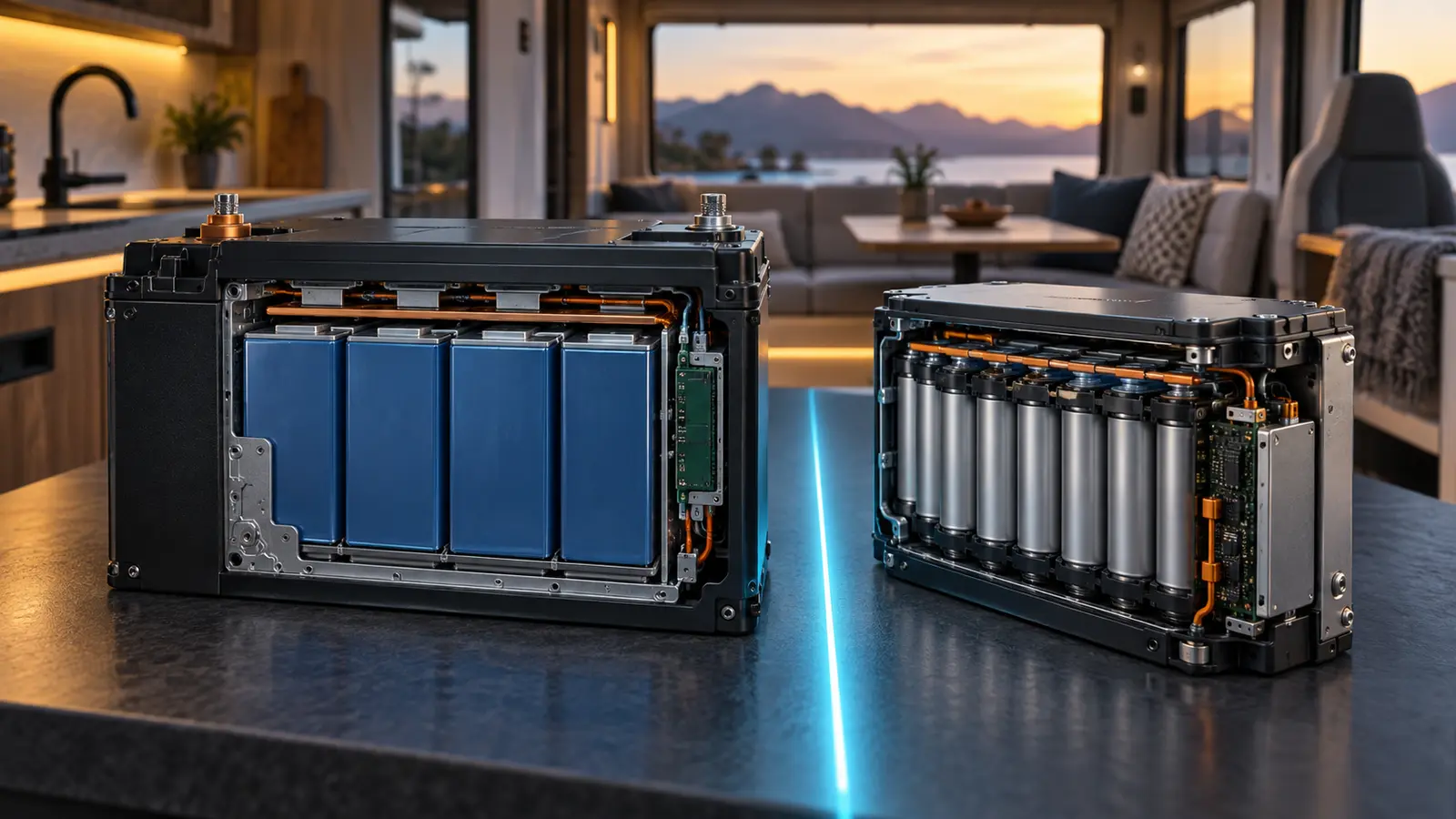
The phrase “LiFePO4 battery vs lithium ion” sounds like a comparison between two separate families. Technically, lithium iron phosphate—LiFePO4 or LFP—is one type of lithium-ion battery. In RV buying language, “lithium-ion” often means higher-energy nickel-based chemistries such as NMC, while “LiFePO4” refers to the lower-voltage iron-phosphate chemistry widely used in 12V house batteries.
For most RV house-battery installations, LiFePO4 is the better default. It offers a strong combination of cycle life, thermal stability, usable capacity, and a voltage profile that works well in 12V systems. Higher-energy lithium-ion chemistries can store more energy for a given weight and volume, but they demand tighter thermal and protection engineering.
The chemistry label alone does not guarantee a safe battery. Cell quality, enclosure, BMS, fusing, charger settings, mounting, temperature control, certification, and installation matter just as much.
lifepo4 battery vs lithium ion: Quick comparison
| Factor | LiFePO4 (LFP) | Higher-energy lithium-ion such as NMC |
|---|---|---|
| Typical role in RVs | House battery banks | Portable electronics, traction batteries, some power stations |
| Nominal cell voltage | About 3.2V | About 3.6–3.7V, chemistry-dependent |
| Energy density | Lower | Higher |
| Thermal stability | Generally stronger | Requires tighter thermal protection |
| Cycle-life potential | Often higher in deep-cycle use | Often lower under comparable deep cycling |
| Weight versus lead-acid | Much lower | Also much lower |
| Cold charging | Restricted without protection/heat | Also chemistry- and product-specific |
| Best RV fit | Long-life stationary/mobile house bank | Space/weight-critical engineered product |
Published values vary by cell design and test conditions. Compare complete products, not chemistry stereotypes.
Why LiFePO4 became common in RVs
An RV house battery spends years being charged, partially discharged, stored, and cycled at moderate rates. That job rewards longevity and fault tolerance more than maximum energy per liter.
LiFePO4 offers several practical advantages:
- A relatively stable olivine-phosphate cathode chemistry
- A flat discharge-voltage curve
- High practical usable capacity when managed correctly
- Thousands of cycles in many published product tests
- No routine watering or acid-gas concerns
- Lower weight than equivalent practical lead-acid capacity
- Good support from RV charger, inverter, and monitoring manufacturers
A 12.8V 100Ah LFP battery stores about 1,280Wh and typically weighs far less than a lead-acid bank delivering similar usable energy.
Where higher-energy lithium-ion wins
Nickel-manganese-cobalt and related chemistries can provide higher gravimetric and volumetric energy density. That matters in a phone, power tool, electric vehicle, or tightly packaged portable power station where every kilogram and cubic inch is expensive.
In an RV, higher energy density can still be useful when:
- The battery is part of a complete engineered and certified product
- Space and carried mass are unusually constrained
- Active thermal control and monitoring are built in
- The manufacturer controls the cell, pack, charger, and enclosure design
It is much less attractive as a collection of loose cells assembled without the protection and thermal engineering of the original product.
Safety: chemistry is only the first layer
LiFePO4 is generally considered more thermally stable than common nickel-based lithium-ion chemistries. That does not mean it cannot fail, overheat, arc, or start a fire. A large 12V bank can deliver destructive short-circuit current even when every cell remains chemically stable.
A safe RV battery system needs layers:
- BMS protection for cell overvoltage, undervoltage, temperature, and current
- A correctly rated main fuse close to the battery source
- Conductors sized for ampacity and voltage drop
- Covered terminals and secured batteries
- Compatible charge profiles
- Temperature sensing and low-temperature charge control
- Correct disconnects, busbars, lugs, and torque
- Ventilation and clearance required by the product
- Protection from water, cargo impact, and road vibration
Do not defeat a BMS trip by repeatedly reconnecting a known overload. Find the cause.
Cycle life: read the footnote
Cycle life is the number of charge/discharge cycles until the battery retains a stated percentage of original capacity under a stated test. The result depends on:
- Depth of discharge
- Charge and discharge rate
- Cell temperature
- Time spent at high state of charge
- End-of-life threshold, such as 70% or 80%
- Calendar aging
Manufacturers of current RV-oriented LFP batteries commonly publish figures in the thousands of cycles, but the conditions differ. A battery advertised at 5,000 cycles to 80% depth of discharge cannot be fairly compared with a different product’s 4,000 cycles to 70% remaining capacity without reading both definitions.
For an owner who cycles 150 times per year, calendar age and installation quality may matter before the headline cycle count is reached.
Usable capacity and voltage curve
LFP maintains a relatively flat voltage through much of its discharge. That helps 12V appliances operate consistently, but it makes voltage alone a poor state-of-charge indicator. A shunt-based battery monitor that counts current is more useful after proper synchronization.
Higher-energy lithium-ion chemistries often use different series-cell counts and voltage windows. A “12V lithium-ion pack” can therefore have a charging voltage incompatible with an RV charger designed for four LFP cells in series.
Never select a charger from the marketing voltage alone. Use the battery maker’s bulk/absorption, float, storage, and temperature instructions.
Weight and space
Both lithium families can reduce weight relative to lead-acid. NMC may store more energy in less mass than LFP at the cell level. In a complete RV battery, enclosure, BMS, heater, terminals, compression, and safety structure narrow the simple chemistry comparison.
For most vans, the practical question is whether the chosen battery fits the tray, can be secured, leaves service clearance, and keeps heavy cable runs short. Saving a few pounds rarely justifies using a poorly supported or undocumented pack.
Cold weather
Low-temperature charging is one of the most important RV differences. Many lithium batteries prohibit charging below a specified temperature because metallic lithium plating can damage cells. Discharge may be allowed at a lower temperature than charge.
A four-season design can use:
- BMS-controlled charge cutoff
- Integrated battery heating
- A heated and insulated compartment
- Charge-source control based on battery temperature
The heater’s operating thresholds and energy consumption matter. A battery in an exterior compartment may also cool faster than the living space suggests.
Charging from the alternator
A lithium bank can accept high current for longer than a lead-acid battery. A direct connection may stress an alternator, particularly at low engine speed, and a smart alternator may not deliver a stable charging voltage.
A properly selected DC-to-DC charger can:
- Limit alternator demand
- Provide the battery’s intended charge profile
- Isolate starter and house systems when the engine is off
- Respond to an ignition or engine-run signal
Its input current can exceed output current after conversion losses. Size source-side wiring and protection from the actual manual.
Solar and shore charging
Program every charging source for the same battery strategy. An MPPT controller, shore converter, inverter/charger, and alternator charger can all operate at once.
Check:
- Combined maximum charge current
- Bulk/absorption voltage and duration
- Float or storage behavior
- Equalization disabled unless explicitly required
- Temperature compensation setting
- BMS remote shutdown or charge-enable wiring
A charger labeled “lithium” is not automatically correct for every lithium chemistry.
Cost: compare lifetime system value
The relevant cost is not only dollars per nameplate amp-hour. Compare:
Lifetime system value = usable energy x realistic cycles x installation fit / total installed cost
Total installed cost may include:
- Battery or cells
- BMS and contactors
- DC-to-DC charger
- Updated shore charger
- Battery monitor and shunt
- Fuses, disconnects, busbars, cables, and lugs
- Heating or insulated enclosure
- Professional design or installation
An inexpensive battery that forces an early replacement or has no practical warranty path can cost more over time.
Drop-in battery versus engineered bank
Drop-in LFP
A self-contained battery with an internal BMS is convenient for modest RV systems. It reduces design complexity but still needs external fusing, correct chargers, and secure mounting. Multiple drop-ins must be wired within the manufacturer’s series/parallel rules.
External-BMS LFP
An external BMS can coordinate chargers and loads, expose cell data, and scale to larger banks. It requires careful control design. A disconnected BMS sense wire or incorrectly programmed contactor can compromise protection.
Integrated NMC product
A portable power station or vehicle traction pack may use higher-energy chemistry as a complete certified assembly with cooling, monitoring, and a dedicated charger. Keep it within its intended application. Do not dismantle such products for an RV house bank.
What about lithium-titanate and sodium-ion?
Lithium-titanate is another lithium-ion architecture known for high power capability and strong low-temperature performance, but its lower energy density and cost have limited mainstream RV adoption. Sodium-ion products are emerging in stationary and mobility markets, yet RV charger support, product selection, and long-term service are still developing. Neither should be selected from chemistry headlines alone.
For a DIY RV in 2026, mature LiFePO4 products have the advantage of broad charger compatibility, published manuals, established form factors, and a large service ecosystem. An alternative chemistry can still be valid when sold as a complete documented system with the required charger, BMS, temperature limits, and safety certifications.
Storage and seasonal use
An RV may sit unused longer than it travels. Follow the battery’s storage state-of-charge, temperature, and inspection guidance. Do not assume lithium has zero self-discharge or leave communication modules and standby devices connected for months.
Before storage:
- Charge or discharge to the manufacturer’s recommended range
- Turn off loads and chargers using the approved sequence
- Confirm whether the BMS can be placed in a low-power mode
- Protect the battery from freezing or extreme heat as specified
- Recheck state of charge at the required interval
- Keep terminals protected from tools, pests, and condensation
On return, inspect the case and terminals, verify voltage through the approved method, and restore charging sources one at a time.
Storage rules can differ even within one chemistry. A self-contained LFP battery with a physical off switch may behave differently from an external-BMS bank whose contactors, monitor, and communication network retain a standby load. Write the approved shutdown and restart sequence on the electrical diagram so another owner or technician does not improvise it.
Which chemistry suits each RV owner?
| Owner profile | Better default | Reason |
|---|---|---|
| Weekend camper replacing lead-acid | Drop-in LiFePO4 | Practical usable capacity and straightforward support |
| Full-time van with daily cycling | LiFePO4 bank | Cycle-life and deep-cycle fit |
| Winter traveler | Heated/protected LiFePO4 system | Documented low-temperature strategy |
| Space-critical certified appliance | Integrated product may use NMC | Energy density inside a designed enclosure |
| DIY builder considering salvaged EV modules | Neither without expert engineering | Protection, isolation, cooling, and fault analysis are complex |
Environmental and end-of-life considerations
Long cycle life can reduce how often a battery is replaced, but lithium batteries still require responsible collection. The US Environmental Protection Agency says used lithium-ion batteries should not be put in household garbage or curbside recycling bins. Tape or otherwise isolate terminals as the collection program directs and use a dedicated recycling or hazardous-waste route.
Ask the seller about take-back options before purchase. Keep battery model and chemistry labels readable for the eventual recycler.
Upgrade checklist
- Calculate daily watt-hours and peak DC current.
- Choose the chemistry and complete battery architecture.
- Verify battery current limits against the inverter and chargers.
- Review alternator capability and select a DC-to-DC strategy.
- Program solar, shore, and inverter/charger settings.
- Design low-temperature charging protection.
- Size conductors and fuses using the exact installation conditions.
- Secure batteries and cover energized terminals.
- Add monitoring that measures every charge and load path.
- Commission the system under controlled load and charging.
- Keep manuals and an updated wiring diagram in the RV.
Frequently asked questions
Is LiFePO4 safer than lithium-ion?
LiFePO4 is a lithium-ion chemistry and is generally more thermally stable than common nickel-based chemistries. A complete battery’s safety still depends on cell quality, BMS, enclosure, protection, charger, and installation.
Does LiFePO4 last longer?
RV-oriented LFP products often publish longer deep-cycle life than higher-energy chemistries, but compare the exact test rate, depth of discharge, temperature, and remaining-capacity threshold.
Can I charge LiFePO4 with a normal RV converter?
Only if the converter’s voltage profile and behavior comply with the battery manual. An old lead-acid converter may charge slowly, fail to reach full charge, or apply an unwanted mode.
Can I install a lithium battery under the hood?
Only if the battery manufacturer explicitly approves the temperature, vibration, water, and mounting environment. Many RV lithium batteries are intended for protected compartments, not an engine bay.
Is LFP worth it for a weekend RV?
It can be, especially when lower weight and more usable capacity solve a real problem. A well-maintained lead-acid system may remain economical for very light use. Compare the full upgrade cost rather than buying chemistry as a trend.
Bottom line
For a conventional RV house bank, LiFePO4 is usually the better choice than higher-energy nickel-based lithium-ion because its strengths align with repeated deep cycling, long service, and stationary installation. Higher-energy chemistry makes the most sense inside a complete engineered product where compactness is critical.
Whichever chemistry you choose, treat the battery as one component in a protected electrical system. The BMS, charger programming, temperature plan, fusing, cables, mounting, and professional review decide whether the result is dependable.
Document the exact chemistry and charge settings beside the battery so future service does not apply an incompatible lead-acid or lithium profile.
Sources
- US Department of Energy, lithium-ion battery overview: https://www.energy.gov/eere/vehicles/articles/how-does-lithium-ion-battery-work
- Victron Lithium Smart technical data: https://www.victronenergy.com/media/pg/Lithium_Battery_Smart/en/technical-data.html
- Victron Lithium Smart operation guidance: https://www.victronenergy.com/media/pg/Lithium_Battery_Smart/en/operation.html
- Victron Lithium NG batteries: https://www.victronenergy.com/batteries/lithium-ng-batteries
- EPA used lithium-ion battery guidance: https://www.epa.gov/recycle/used-lithium-ion-batteries
- EPA lithium-ion battery questions: https://www.epa.gov/recycle/frequent-questions-lithium-ion-batteries
- NFPA 1192 overview: https://www.nfpa.org/codes-and-standards/nfpa-1192-standard-development/1192
Related guides: LiFePO4 fundamentals and 100Ah LiFePO4 comparison.
A LiFePO4 battery vs lithium ion comparison for RV use should include chemistry, safety controls, cycle-life conditions, temperature limits, and system design.