
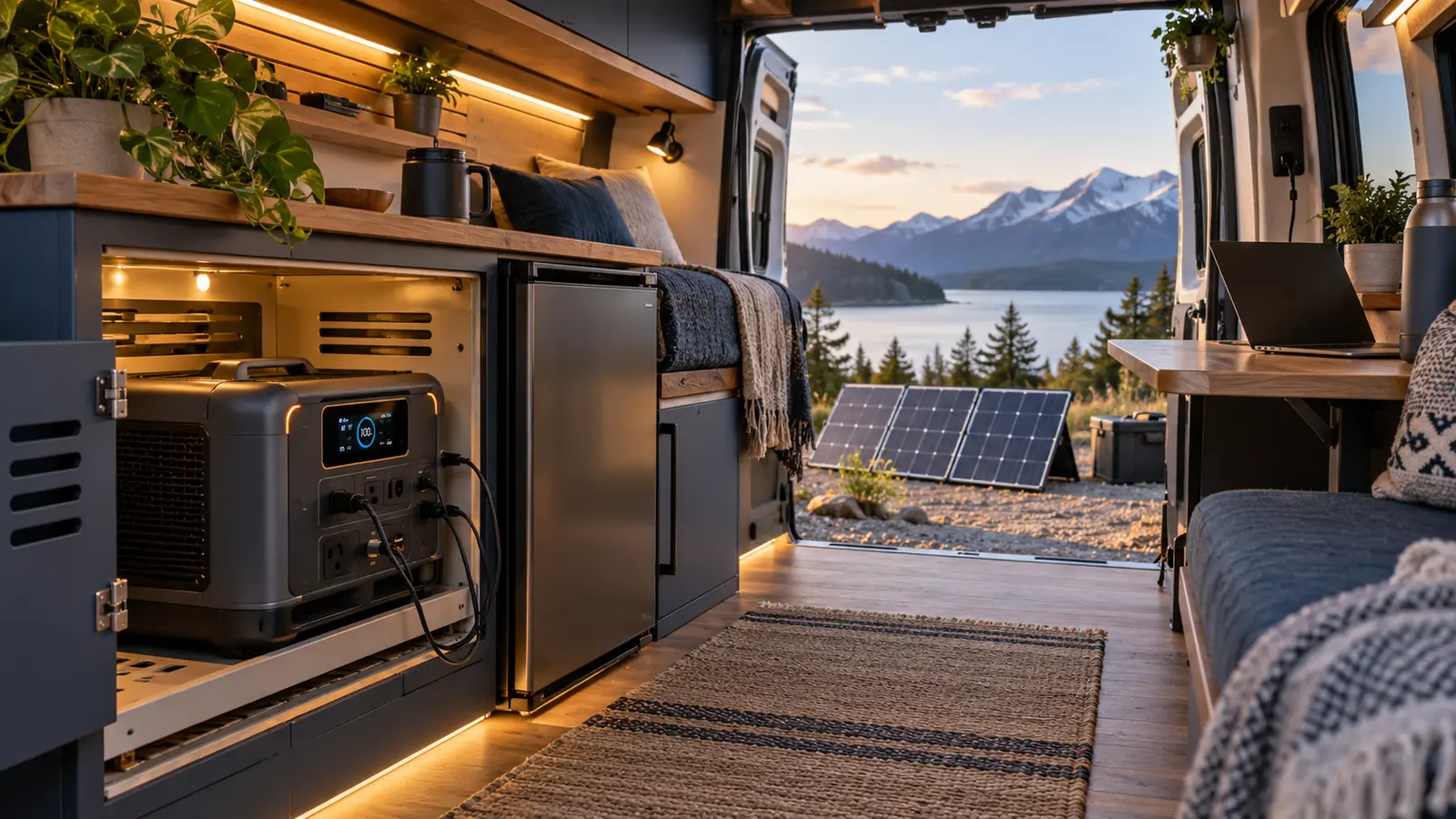
The best portable power station for van life must do more than run a laptop on a weekend. It needs enough usable energy for a refrigerator, fan, lights, devices, and occasional AC loads; it also needs a credible way to recharge during repeated travel days.
This guide compares current products using manufacturer-published specifications available on September 7, 2026. The recommendations are based on documented capacity, output, inputs, ports, weight, expansion, and safety information—not invented long-term testing. Prices are omitted because bundles and promotions change quickly.
Quick picks
| Van-life need | Recommended station | Why it fits |
|---|---|---|
| Best compact 1kWh value | BLUETTI Elite 100 V2 | 1,024Wh, 1,800W output, up to 1,000W solar input, about 25 lb |
| Best balanced 1kWh system | EcoFlow DELTA 3 Plus | 1,024Wh LFP, 1,800W output, dual 500W MPPT inputs |
| Best 2kWh lighter choice | Jackery Explorer 2000 v2 | 2,042Wh, 2,200W output, around 39.5 lb |
| Best expandable 2kWh choice | Anker SOLIX C2000 Gen 2 | 2,400W rated output, expansion to 4kWh, 9W published idle consumption |
| Best rugged base-camp station | Goal Zero Yeti 1500 | 1,505Wh, 2,000W, IPX4, high-power 12V output, UL 2743 listing information |
The right category depends on daily watt-hours and charging opportunity. A 1kWh station with strong alternator or solar recovery can outperform a 2kWh station that returns to camp half empty every day.
What a van actually consumes
| Load | Illustrative daily energy |
|---|---|
| 12V compressor refrigerator | 360Wh |
| Roof fan | 110Wh |
| LED lights | 60Wh |
| Laptop work | 180Wh |
| Phones, camera, router | 120Wh |
| Water pump and controls | 30Wh |
| Daily total | 860Wh |
Add a 15% planning allowance and the example reaches about 990Wh. That is nearly an entire 1,024Wh nameplate battery before accounting for reserved capacity and conditions. A full-time remote worker with this load needs daily charging or more storage.
Measure the refrigerator over 24 hours because ambient temperature, ventilation, door openings, and set point dominate its energy use.
How the picks were evaluated
- Nameplate watt-hours and battery chemistry
- Rated continuous AC output, not only “boost” claims
- Solar input voltage, current, and power limits
- Vehicle or alternator-charging options
- Regulated 12V output for refrigerators and other DC loads
- USB-C output for efficient laptop charging
- Weight and secure-storage requirements
- Expansion options and proprietary accessory dependence
- Idle consumption with AC/DC outputs enabled
- Published cycle-life, warranty, and safety information
Runtime examples from manufacturers are treated as illustrations, not guarantees.
Best compact 1kWh value: BLUETTI Elite 100 V2
BLUETTI lists the Elite 100 V2 at 1,024Wh and 1,800W AC output. Its official pages publish approximately 25 lb, up to 1,000W solar input, and a 12–60V solar-input range in the manual.
That solar ceiling is unusually high for a compact 1kWh station. It can be useful in a van with enough deployable panel area and two clear input routes. The 60V limit still requires a cold-weather Voc calculation; “1,000W” does not permit excessive string voltage.
Best for
- Weekend or part-time vans with a 1kWh daily budget
- Campers who want strong solar recovery in a small package
- Laptop, refrigerator, fan, lights, and brief cooking loads
- Owners who prefer a 25-pound carry over a 40-to-50-pound station
Limitations
The 1,800W inverter can drain 1,024Wh quickly. Full-time users may need more capacity. Verify the regulated 12V output behavior for the exact refrigerator, along with the car/alternator charging accessory and any app dependence.
Best balanced 1kWh system: EcoFlow DELTA 3 Plus
EcoFlow’s manual lists a 1,024Wh LiFePO4 battery. The US DELTA 3 series page publishes 1,800W rated output and two 500W MPPT inputs, for up to 1,000W solar under the specified conditions.
Two MPPT paths can be helpful on a van because differently oriented or shaded panel groups do not have to share one controller. It also creates more design details: each port has its own voltage/current limits, and the total headline number assumes suitable arrays.
Best for
- Compact full-time setups with reliable daily charging
- Roof plus portable solar arrangements
- Remote workers needing laptop, network, and refrigerator power
- Owners who value a broad accessory ecosystem
Limitations
Do not assume the 1kWh battery can support a full day of heavy induction cooking or climate control. EcoFlow’s rapid charging claims depend on specified AC or array conditions and are not typical output from a single portable panel.
Best 2kWh lighter choice: Jackery Explorer 2000 v2
Jackery’s current US information lists 2,042Wh of LiFePO4 capacity, 2,200W AC output, around 39.5 lb, and a pure sine wave inverter. The company’s support documentation identifies the JE-2000D model and a 4,000-cycle-to-70%-capacity claim.
Two kilowatt-hours provides much more useful overnight margin for a refrigerator, fan, laptops, and lighting than a 1kWh unit. Around 40 lb is still a deliberate lift, but it is lighter than some older 2kWh-class stations.
Best for
- Full-time vans without a fixed battery system
- Longer stays between charging opportunities
- Couples running two laptops and a larger refrigerator
- Users who want 2.2kW rated AC output
Limitations
The current model is non-expandable according to Jackery’s comparison material. Verify solar voltage/current and bundle-specific inputs. A 2kWh station still needs secure mounting so it cannot become a projectile in a collision.
Best expandable 2kWh choice: Anker SOLIX C2000 Gen 2
Anker lists 2,400W rated output, 4,000W peak, and expansion to 4kWh with a compatible BP2000 Gen 2 battery. The company also publishes 9W idle power consumption and a fast AC recharge claim under its test mode.
Low idle consumption matters in a van because the inverter may remain enabled for many hours while the active loads are modest. Expansion lets an owner begin around the 2kWh class and add storage later without replacing the main station.
Best for
- Full-time van owners who may expand capacity
- Higher simultaneous AC demand
- Users who leave outputs enabled for long work sessions
- A modular setup that can move between van and home backup
Limitations
Expansion ties the owner to compatible proprietary batteries and cables. The advertised 4,000W peak is not the continuous rating. Confirm the base capacity, vehicle-charging accessory, 12V output, solar input limits, and installed weight for the exact bundle.
Best rugged base-camp station: Goal Zero Yeti 1500
Goal Zero lists 1,505.28Wh, 2,000W continuous AC output, 3,600W surge, 52.75 lb, IPX4 protection, and up to 900W combined DC/solar input. It also publishes a high-power 13.5V DC output rated up to 405W and states UL 2743 certification by a third-party Nationally Recognized Testing Laboratory.
That DC output is relevant for compatible van appliances, and IPX4 provides a defined level of splash resistance. The unit still needs a dry, ventilated operating location and secure transport.
Best for
- Overland base camps and vehicle-supported travel
- Owners who prioritize robust DC capability and a stated water-resistance rating
- 1.5kWh daily budgets with strong solar recovery
- Users who value published third-party certification information
Limitations
At more than 52 lb, this is not a casual carry. Its 1,505Wh capacity is smaller than the 2kWh picks despite similar output. Check whether the high-power DC connector matches the appliance or requires an approved cable.
Published comparison
| Station | Capacity | Rated AC output | Approx. weight | Solar input | Expansion |
|---|---|---|---|---|---|
| BLUETTI Elite 100 V2 | 1,024Wh | 1,800W | 25 lb | Up to 1,000W | Verify current system |
| EcoFlow DELTA 3 Plus | 1,024Wh | 1,800W | Verify current manual | Dual 500W MPPT | Ecosystem-dependent |
| Jackery Explorer 2000 v2 | 2,042Wh | 2,200W | 39.5 lb | Verify exact input | No, per current comparison material |
| Anker SOLIX C2000 Gen 2 | 2kWh class; verify exact label | 2,400W | Verify current page | Verify voltage/current limits | Up to 4kWh stated |
| Goal Zero Yeti 1500 | 1,505Wh | 2,000W | 52.75 lb | Up to 900W combined | Verify current system |
These are manufacturer-published figures, not independent test results. Exact port limits and regional models must be checked before purchase.
Capacity: 1kWh or 2kWh?
Use:
Required battery Wh = daily load Wh x days between charging / usable planning factor
If daily use is 850Wh, charging occurs every day, and the planning factor is 0.85:
850 / 0.85 = 1,000Wh
That leaves little weather reserve. For two days between reliable charges:
850 x 2 / 0.85 = 2,000Wh
A full-time van usually benefits more from balanced storage and charging than maximum inverter watts.
Inverter output: calculate simultaneous loads
Add the devices that can run at the same time:
| Load | Example running watts |
|---|---|
| Laptop chargers | 160W |
| Refrigerator while compressor runs | 50W |
| Induction cooktop | 1,300W |
| Router and lights | 40W |
| Possible simultaneous total | 1,550W |
A 1,800W station may support the example on paper, but surge, high ambient temperature, battery state, and other ports reduce margin. Cooking at a lower setting or pausing other loads is often the more energy-efficient plan.
“Power lifting,” “X-Boost,” or peak figures are not substitutes for rated continuous output. Some modes change voltage and may not suit sensitive electronics or motors.
Solar sizing for van life
To replace 850Wh/day with four peak-sun-hours and a 0.75 factor:
Panel watts = 850 / (4 x 0.75) = about 283W
A nominal 400W array provides useful margin. Shade, roof heat, winter sun, smoke, clouds, and parking orientation can reduce harvest sharply.
Check array Voc at the lowest temperature, controller current, total watts, connector, polarity, and whether roof and portable panels can use separate MPPT inputs.
Alternator charging may matter more than fast AC charging
Wall charging in under an hour is useful at home but may be irrelevant while traveling. For a van, ask:
- Does the manufacturer offer an approved alternator charger?
- What is its actual input and output power?
- Does it require ignition wiring or app control?
- Is the vehicle alternator able to support the load?
- Can solar and alternator charging operate together?
- What cable route, fuse, and connector are required?
A cigarette-lighter input is often limited to roughly 100W class charging. Replacing 1,000Wh can therefore take much of a driving day.
Ports that matter
Regulated 12V DC
A refrigerator can run efficiently on DC, but check the output’s current limit, voltage regulation, auto-off behavior, and physical connector. Some stations turn DC ports off after low load or at a set state of charge.
USB-C power delivery
Use a 100W or 140W USB-C port for compatible laptops instead of converting DC to AC and back through the laptop brick. Confirm cable wattage and charging profile.
AC outlets
Outlet count does not increase inverter capacity. Check the combined rating and whether all outlets remain accessible with bulky plugs.
Installation inside a van
A portable station is not “installed” merely because it sits on the floor.
- Restrain it for braking and collision loads without blocking vents.
- Keep it away from water plumbing, direct sun through glass, and heater outlets.
- Provide access to the main switch and charging ports.
- Do not place loose metal tools near outputs.
- Route cables through strain relief and abrasion protection.
- Follow charge and discharge temperature limits.
- Never connect station AC output into van wiring through a male-to-male cord.
If feeding installed outlets, use a listed transfer/distribution solution and a qualified professional.
Portable station or fixed electrical system?
Choose a portable station when speed, removability, and warranty integration matter. Choose a fixed system when the van needs more battery capacity, roof solar, high-output alternator charging, serviceable components, custom DC circuits, or a permanent inverter/charger.
A hybrid can work: a modest fixed 12V system for refrigerator, lights, and fan, plus a portable station for AC and backup. Prevent unintended cross-connections and use only approved charging paths.
Plan for the worst charging day, not the best screenshot
Assume the van uses 850Wh per day but collects only 350Wh during a cloudy forest stop. The daily deficit is 500Wh. A 2,000Wh station that begins at 90% and keeps a 15% emergency reserve has roughly 1,500Wh available for planned use, so it can absorb about three such deficit days before another charging source is needed.
This scenario method is more useful than dividing battery watt-hours by a single appliance. Run at least three cases:
- Normal summer day with full roof and portable solar
- Shaded or cloudy day with low solar
- Travel day with alternator/vehicle charging but limited campsite sun
The result may show that an approved alternator charger is a better purchase than a larger station. It may also justify a separate emergency reserve for communication, heat controls, or medical equipment.
Keep the assumptions with the travel plan and update them after measuring one week of real use.
Buying checklist
- Measure 24-hour energy use.
- Calculate maximum simultaneous watts and surge.
- Choose one or two days of storage based on charging reliability.
- Verify solar voltage, current, watts, connector, and array layout.
- Verify alternator and vehicle-charging strategy.
- Check 12V regulation and USB-C ratings.
- Measure the storage space and safe lifting route.
- Plan crash restraint and ventilation.
- Read temperature, warranty, and cycle-life conditions.
- Check third-party safety certification and the CPSC recall database.
- Confirm service and replacement-cable availability.
Frequently asked questions
Is 1,000Wh enough for van life?
It can be enough for a refrigerator, fan, lights, laptop, and devices when daily charging is reliable. It offers little margin for electric cooking or poor solar weather. Calculate the actual 24-hour load.
Can a portable power station run a van refrigerator?
Usually, if the refrigerator’s voltage, current, startup, connector, and daily watt-hours fit the station. A regulated 12V output is often preferable to AC.
Can I charge from solar while driving?
Some stations accept simultaneous inputs, but cable routing, connector limits, and product logic vary. Roof panels must remain within solar-input limits, and an alternator charger must be approved for the vehicle and station.
Can a power station run an induction cooktop?
Only if rated continuous output and energy capacity are adequate. A 1,300W cooktop can consume more than 20Wh every minute at full power, so cooking strategy matters.
Is a power station safe to sleep beside?
Use it only within the manual: dry, undamaged, ventilated, temperature-controlled, and secured. Do not block fans or charge a damaged unit. For medical equipment, obtain manufacturer approval and create a backup plan.
Final recommendation
The Elite 100 V2 and DELTA 3 Plus are strong 1kWh choices when daily charging is dependable. The Explorer 2000 v2 provides more storage without extreme weight. The C2000 Gen 2 fits owners who want expansion and higher output. The Yeti 1500 suits vehicle-supported users who value ruggedness, DC capability, and published certification details.
The best portable power station for van life is the smallest model that covers measured daily energy, simultaneous loads, and bad-weather reserve—paired with a charging plan that works where the van actually travels.
Measure that plan on a short trip before depending on it remotely.
Sources
- BLUETTI Elite 100 V2: https://www.bluettipower.com/products/elite-100-v2-portable-power-station
- BLUETTI Elite 100 V2 manual: https://s4.bluettipower.com/bluetti_lgf/support/2025/07/f530cba7-24cc-4d2f-a0d3-b3ce8ed81add.pdf
- EcoFlow DELTA 3 series: https://www.ecoflow.com/us/delta-3-series-portable-power-station
- EcoFlow DELTA 3 Plus manual: https://manuals.ecoflow.com/us/product/delta-3-plus?lang=en_US
- Jackery Explorer 2000 v2: https://www.jackery.com/products/jackery-explorer-2000-v2-portable-power-station
- Jackery Explorer 2000 v2 specifications: https://faq.jackery.com/hc/en-us/articles/52303644507803-Explorer-2000-V2-Basic-Information
- Anker SOLIX C2000 Gen 2: https://www.anker.com/products/a1780
- Goal Zero Yeti 1500: https://goalzero.com/products/yeti-1500-portable-power-station-lifepo4-battery
- EPA used lithium-ion battery guidance: https://www.epa.gov/recycle/used-lithium-ion-batteries
Related guides: portable power station basics and van electrical system planning.