
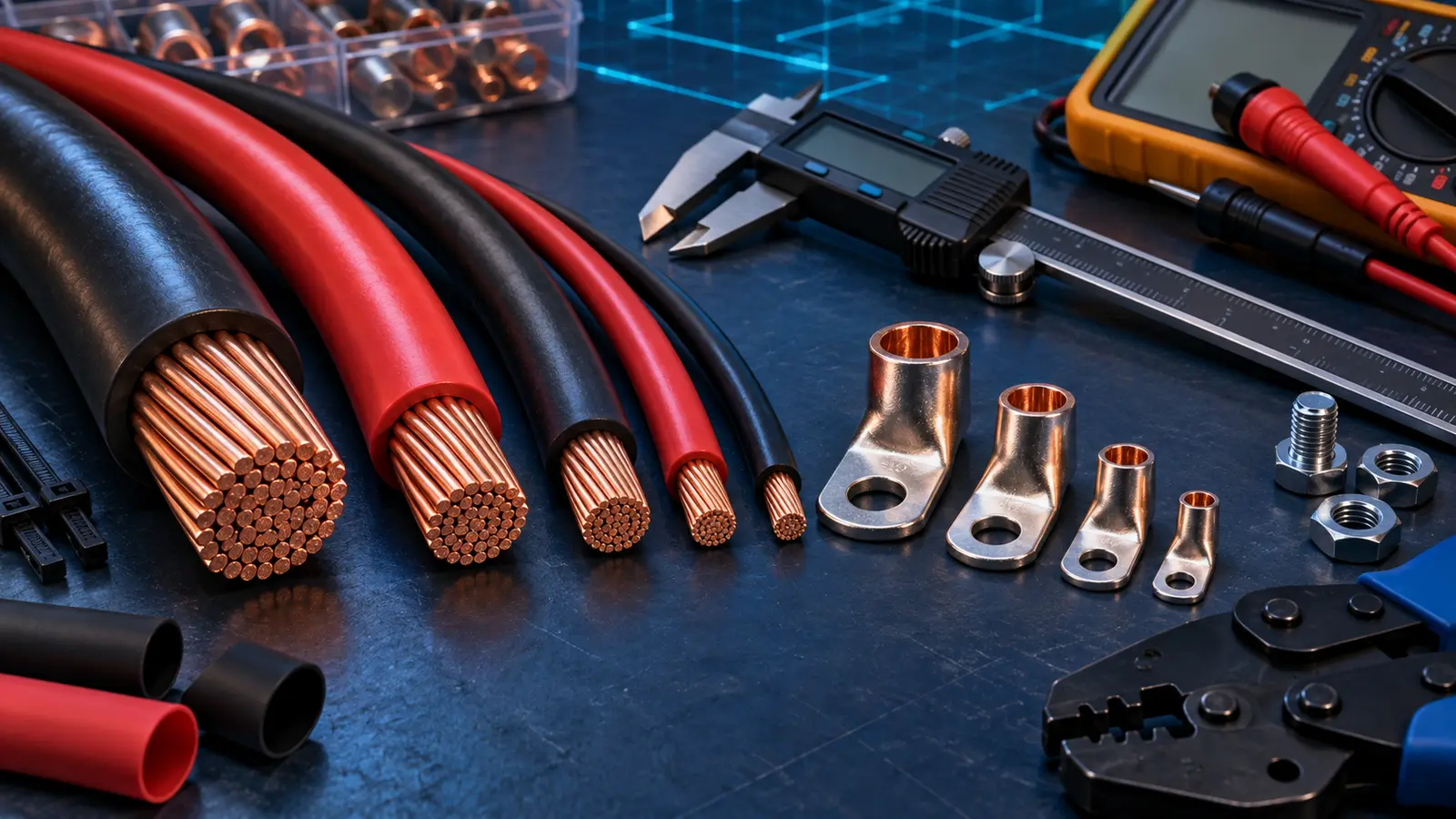
Need a quick answer on wire size for a 12V circuit? The two charts below show the smallest copper wire (AWG) that keeps voltage drop under a set limit for common current and distance combinations. Find your amps, find your distance, read the gauge.
For your exact load, with a different voltage-drop target or metric sizes, use the wire gauge calculator. These charts are the fast version of the same idea.
How to read the chart
- Find the amps. Use the maximum running current from the appliance label or manual. If you only know watts, divide watts by 12 and add a little margin.
- Measure the distance one way. That’s the cable run from the battery (or fuse block) to the load. The chart already doubles it for the return wire, so don’t do that yourself.
- Round up. If your numbers fall between rows or columns, use the next higher amps and the next longer distance.
- Read the gauge. Bigger numbers mean thinner wire (14 AWG is thin, 4/0 is very thick). If in doubt, go one size thicker. Thicker wire is always fine electrically; it just costs more and is harder to route.
Chart 1: 3% voltage drop (use this for most things)
Three percent of 12V is 0.36V. This is the safer default for refrigerators, pumps, inverters, chargers and electronics, which run poorly or shut off when voltage sags.
| Amps | 3 ft | 5 ft | 10 ft | 15 ft | 20 ft | 25 ft |
|---|---|---|---|---|---|---|
| 5 A | 14 | 14 | 14 | 12 | 12 | 10 |
| 10 A | 14 | 14 | 12 | 10 | 8 | 8 |
| 15 A | 14 | 12 | 10 | 8 | 6 | 6 |
| 20 A | 12 | 12 | 8 | 6 | 6 | 4 |
| 30 A | 10 | 10 | 6 | 6 | 4 | 2 |
| 40 A | 8 | 8 | 6 | 4 | 2 | 2 |
| 50 A | 6 | 6 | 4 | 2 | 2 | 1 |
| 75 A | 2 | 2 | 2 | 2 | 1/0 | 2/0 |
| 100 A | 1 | 1 | 1 | 1/0 | 2/0 | 3/0 |
| 150 A | 3/0 | 3/0 | 3/0 | 3/0 | 4/0 | Larger than 4/0 |
Chart 2: 10% voltage drop (non-critical loads only)
Ten percent allows 1.2V of drop. It’s only reasonable for simple loads that don’t mind a dimmer result, such as some cabin lighting. If you’re not sure whether a load is critical, use Chart 1.
| Amps | 3 ft | 5 ft | 10 ft | 15 ft | 20 ft | 25 ft |
|---|---|---|---|---|---|---|
| 5 A | 14 | 14 | 14 | 14 | 14 | 14 |
| 10 A | 14 | 14 | 14 | 14 | 14 | 12 |
| 15 A | 14 | 14 | 14 | 14 | 12 | 12 |
| 20 A | 12 | 12 | 12 | 12 | 10 | 10 |
| 30 A | 10 | 10 | 10 | 10 | 10 | 8 |
| 40 A | 8 | 8 | 8 | 8 | 8 | 6 |
| 50 A | 6 | 6 | 6 | 6 | 6 | 6 |
| 75 A | 2 | 2 | 2 | 2 | 2 | 2 |
| 100 A | 1 | 1 | 1 | 1 | 1 | 1 |
| 150 A | 3/0 | 3/0 | 3/0 | 3/0 | 3/0 | 3/0 |
Notice that the high-current rows barely change with distance. That’s because at those currents the wire has to be thick enough to carry the load safely, not just to limit voltage drop. More on that below.
Three quick examples
- 12V compressor fridge, 5 A, 12 ft from the fuse block. Round up to the 15 ft column on Chart 1: 12 AWG.
- Roof fan, 3 A, 10 ft. Use the 5 A row: 14 AWG is enough.
- DC-DC charger with a 50 A output, 5 ft to the house battery. Chart 1 gives 6 AWG. If the charger’s manual asks for thicker cable, follow the manual.
How these numbers were worked out
Voltage drop = current × wire resistance × 2 × one-way length (the 2 covers the return wire). We used standard resistance values for solid copper and the voltage-drop limit shown above on a 12V system. Each result is the smallest wire that meets both the voltage-drop limit and a conservative current-carrying floor, which is why the thick-wire rows don’t shrink at short distances. The floor uses the 60°C copper column of NEC Table 310.16 for a single conductor. Treat the chart as a starting estimate, not a code ruling.
What this chart doesn’t cover
- Heat and bundling. A hot engine bay, or many cables bundled together, lowers how much current a wire can carry. Go thicker in those spots.
- Fuses. The fuse protects the wire, so it must be rated at or below what the wire can carry, and not above the appliance’s stated maximum. Use the fuse sizing calculator as a starting point, then check the manuals.
- Inverter and battery cables. A 1,000W inverter can pull on the order of 100 A from a 12V battery at full load, and the cables are usually specified by the maker. Follow the inverter manual first. Our inverter guide explains why.
- AC wiring. This chart is for low-voltage DC only. Have 120V AC wiring designed or inspected by a qualified electrician.
- 24V systems. For the same watts, a 24V circuit draws half the amps, and 3% is 0.72V. The quickest way to get a number is the calculator.
Common questions
Why 3% voltage drop?
It’s a widely used target for important circuits. At 12V, a small drop is a big percentage, so sagging voltage can make fridges and electronics misbehave.
What does AWG mean?
American Wire Gauge. A bigger AWG number means a thinner wire, and sizes past 1 AWG are written 1/0, 2/0, 3/0 and 4/0.
Can I use thicker wire than the chart says?
Yes. Thicker wire loses less voltage and runs cooler. The tradeoffs are cost, weight and getting it through tight spaces and into the terminals.
Does the wire need to be a certain type?
Use stranded copper cable with insulation rated for the job, from a reputable supplier. Copper-clad aluminum cable has higher resistance and needs a larger size than this chart shows.
Planning a whole system? Start with the beginner’s guide to van electrical systems and the wiring diagram walkthrough, or test a day of power use in the power system simulator.
Last updated: October 6, 2026. This is general educational information. It does not replace manufacturer instructions, electrical code requirements or advice from a qualified electrician.