
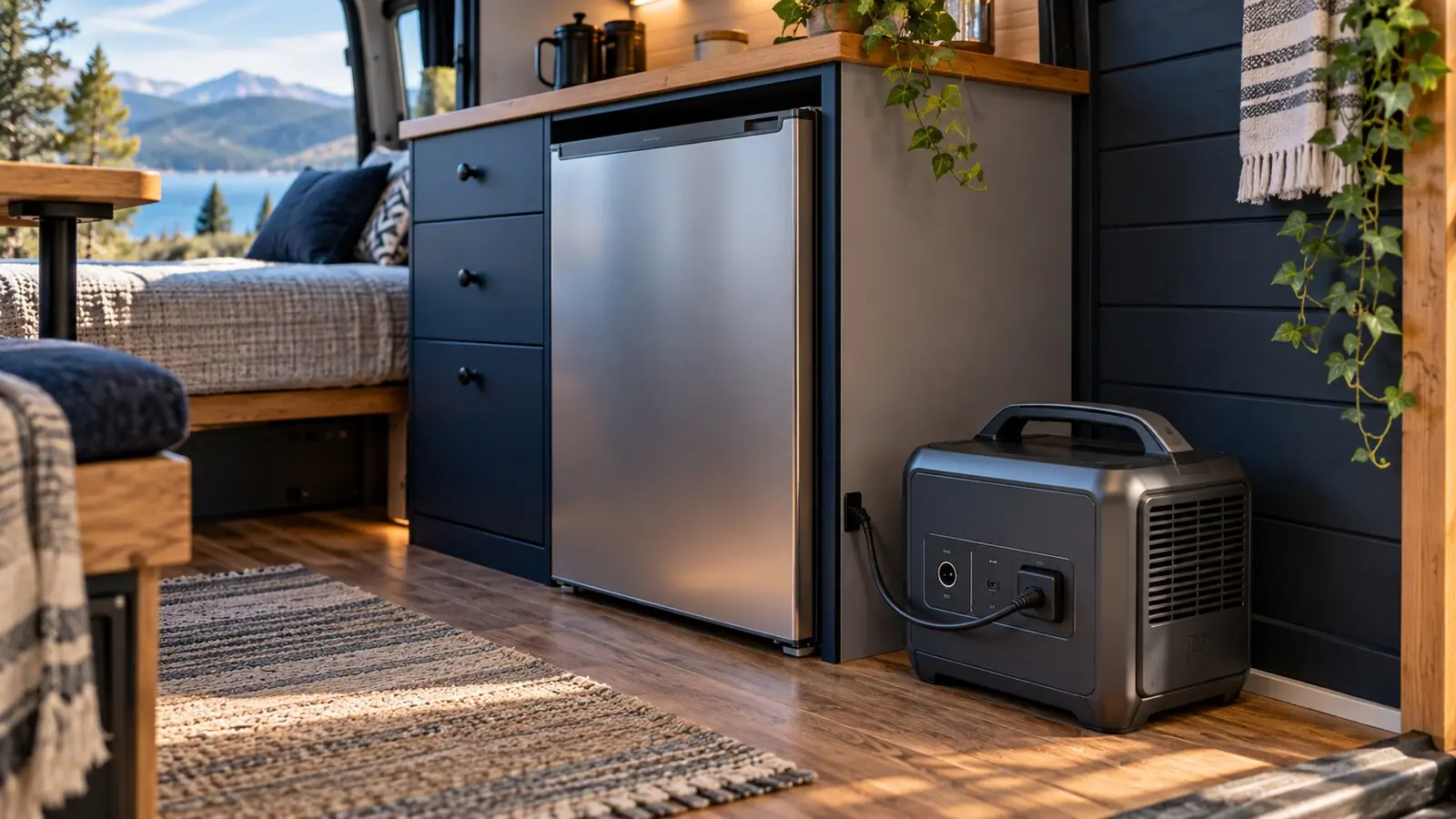
The best portable power station for a refrigerator is the smallest one that can start the compressor and still has enough stored energy for the hours you need, after inverter losses and a safety reserve. That answer comes from two numbers you can measure at home, not from the fridge’s size or the station’s biggest headline.
For a small, efficient fridge, a 1 kWh station can bridge an overnight outage. A full-size fridge, a hot room, or a whole day with no recharge points toward roughly 2 kWh or more. Below is how to work out which side you’re on, plus four current models worth comparing by their published specs.
Start with food safety, not battery size
The FDA says an unopened refrigerator generally keeps food cold for about four hours in a power outage, and refrigerated perishables that have been above 40°F for four hours or more should be thrown out. A power station can stretch that window, but it doesn’t replace an appliance thermometer.
For a short outage, the best move is often to keep the door shut and save battery for lights, phones and a router. For a long or uncertain one, plug the fridge in sooner and watch the thermometer. A compressor you can hear running is not proof the food is cold enough.
Step 1: Find out how much energy your fridge really uses
The running watts printed on a fridge don’t tell you its daily use. The compressor runs for a while, shuts off, then restarts, and defrost heaters, fans and ice makers add loads at other moments.
The simplest fix is a plug-in energy meter. Leave the fridge connected for at least 24 hours in normal conditions and write down the total watt-hours. A longer test also catches a defrost cycle. No meter? The EnergyGuide label gives annual kilowatt-hours; divide by 365 for an average day, then add margin, because hot weather, warm groceries, frequent door openings and worn seals all push the real figure up.
Step 2: Turn watt-hours into battery size
Not all of a station’s rated energy reaches the fridge. We’ll assume about 85% does after inverter and operating losses, and keep a 20% reserve so you’re never planning to hit zero. Here’s a demanding day of 1,100 Wh:
- 1,100 Wh ÷ 0.85 = 1,294 Wh
- 1,294 Wh ÷ 0.80 = about 1,618 Wh
So for one full day without recharging, that fridge needs a station comfortably above 1.6 kWh. The same math for a compact 550 Wh/day fridge gives about 809 Wh, and a 1 kWh model becomes a sensible choice. These are planning numbers under stated assumptions, not a promise of 24 hours.
Step 3: Check startup and continuous output
A compressor pulls a short burst of power when it starts. The station’s continuous AC rating has to cover the running load plus anything else on at the same time, and its surge handling has to cover the start. A 1,800 W station that happily runs a fridge can still trip if you add a 1,500 W kettle.
Don’t compare surge numbers on their own. Makers define surge duration differently, and some “power lifting” modes drop the voltage instead of delivering normal output. A big surge figure does not guarantee a particular compressor will start, so check the fridge’s requirements against the station manual.
Four models worth comparing
These are examples picked from manufacturer specifications, not hands-on test winners. Models and regional versions change, so confirm on the maker’s current page before buying.
| Model | Capacity | AC output | Worth knowing |
|---|---|---|---|
| EcoFlow DELTA 3 series | 1,024 Wh | 1,800 W | LiFePO4; variants differ in ports, input and expansion |
| Anker SOLIX C1000 Gen 2 | 1,024 Wh | 2,000 W | 10 ms UPS switching; up to 600 W solar input |
| Jackery Explorer 2000 v2 | 2,042 Wh | 2,200 W | LiFePO4; pure sine wave |
| BLUETTI AC200L | 2,048 Wh | 2,400 W | Up to 1,200 W solar; expandable; some regional pages show it as discontinued |
The 1 kWh class: DELTA 3 series or SOLIX C1000 Gen 2
Both are good for an efficient fridge and shorter outages, especially if you can recharge from the grid, a vehicle or solar during the day. The C1000 Gen 2’s higher continuous rating gives extra headroom for small loads, but remember that capacity, not output watts, decides fridge runtime once startup is covered. Before buying, check the exact solar input range, car-charging limits, and (for EcoFlow) which DELTA 3 variant you’re getting.
The 2 kWh class: Explorer 2000 v2 or AC200L
This is the class for full-size fridges, longer runtimes, or a fridge plus communications gear. The Explorer 2000 v2 is the simpler pick if you want a big battery without expansion. The AC200L adds expansion and a high solar-input ceiling, so it suits people with a substantial compatible array, but confirm availability, warranty service and expansion batteries in your market. For either, check the outlet layout for your region, charge time from the source you’ll actually use, and weight for where it will live.
Solar and other ways to recharge
Solar is useful, but it depends on weather. For a rough idea, multiply panel watts by equivalent peak sun hours: 400 W for four hours is 1,600 Wh on paper, before losses from heat, angle, shade and controller behavior. Clouds or a poor angle can cut that sharply.
Make sure the station accepts your array’s cold-weather open-circuit voltage and current. Don’t plug household rooftop strings or random panels into a portable station without checking the manual, and use correctly rated cables and connectors. Our solar panel compatibility guide covers this in more detail. A 12V car socket charges slowly compared with a wall outlet, and heavier vehicle charging needs a separate, properly installed system. A generator can recharge a station only if its output suits the manual, and it must run outdoors, away from doors, windows and vents, never in a garage or vehicle.
Settings that matter in a real outage
- AC timeout. Some stations switch off AC output when the load stays low for a while. A fridge’s off cycle can look like no load. Make sure the timeout can be changed or turned off.
- Backup or UPS mode. A short transfer time may keep some appliances running if the grid drops, but a portable station is not a code-compliant whole-home backup system. Read the manual’s grounding and connection limits.
- Temperature limits. Charging can be restricted when it’s very cold or hot. Keep it ventilated and within the stated range.
- Runtime display. The estimate swings with the compressor cycle. Trust measured watt-hours from a real test over the live estimate.
- Expansion batteries. They extend runtime, but check whether they charge from every source and whether cables or firmware are model-specific.
Setting it up safely
Keep the station indoors in a dry, ventilated spot unless the manual says otherwise, and not behind the fridge, where heat and dust build up. Avoid extension cords; if you must use one, make it a properly rated cord, fully uncoiled and protected from damage. Never backfeed a household outlet or panel with a portable station. If you want to power building circuits, use a transfer device that suits the job and is installed to local requirements. And don’t connect it to a damaged fridge or one that’s been in floodwater.
Two worked examples
Apartment fridge, 12-hour outage
The fridge measures 700 Wh over 24 hours, so 12 hours is roughly 350 Wh. Compressor cycles aren’t perfectly even, and you’ll lose some energy to the inverter and the station’s own idle draw, so add a buffer. A 1,024 Wh station has plenty on paper, but a test run should confirm startup and actual delivered energy. Don’t add a kettle or space heater without redoing the math.
Full-size fridge plus internet
The fridge measures 1,300 Wh/day, and a modem and router at 25 W add 600 Wh/day, so the total is 1,900 Wh before losses. A 2,042 Wh station delivers roughly 1,736 Wh at 85%, which means it’s short for a full day. You’d need to recharge or trim the load. The lesson: small support loads can matter as much as the fridge.
Run a test before you need it
Charge the station fully, put a thermometer in the fridge, and run the fridge alone for a day at normal room temperature. Note the starting and ending percentage, delivered watt-hours if the station reports them, the highest output, any alarms, and whether AC output ever timed out. Then repeat with the extra loads you’d actually run. That record is worth more than any runtime claim online. Repeat it after a firmware update, a battery expansion, or a new fridge.
Buying checklist
- Measure the fridge for at least 24 hours.
- Decide how many hours you want covered and how much reserve you want left.
- Calculate capacity with a stated efficiency figure.
- Check continuous output, startup behavior and AC timeout settings.
- Verify every solar, AC and vehicle input limit.
- Compare warranty and service in your country.
- Keep an appliance thermometer in the fridge.
Common questions
Can a 500 W power station run a refrigerator?
It depends which “500” you mean. A 500 W inverter might start a small fridge but struggle with a bigger compressor. A 500 Wh battery might run an efficient unit for a few hours, not a day. You need continuous watts, startup behavior and measured watt-hours.
Should the fridge stay plugged in the whole time?
Usually yes, as long as the station has the capacity and won’t time out between compressor cycles. Switching power on and off by hand lets the temperature creep up and can cause repeated starts. If you’re saving energy, do it on a deliberate schedule based on the thermometer.
Can solar panels run the fridge directly?
Not safely in most cases. The station buffers variable solar power and supplies steady AC. Clouds change panel output faster than a fridge can tolerate.
What about an ice maker or water dispenser?
Those add heaters, valves and extra cycling. Measure the fridge with those features set as you’d use them in an outage, and follow the appliance instructions rather than switching off safety or defrost functions.
The bottom line
Size capacity from measured watt-hours and output from compressor startup. A 1 kWh station is a solid starting point for an efficient fridge and short outages. Move to 2 kWh when your measurements, room temperature or desired reserve show 1 kWh would be tight. The best buy is the smallest unit that passes your own runtime test with margin, not the one with the loudest surge claim.
Sources: FDA: Food and Water Safety During Power Outages and Floods; EcoFlow DELTA 3 series; Anker SOLIX C1000 Gen 2; Jackery Explorer 2000 v2 specifications; BLUETTI AC200L. Specifications were taken from these manufacturer pages and can change.
Related guides: what a portable power station is, solar generator vs portable power station, what size solar generator you need.
Affiliate disclosure: Van Volt Pro may earn a commission from qualifying purchases made through affiliate links, at no additional cost to you. Commercial relationships do not change how we research or our advice to check current specifications.
Last updated: October 6, 2026. General educational information. Follow the manufacturer’s instructions for your appliance and power station.