
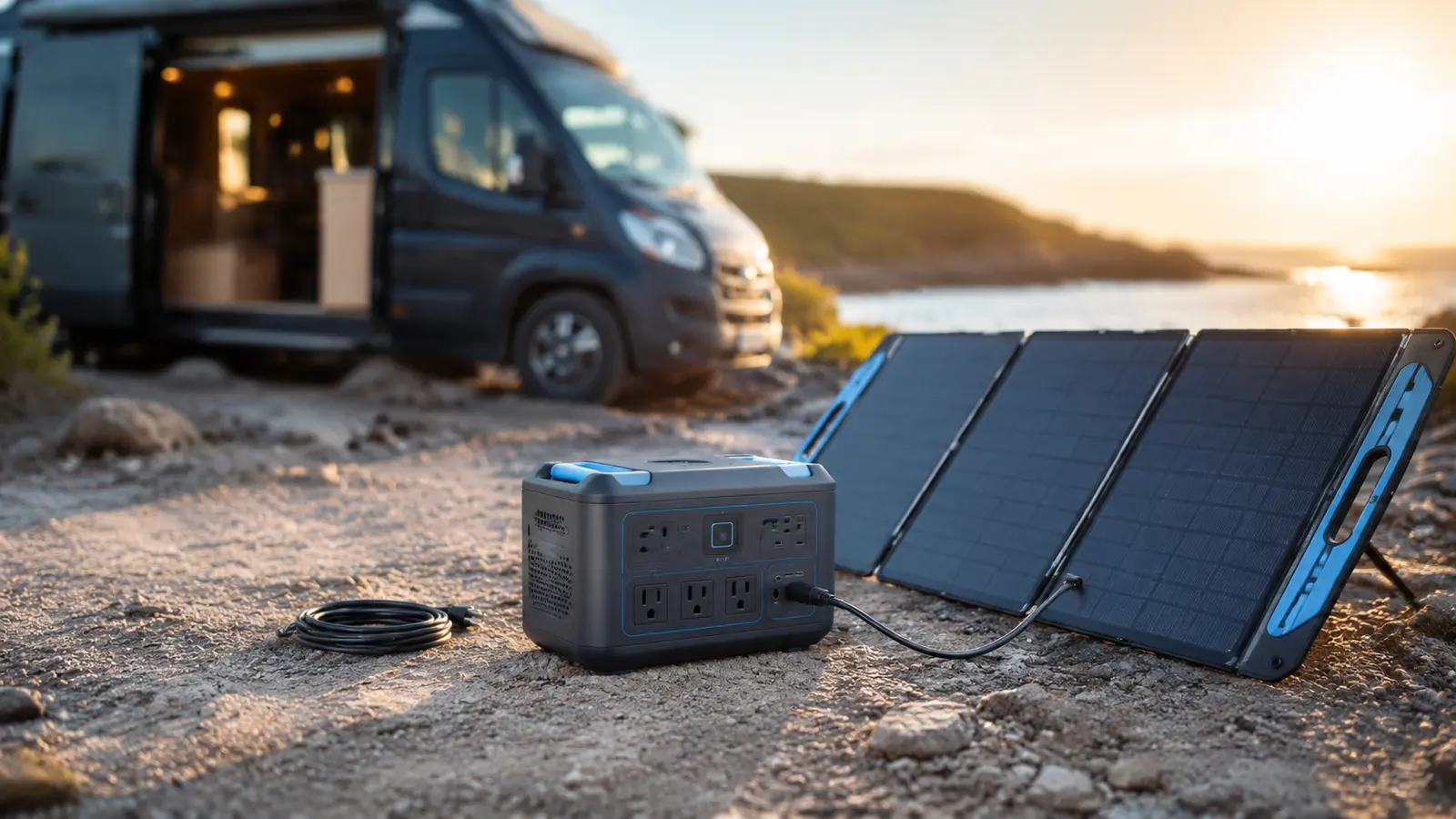
The difference between a solar generator and a portable power station is smaller than the names suggest. In most consumer product lines, the power station is the rechargeable battery unit. Add a compatible solar panel and the same unit is marketed as a solar generator or solar-generator kit.
That naming can make shopping harder than it needs to be. A product described as a generator may not generate electricity by itself; the panel collects solar energy, while the power station regulates, stores, and delivers it. A power station can also recharge from a wall outlet or vehicle, so buying one without a panel does not prevent solar charging later.
This comparison focuses on current battery-based systems. It does not use “solar generator” to describe a gasoline generator, a permanently installed home battery, or a bare solar panel.
portable power station vs solar generator: The short answer
Choose a portable power station if you need stored electricity now and expect to recharge mainly from the grid or a vehicle. Choose a solar-generator bundle if you also need a compatible portable panel and the package price, connectors, and input limits make sense together.
The panel does not make the battery larger or the inverter stronger. It changes how the battery can be refilled when sunlight is available.
| Question | Portable power station | Solar generator bundle |
|---|---|---|
| Main equipment | Battery, BMS, charge electronics, inverter, output ports | The same power station plus one or more solar panels and required cable |
| Stores energy | Yes | Yes |
| Produces solar electricity | Not without a panel | Yes, when the included panel is connected in useful sunlight |
| Wall charging | Usually | Usually |
| Vehicle charging | Often | Often |
| Works at night | Yes, from stored battery energy | Yes, from stored battery energy |
| Typical reason to buy | Backup power, travel, tools, electronics | Off-grid charging package with known panel compatibility |
What is inside a portable power station?
A portable power station normally combines several components in one enclosure:
- Rechargeable battery cells
- Battery management system
- AC charging equipment
- Solar or vehicle DC input
- Solar charge controller, often MPPT
- Pure sine wave or other inverter for AC outlets
- USB and 12V DC outputs
- Display, controls, cooling, and protective circuitry
Capacity is normally listed in watt-hours. Inverter output is listed in watts. Those numbers answer different questions. Watt-hours help estimate how long equipment can run; watts indicate whether the inverter can supply the load at a given moment.
A 1,000Wh power station does not guarantee 1,000Wh at the AC outlets. Battery reserve, inverter conversion, temperature, load level, cable loss, and automatic shutdown consume or protect part of the rated energy. Runtime calculations should use a documented efficiency figure when available or a clearly stated planning factor.
What is a solar generator?
In current portable-power marketing, a solar generator is usually a package made from:
Solar panel + charging cable + portable power station
The panel converts sunlight into DC electricity. The station’s charge controller manages that input and charges the internal battery. The battery then supplies DC ports or feeds the inverter for AC outlets.
This is not only our interpretation. EcoFlow describes a prepackaged solar generator as a power station bundled with solar panels. Goal Zero says its solar generators are made up of a power station and panels. Anker similarly describes a solar generator as panels paired with a portable power station. Jackery’s product comparisons use the same practical distinction.
The terminology is commercial rather than a strict engineering category, so always inspect what is included. Some pages use “solar generator” for the battery unit even when the panel is sold separately. Others show a panel in the photographs but list it as an optional bundle.
Why the word generator is confusing
A gasoline generator converts fuel energy into electricity while its engine is running. A battery power station stores energy that came from somewhere else. A solar panel converts sunlight into electricity but does not store it.
The complete solar-generator system can collect, store, and deliver energy, but the power station alone is still a storage and conversion device. This distinction matters when estimating runtime. A panel can extend operation only when it produces more useful energy than the connected loads consume over the same period.
For example, a nominal 200W panel will not continuously deliver 200W from sunrise to sunset. Weather, sun angle, shade, panel temperature, controller limits, cable loss, and battery state all influence output.
Portable power station vs solar generator: the practical differences
What comes in the box
A power-station package typically contains the station, AC charging cable, and documentation. Vehicle or solar charging cables may or may not be included.
A solar-generator package should add at least one panel and the correct cable or adapter. Confirm this in the itemized contents. Product photographs are not a reliable contents list.
Initial cost
The solar bundle usually costs more because it includes a panel. A bundle discount can make it less expensive than buying the same items separately, but prices change frequently. Compare the exact station model, panel model, cable, warranty, shipping, and return policy rather than the crossed-out list price.
Charging away from an outlet
Both systems can use solar if the power station has a compatible solar input. The bundle simply supplies a matched panel from the start.
Solar is valuable for multi-day trips, but it is weather-dependent. A wall outlet is generally the fastest and most predictable charging source. Vehicle charging can be useful while driving but may be limited to roughly the power available from the vehicle port unless a product-specific high-power alternator charger is used.
Portability
The station weighs the same whether it is sold alone or in a solar bundle. The bundle adds panel weight, cable, storage volume, and setup time. A folding panel may be easy for one person to carry but awkward in wind or difficult to store in a full vehicle.
Setup time
A power station is normally ready once charged: place it in a dry, ventilated location and connect a compatible load. A solar generator adds panel placement, orientation, cable routing, input checking, and weather management.
Compatibility risk
A manufacturer bundle reduces one part of the compatibility problem because the supplied panel and cable were selected for that station. A separately purchased panel can also work well, but its open-circuit voltage, operating voltage, short-circuit current, connector polarity, cable, and total array configuration must stay inside the station’s published limits.
Do not select a panel from wattage alone. Two 200W panels can have different voltages and connectors. Series or parallel combinations further change the array voltage and current.
Expandability
Some power stations accept expansion batteries; others have fixed capacity. Some accept a large solar array, while compact models may be limited to 100W or 200W of solar input. Buying the panel bundle does not change those internal limits.
If future expansion matters, check the maximum battery capacity, supported expansion models, maximum solar voltage, current, wattage, and whether more than one solar input is available.
A simple energy example
Suppose a campsite uses the following energy each day:
| Device | Daily estimate |
|---|---|
| 12V cooler | 360Wh |
| Two laptop charges | 130Wh |
| Phones and cameras | 70Wh |
| LED lights | 45Wh |
| Fan | 90Wh |
| Total | 695Wh |
A 1,024Wh station may cover that one-day estimate after conversion losses and reserve are considered, but the margin depends on the actual cooler duty cycle and load efficiency.
Now add a 200W portable panel. With four equivalent peak-sun-hours and a 0.75 planning factor, a rough daily estimate is:
200W x 4 x 0.75 = 600Wh
That could replace much of the estimated daily use in favorable conditions, but it is not guaranteed. Shade, clouds, heat, panel angle, cable loss, and the station’s input limit can lower production. The battery still needs enough stored energy to cover evening use and poor solar conditions.
This is the key decision: the power station determines stored capacity and output; the solar equipment determines how much energy might be collected during the day.
Which is better for a weekend camping trip?
For one or two nights, a correctly sized power station charged at home may be simpler. It avoids carrying and setting up a panel, and there may not be enough daytime at camp to recover the panel cost or storage space.
A solar bundle becomes more useful when the trip lasts several days, the campsite receives reliable sun, daily loads are moderate, and access to wall or vehicle charging is limited. Campers who park in forest shade may get better results from a portable panel placed in a sunny clearing, but the cable must be correctly sized and protected.
If the load includes an electric heater, air conditioner, induction cooktop, or other high-energy appliance, neither a small power station nor a small solar panel should be assumed sufficient. Calculate both instantaneous watts and daily watt-hours.
Which is better for emergency home backup?
For short outages, a charged power station may be the most dependable starting point because it is ready regardless of weather. Solar panels can extend an outage plan, but production varies and portable panels need a safe outdoor location while the battery remains protected according to its manual.
Medical equipment, refrigeration, sump pumps, and communications equipment deserve a separate reliability plan. Verify startup power, runtime, charging redundancy, and any device-specific requirements. A consumer power station is not automatically a medical-grade backup system or a substitute for a professionally designed standby system.
Solar generator vs gas generator
This is a different comparison. A gasoline or propane generator can produce energy as long as suitable fuel is available, subject to maintenance and operating limits. A battery-based solar generator is quiet at the point of use and has no engine exhaust, but its stored energy is finite and solar recharging depends on conditions.
Never operate a fuel-burning generator inside an RV, tent, garage, or other enclosed or partly enclosed space. Carbon monoxide can kill without warning. Follow the U.S. Consumer Product Safety Commission’s generator guidance and the equipment manual.
How to choose between the two packages
Buy the station alone when:
- You already own a compatible panel
- Most charging will happen from a wall outlet
- The trip is short enough to carry all required energy
- Storage space and carried weight matter more than off-grid charging
- You want to choose a different panel later
Buy the solar-generator bundle when:
- You need a panel and station together
- The bundle clearly includes the correct cable and adapter
- The panel’s voltage and current match the station
- You expect multi-day use with useful sunlight
- The combined warranty and support are valuable
- The bundle price is better than purchasing the exact parts separately
Buying checklist
Before choosing either package, compare these specifications:
- Battery capacity in watt-hours
- Continuous AC output and surge behavior
- Maximum solar input voltage, current, and watts
- Panel Voc, Vmp, Isc, Imp, and connector type
- Usable DC outputs, including a regulated 12V port if a cooler is planned
- USB-C power for laptops and cameras
- Unit and panel weight
- AC, vehicle, and solar recharge times under stated conditions
- Charge and discharge temperature ranges
- Battery chemistry and published cycle-life test condition
- Independent safety certification relevant to portable power equipment
- Warranty, service network, replacement cables, and firmware support
UL Solutions identifies UL 2743 as a safety standard for portable power packs. Certification is not a performance comparison, but checking for a credible third-party safety evaluation is more useful than relying on a generic “safe” badge.
Common mistakes
Assuming the panel is included
Read the selected variant and box contents. The same page may sell a station-only option and several solar bundles.
Matching by connector alone
A plug that fits does not prove electrical compatibility. Voltage, current, polarity, and configuration still matter.
Comparing watts with watt-hours
A 2,000W inverter rating does not mean the battery stores 2,000Wh. One is power; the other is energy.
Treating advertised recharge time as universal
Solar recharge claims normally assume strong sunlight, correct panel alignment, suitable temperature, and little or no simultaneous load. Real conditions vary.
Forgetting that panels need outdoor space
A large folding panel needs safe ground area, cable routing, wind management, and protection from vehicle traffic and theft.
Frequently asked questions
Can a portable power station be charged with solar panels?
Yes, if it has a solar-compatible DC input and the panel array stays inside its voltage, current, and power specifications. Use an approved cable with verified polarity.
Is a solar generator just a battery?
The power station portion is a battery-based storage and output system. The complete solar-generator package adds panels that convert sunlight into electricity for charging.
Does a solar generator work at night?
It can power loads at night from energy stored in the battery. The panels do not produce useful energy without sunlight.
Can I add solar panels later?
Usually, but confirm the station’s input limits and connectors before purchasing panels. Future series or parallel combinations must also remain within the limits.
Is a solar generator worth the extra cost?
It can be worthwhile when the panel will be used regularly and the bundle is genuinely compatible and competitively priced. If most trips have hookups or vehicle charging, a station-only purchase may be more practical.
Final verdict
In most portable systems, the power station and solar generator are not competing technologies. The solar generator is the power station plus a way to recharge it from sunlight. Choose the battery capacity and output for the loads, then decide whether buying a matched panel now is better than charging by wall or vehicle and adding solar later.
Sources and references
- EcoFlow, Portable Power Station vs Solar Generator: https://www.ecoflow.com/us/blog/portable-power-station-vs-solar-generator
- Goal Zero, What Is a Solar Generator?: https://help.goalzero.com/hc/en-us/articles/39081970875291-What-is-a-Solar-Generator
- Goal Zero, Portable Solar Generator Kits: https://goalzero.com/collections/portable-solar-generator-kits
- Anker SOLIX, Solar Generators: https://www.anker.com/collections/solar-generators
- Jackery, Solar Generator vs Portable Power Station: https://www.jackery.com/blogs/knowledge/solar-generator-vs-portable-power-station-vs-solar-panel
- U.S. Department of Energy, Solar Photovoltaic Technology Basics: https://www.energy.gov/cmei/systems/solar-photovoltaic-technology-basics
- UL Solutions, Portable Power Pack Testing: https://www.ul.com/services/portable-power-pack-testing
- U.S. Consumer Product Safety Commission, Carbon Monoxide Information Center: https://www.cpsc.gov/Safety-Education/Safety-Education-Centers/Carbon-Monoxide-Information-Center
Editorial note: Package contents, specifications, and prices can change. Verify the exact model, selected bundle, input limits, and included cables on the manufacturer’s current product page before purchasing.
Related guides: portable power station basics and solar generator basics.
A portable power station vs solar generator comparison should distinguish the battery system from the optional solar panels used for recharging.