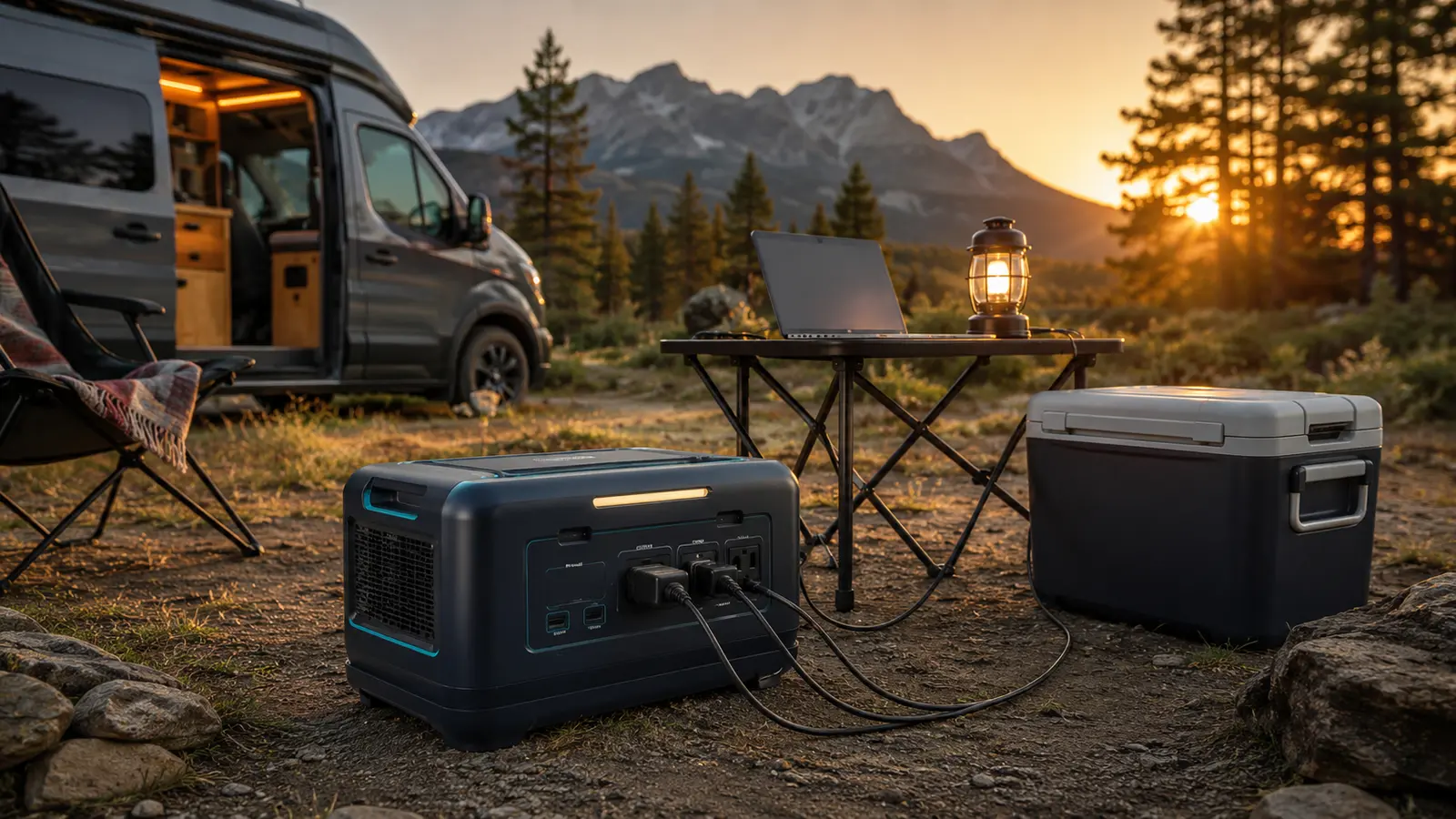
The best portable power station for camping is not automatically the model with the biggest battery. A 1,500Wh unit may be ideal for a long base-camp stay but irritating on a quick tent trip. A compact 288Wh station is easy to carry yet cannot run the same appliances as a 2,000W inverter system.
This guide matches current power stations to specific camping jobs. The selections are based on manufacturer-published specifications available on September 4, 2026, not invented hands-on tests. Prices and availability are intentionally excluded because they change quickly. Before buying, verify the current product page, manual, warranty, recall status, and exact bundle contents.
Quick picks
| Camping need | Recommended model | Why it fits |
|---|---|---|
| Best overall for most car campers | Anker SOLIX C1000 Gen 2 | 1,024Wh, 2,000W output, 600W solar input, 24.9 lb |
| Best ultralight AC option | Jackery Explorer 300 v2 | 288Wh, 300W output, 8.16 lb |
| Best compact station with more AC headroom | EcoFlow RIVER 3 Plus | 286Wh, 600W output, 10.4 lb, expandable battery support |
| Best rugged mid-size choice | Goal Zero Yeti 700 | 677Wh, 600W output, IPX4, 20.3 lb |
| Best for longer base-camp stays | Goal Zero Yeti 1500 | 1,505Wh, 2,000W output, up to 900W combined solar input, IPX4 |
These are different classes, not a simple first-to-fifth ranking. A smaller station can be the better purchase when it covers the load and is carried often.
How the picks were evaluated
The comparison gives priority to specifications that change the camping experience:
- Battery capacity in watt-hours
- Continuous AC output and surge rating
- Total carried weight
- Solar and vehicle charging limits
- Useful USB-C and regulated 12V outputs
- Battery chemistry and published cycle-life conditions
- Charge and discharge temperature ranges
- Weather-resistance claims supported by a stated rating
- Safety certification information
- Warranty, service, and replacement-cable availability
Marketing runtime examples were not treated as universal results. Appliance runtime changes with actual draw, startup behavior, inverter efficiency, temperature, battery reserve, and whether other devices are connected.
Best overall: Anker SOLIX C1000 Gen 2
The Anker SOLIX C1000 Gen 2 is the most balanced choice here for car camping, powered coolers, photography equipment, laptops, and occasional higher-wattage appliances. Anker lists a 1,024Wh LiFePO4 battery, 2,000W continuous AC output, 3,000W peak output, 600W maximum solar input, and a weight of 24.9 lb.
That combination gives it much more appliance headroom than compact 300W or 600W stations without becoming a 50-pound base-camp battery. The official input specification lists two MPPT ranges and a 60V maximum at the higher range, so third-party panels must be checked for array voltage and current rather than matched by watts alone.
Anker states that the battery is rated for 4,000 cycles to at least 80% capacity. It also advertises a 49-minute full recharge in UltraFast mode, but the product page notes that this mode must be enabled and that temperature affects charging speed. Fast wall charging is useful on travel days; it should not be confused with normal solar performance.
Best for
- Two- to four-night car camping
- 12V cooler plus laptops, lights, cameras, and device charging
- Campers who want a 2,000W inverter without carrying a 50-pound station
- Faster recovery at a wall outlet between trips
Limitations
The C1000 Gen 2 does not support battery expansion, according to Anker’s current page. Its enclosure should not be assumed weatherproof, and its 24.9-pound weight is not backpack-friendly. A 2,000W inverter also makes it possible to connect loads that will drain 1,024Wh quickly, so capacity still needs to be calculated.
Best ultralight AC option: Jackery Explorer 300 v2
The Jackery Explorer 300 v2 is a strong fit when the load is mostly phones, cameras, drones, lights, a laptop, and other small electronics. Jackery lists 288Wh of LiFePO4 capacity, 300W continuous AC output, 600W surge, and a weight of 8.16 lb.
Its 100W USB-C output can charge many laptops directly, avoiding the inverter conversion step. The station also includes AC, USB-A, USB-C, and a 12V car-style output. Jackery lists 4,000 cycles to 70% or greater capacity and a charge-temperature range of 32 to 113 degrees Fahrenheit.
The 300W AC ceiling is the key boundary. It is not intended for common coffee makers, hair dryers, induction cooktops, electric kettles, or most space heaters. Those appliances often exceed the rating even before startup behavior is considered.
Best for
- Solo campers and photographers
- Short weekend trips
- Laptop and USB-C charging
- Lights, fans, cameras, drones, and small electronics
- Anyone who values an 8-pound carry over high inverter power
Limitations
The 288Wh battery provides limited overnight energy for a refrigerator or CPAP plan once reserve and conversion loss are considered. Solar input is also in the compact class. Verify the exact panel bundle and connector because the current product page offers multiple variants.
Best compact station with more AC headroom: EcoFlow RIVER 3 Plus
The EcoFlow RIVER 3 Plus combines a compact 286Wh battery with 600W rated AC output. That makes it useful for campers who need more instantaneous power than the Jackery 300 v2 but do not need a large battery.
EcoFlow lists a weight of 10.4 lb, three AC outlets, USB outputs, a vehicle-style DC output, and under-10-millisecond switching for supported backup use. The battery can expand to 858Wh with compatible extra batteries, which is unusual in this compact class. EcoFlow’s current buying guidance lists up to 220W solar input for the RIVER 3 Plus.
The important tradeoff is that output is not capacity. A 600W appliance can use a 286Wh battery very quickly. EcoFlow publishes a 21-minute laboratory runtime example for a 600W desktop under its test conditions; users should calculate their own loads rather than treating that figure as a guarantee.
Best for
- Compact car-camping setups
- Short use of moderate-power AC devices
- Laptops, network equipment, lights, and electronics
- Campers who may add a compatible expansion battery later
Limitations
The base battery is still only 286Wh. “X-Boost” or similar voltage-management modes are not the same as normal rated output and may not suit appliances with strict voltage requirements. Read the appliance and station manuals before using such modes.
Best rugged mid-size choice: Goal Zero Yeti 700
The Goal Zero Yeti 700 sits between pocketable weekend units and 1kWh stations. Goal Zero lists 677.37Wh of LiFePO4 capacity, 600W continuous AC output, 1,000W surge, 200W maximum solar input, and a weight of 20.3 lb.
Its IPX4 rating is a meaningful differentiator for outdoor use. IPX4 means resistance to splashing water under the stated test, not permission to leave the station in rain or submerge it. Port covers, a dry operating location, and the product manual still matter.
The Yeti 700 also has unusually useful DC capability for camping. Goal Zero lists a 13.5V auxiliary port rated at 12A continuous and a combined 12V output limit. That can be valuable for a compatible portable refrigerator, but the fridge plug, voltage range, cable, and station output must all be checked.
Goal Zero says the model meets UL 2743 requirements and lists 4,000 cycles to 80% capacity under specified test conditions.
Best for
- Campers who prioritize an outdoor-oriented enclosure
- 12V refrigerator and DC-device users
- Moderate daily energy without a 1,000Wh-class battery
- Trips where 600W AC is sufficient
Limitations
At 20.3 lb, the Yeti 700 is heavy relative to its 677Wh capacity. Its 600W inverter excludes many heating appliances, and 200W solar input means a full solar recharge still takes several strong-sun hours under ideal conditions.
Best for longer base-camp stays: Goal Zero Yeti 1500
The new Goal Zero Yeti 1500 is the largest recommendation in this guide. It has 1,505.28Wh of LiFePO4 capacity, a 2,000W continuous pure sine wave inverter, 3,600W surge, and up to 900W of combined DC/solar input through its published input paths.
It also includes an IPX4 rating and a 12V high-power output rated at 405W, making it relevant to more serious vehicle and base-camp installations. Goal Zero lists UL 2743 certification by a third-party Nationally Recognized Testing Laboratory. The battery cycle-life claim is 4,000 cycles to 80% capacity under the stated temperature and charge/discharge condition.
The price of that capability is mass: the station weighs 52.75 lb. It belongs in a vehicle or established base camp, not on a hike. The unit’s 2,000W inverter can power high-wattage devices, but a 1,500W load can still drain the battery in roughly an hour after real losses are considered.
Best for
- Longer car-camping or overland base camps
- Larger refrigerators, multiple laptops, photography production, and tools
- Campers who need strong DC output
- Users who want a stated water-resistance rating and third-party safety certification
Limitations
The 52.75-pound weight requires deliberate transport and secure storage. The larger system also needs more solar-panel area to recharge off-grid. An advertised 900W maximum input does not mean 900W will be available from a portable array in ordinary conditions.
Published specification comparison
| Model | Capacity | Rated AC output | Weight | Maximum solar input | Battery |
|---|---|---|---|---|---|
| Jackery Explorer 300 v2 | 288Wh | 300W | 8.16 lb | Compact-panel class; verify selected input and bundle | LiFePO4 |
| EcoFlow RIVER 3 Plus | 286Wh | 600W | 10.4 lb | Up to 220W | LiFePO4 |
| Goal Zero Yeti 700 | 677Wh | 600W | 20.3 lb | 200W | LiFePO4 |
| Anker SOLIX C1000 Gen 2 | 1,024Wh | 2,000W | 24.9 lb | 600W | LiFePO4 |
| Goal Zero Yeti 1500 | 1,505Wh | 2,000W | 52.75 lb | 900W combined DC/solar | LiFePO4 |
Specifications are manufacturer-published values current at the research date. They are not independent bench-test results.
How much capacity do you need for camping?
Create a daily energy budget before choosing a model.
| Camping load | Example daily energy |
|---|---|
| 12V cooler | 360Wh |
| Two laptop charges | 130Wh |
| Phones, watches, and camera batteries | 70Wh |
| LED lights | 45Wh |
| Fan | 90Wh |
| Estimated daily total | 695Wh |
Add a reasonable planning allowance. At 15%, the example becomes about 799Wh. A 1,024Wh station is therefore a more credible one-day choice than a 677Wh unit if no charging is available, but actual cooler consumption can shift the result.
For AC loads, a practical runtime estimate is:
Runtime hours = battery watt-hours x usable factor / load watts
Using an illustrative 0.85 usable factor, a 1,024Wh station powering a steady 100W load estimates:
1,024 x 0.85 / 100 = 8.7 hours
The factor is not universal. Use manufacturer or measured efficiency data when available.
Output: how many watts are enough?
Add the running watts of devices that may operate at the same time, then check startup surge for motors and compressors. A refrigerator may run at a modest wattage but briefly draw more at startup.
Do not size from a model’s “boost” number without understanding how the mode works. Some boost features reduce output voltage so resistive appliances can continue operating. That may not be appropriate for electronics, motors, or devices with strict voltage requirements.
For typical camping electronics, 300W may be enough. A small cooler, laptop, fan, and lighting setup often benefits from 600W. Coffee makers, induction cooking, power tools, and other heating loads may justify 1,500W to 2,000W, but their energy consumption can make a larger battery equally important.
Solar charging: check voltage before wattage
A station’s solar input has limits for voltage, current, and power. The panel array must remain inside all three, including cold-weather open-circuit voltage. A connector that fits does not prove compatibility.
Estimate daily solar energy with:
Panel watts x peak-sun-hours x system factor
A 200W panel with four peak-sun-hours and a 0.75 factor estimates about 600Wh per day. It will not reliably refill a 1,500Wh station from empty in one day. A large station therefore needs either more compatible panel capacity, more time, or another charging source.
Ports that matter at camp
USB-C power delivery
A 100W or 140W USB-C port can charge many laptops directly and avoid running the AC inverter. Check the laptop’s supported charging profile and cable rating.
Regulated 12V output
Portable refrigerators can be more efficient on DC, but some power stations reduce or disable a DC output at certain battery levels. Verify voltage regulation, current limit, connector, and low-voltage behavior.
AC outlets
Outlet count matters less than total inverter output. Three outlets do not mean three high-wattage appliances can run simultaneously.
Pass-through and backup modes
Some models can power loads while charging or switch during an outage. Read the manual for total bypass current, supported loads, grounding, and whether the function is a true UPS under a recognized standard.
Safety and campsite use
Battery stations do not produce carbon monoxide at the point of use, but they still contain high-energy lithium batteries and power electronics.
- Keep the station dry unless the manual explicitly permits limited exposure
- Maintain required ventilation and clearance
- Use only approved charging cables and adapters
- Do not cover cooling openings
- Protect the unit from direct campfire heat and vehicle traffic
- Stop using a damaged, swollen, wet, recalled, or overheating product
- Check the CPSC recall database before buying used equipment
- Recycle end-of-life lithium batteries through an appropriate collection program
The U.S. Environmental Protection Agency says lithium-ion batteries should not be placed in household garbage or recycling bins. Use a separate recycling or household hazardous-waste collection point.
What not to buy a small power station for
A compact power station is not a practical all-night space-heater battery. A 1,500W heater would use 1,500Wh in one hour before conversion losses. It is also not automatically suitable for life-support or critical medical equipment. Those applications need manufacturer approval and a complete reliability plan.
For long-duration air conditioning, electric cooking, or multiple days without charging, compare a fixed RV electrical system, a larger expandable battery, shore power, or an approved fuel-generator strategy operated outdoors according to carbon-monoxide guidance.
Buying checklist
- Measure daily energy in watt-hours.
- List the highest simultaneous running watts.
- Record motor or compressor startup requirements.
- Choose the maximum weight one person can safely handle.
- Confirm solar voltage, current, wattage, connector, and cable limits.
- Check vehicle-charging time if road charging matters.
- Confirm USB-C and 12V output ratings.
- Read charge and discharge temperature limits.
- Look for credible third-party safety certification.
- Check warranty length, service options, and replacement accessories.
- Search the CPSC recall database for the exact model.
- Compare the station-only and panel-bundle contents.
Frequently asked questions
What size power station is best for camping?
Around 250 to 300Wh suits light electronics and short trips. Roughly 600 to 1,000Wh is more flexible for coolers, laptops, fans, and longer weekends. Above 1,500Wh is useful for high daily energy or base-camp use but becomes heavy. Calculate the actual loads.
Can a portable power station run a camping fridge?
Often, if the station has sufficient watt-hours, a suitable regulated DC or AC output, and enough startup capability. Measure the fridge’s daily energy in the expected weather.
Can it run a coffee maker?
Only if the inverter’s continuous output covers the coffee maker and the battery can supply the energy and current. Many coffee makers draw 800W to 1,500W, which excludes compact 300W and 600W stations.
Is LiFePO4 better for camping?
LiFePO4 commonly offers a long published cycle life and good thermal stability, but performance still depends on cell quality, BMS design, enclosure, certification, temperature, and correct use. Low-temperature charging limits remain important.
How much solar should I bring?
Divide the daily watt-hours you want to replace by expected peak-sun-hours and a planning factor. Then confirm the station’s maximum voltage, current, and power limits.
Final recommendation
For most car campers who want one flexible station, the Anker SOLIX C1000 Gen 2 offers the strongest balance of capacity, output, solar input, and manageable weight in this group. Choose the Jackery Explorer 300 v2 when portability matters most, the EcoFlow RIVER 3 Plus when compact size and 600W output matter, the Goal Zero Yeti 700 for its outdoor-oriented mid-size design, and the Goal Zero Yeti 1500 for a vehicle-based long-stay system.
The correct winner is the smallest model that safely covers the measured energy, output, temperature, and charging requirements with realistic reserve.
Sources and references
- Anker, SOLIX C1000 Gen 2 official product page: https://www.anker.com/products/a1754
- Jackery, Explorer 300 v2 official product page: https://www.jackery.com/products/jackery-explorer-300-v2-portable-power-station
- EcoFlow, RIVER 3 Plus official product page: https://www.ecoflow.com/us/river-3-plus-portable-power-station
- EcoFlow, portable power-station buying guide: https://www.ecoflow.com/us/blog/what-to-know-before-buying-power-stations
- Goal Zero, Yeti 700 official product page: https://goalzero.com/products/yeti-700-portable-power-station-lfp-batteries
- Goal Zero, Yeti 1500 official product page: https://goalzero.com/products/yeti-1500-portable-power-station-lifepo4-battery
- UL Solutions, Portable Power Pack Testing: https://www.ul.com/services/portable-power-pack-testing
- U.S. Consumer Product Safety Commission, Recalls: https://www.cpsc.gov/Recalls
- U.S. Environmental Protection Agency, Used Lithium-Ion Batteries: https://www.epa.gov/recycle/used-lithium-ion-batteries
Editorial note: This article compares published specifications and does not claim hands-on laboratory testing. Verify current manuals, certifications, prices, availability, firmware, warranty terms, and recall status before purchase.
Related guides: portable power station basics and solar generator fundamentals.