
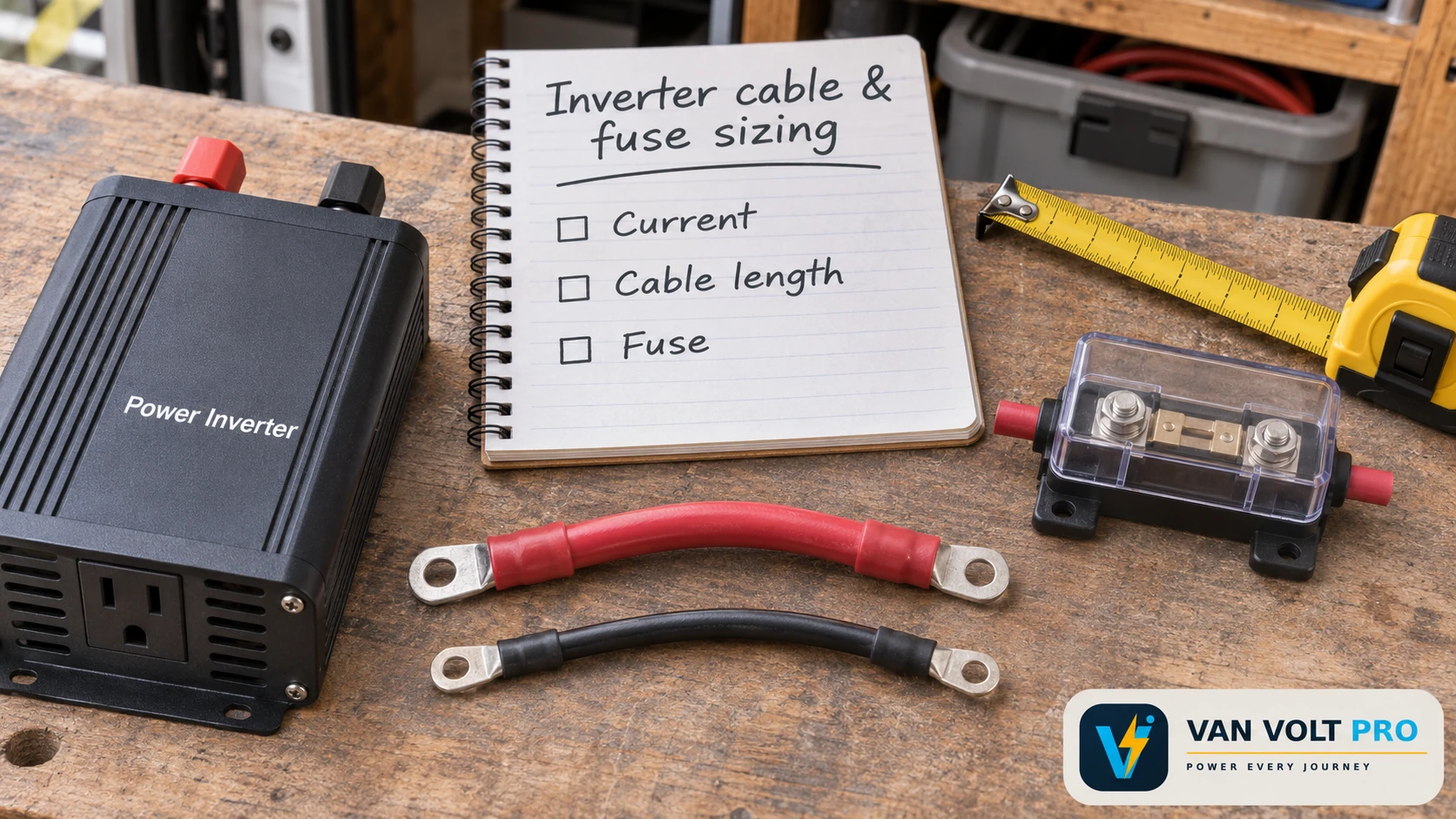
This inverter cable size calculator works out how much current an inverter draws from the battery, then suggests a fuse and the smallest copper cable to consider. It is a screening estimate, and your inverter maker’s table comes first.
How to use this calculator
- Enter the inverter’s continuous power in watts, not its surge rating.
- Choose your battery voltage and type, then enter the one-way cable length from battery to inverter.
- Read the DC current, the fuse size to consider and the smallest cable that carries that fuse within your allowed voltage drop.
How Inverter DC Cable & Fuse Sizing Is Calculated
- DC current (A) = inverter watts ÷ (battery voltage × efficiency)
- Smallest fuse to consider = 125% of the DC current, rounded up to a standard size
- Cable: its ampacity must be at least the fuse rating, and the voltage drop at that current must stay within your limit
Assumptions
- Efficiency is 90% by default and battery voltage is the nominal value, so the current is higher when the battery voltage sags.
- Cable ampacity comes from NEC Table 310.16 copper values at the temperature rating you choose (75°C by default).
- Voltage drop uses copper resistance at 20°C.
Inverter DC Cable & Fuse Sizing Worked Example
- A 1,500 W inverter on a 12V LiFePO4 battery (12.8 V) at 90% efficiency draws 1,500 ÷ (12.8 × 0.90) = 130 A.
- 125% of 130 A is 163 A, so the next standard fuse size is 175 A.
- 2/0 AWG at 75°C is rated for 175 A, and over 6 ft one way it drops about 1.0%.
- A 3,000 W inverter on the same battery draws about 260 A and needs a 350 A fuse. No single cable in this table carries that at 75°C, so a 24V system or the maker’s multi-cable layout is needed.
Common Inverter DC Cable & Fuse Sizing Mistakes to Avoid
- Using the inverter’s surge rating instead of its continuous rating.
- Fitting a fuse that is larger than the cable can carry.
- Using a fuse without enough interrupt rating for a lithium battery.
Inverter DC Cable & Fuse Sizing Frequently Asked Questions
Why 125%?
A common sizing method leaves headroom so a fuse does not nuisance-blow at normal load. Your inverter manual may state a different fuse size, and it overrides this tool.
Why does 24V help?
For the same watts, a 24V system draws half the current of a 12V one, so cables and fuses are smaller.
What fuse type should I use?
Large DC circuits usually use ANL, MEGA or Class T fuses. Class T is widely used for lithium because of its high interrupt rating. Check the fuse’s voltage and interrupt ratings against your battery.
Keep Building Your Inverter DC Cable & Fuse Sizing Plan
Inverter DC Cable & Fuse Sizing Sources & References
- Blue Sea Systems: Grounding and circuit protection for inverters and chargers
- Victron Energy: Wiring Unlimited
- NFPA 70, National Electrical Code: Table 310.16 (conductor ampacity)
Last updated: November 13, 2026. General educational information. Results are estimates for planning. Follow your equipment manuals and local rules, and ask a qualified electrician when unsure.