
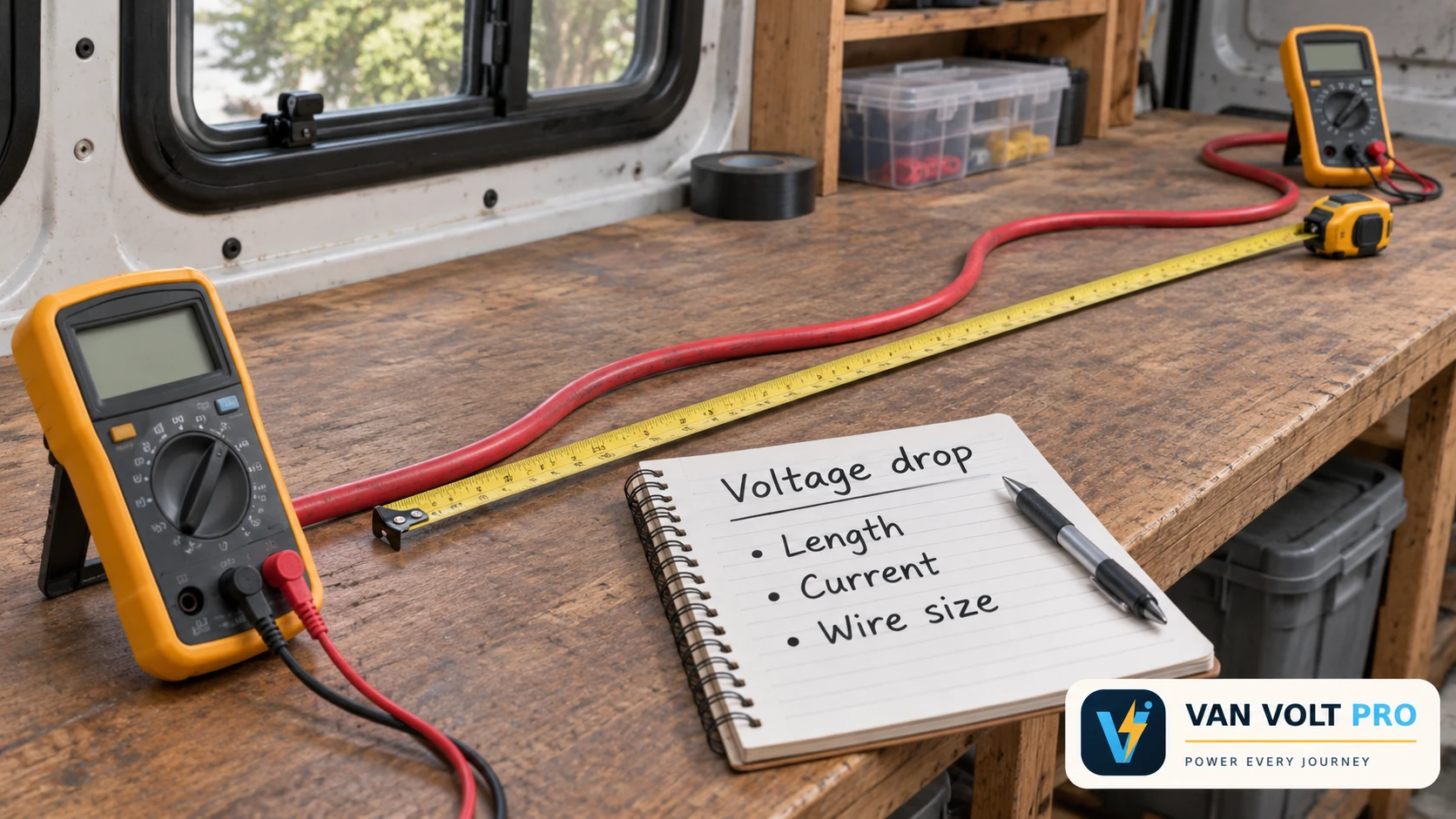
This voltage drop calculator shows how much voltage a copper wire loses at a given current and length. Use it to check a wire you already have, or to see why a longer run needs thicker wire.
How to use this calculator
- Enter the current of the load in amps.
- Enter the one-way length of the wire. The return wire is counted for you, so do not double it.
- Choose the copper wire size. A smaller AWG number means thicker wire.
How 12V, 24V & 48V DC Voltage Drop Is Calculated
- Voltage drop (V) = current × resistance per foot × 2 × one-way length
- Voltage drop (%) = drop ÷ system voltage × 100
- Power lost as heat (W) = current × voltage drop
Assumptions
- Copper wire, solid-wire resistance at 20°C. Stranded wire has a few percent more.
- Hot wire (75°C) raises resistance by about 22%.
- 3% is the usual limit for most circuits, and 10% is the limit for loads that tolerate a lower voltage.
12V, 24V & 48V DC Voltage Drop Worked Example
- 20 A over 10 ft one way on 8 AWG in a 12V system: 20 × 0.000628 × 2 × 10 = 0.25 V, which is 2.1%. That is inside the 3% limit.
- The same run on 12 AWG loses 0.64 V, which is 5.3%. That is too much for a sensitive load.
Common 12V, 24V & 48V DC Voltage Drop Mistakes to Avoid
- Entering the round-trip length. Enter one way only.
- Judging a wire only by how much current it can carry. At 12V, voltage drop usually limits you first.
- Using the 10% limit for electronics that need a steady voltage.
12V, 24V & 48V DC Voltage Drop Frequently Asked Questions
What voltage drop is acceptable?
A common guide is 3% or less for most circuits and up to 10% for loads that tolerate a lower voltage. The equipment manual comes first.
Why does 12V suffer more than 24V?
For the same power, a 12V circuit carries twice the current of a 24V circuit. Voltage drop grows with current, and the same drop is also a bigger share of 12 V.
Does this include the return wire?
Yes. The calculation doubles the one-way length for the round trip.
Keep Building Your 12V, 24V & 48V DC Voltage Drop Plan
12V, 24V & 48V DC Voltage Drop Sources & References
- Blue Sea Systems: Choosing the correct wire size for a DC circuit
- NFPA 70, National Electrical Code: Table 310.16 (conductor ampacity)
Last updated: November 13, 2026. General educational information. Results are estimates for planning. Follow your equipment manuals and local rules, and ask a qualified electrician when unsure.