
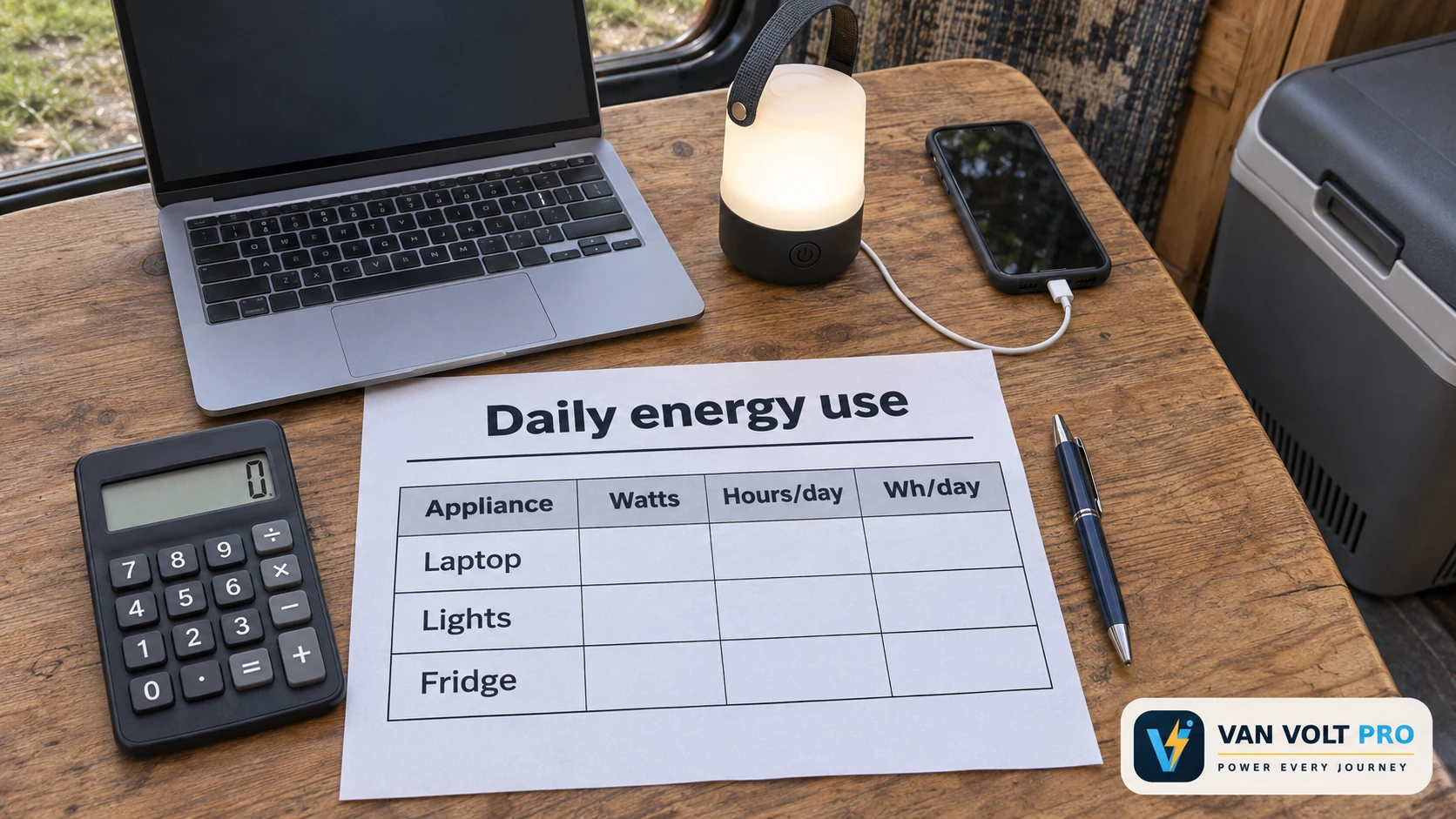
This daily energy use calculator adds up your appliances and shows how many watt-hours (Wh) and amp-hours (Ah) you use each day. It is the first step before you size a battery or solar panels, and it takes about two minutes.
How to use this calculator
- Write down each appliance’s watts from its label, or measure it with a plug-in watt meter.
- Enter the hours it really runs per day. A compressor fridge switches on and off, so use its running time, not 24 hours.
- Mark anything that runs through an inverter as AC, so the inverter’s losses are added.
How Daily Van & RV Energy Use Is Calculated
- Wh per day = watts × hours a day × quantity
- AC loads: Wh ÷ inverter efficiency (90% by default)
- Ah per day = total Wh ÷ battery nominal voltage
Assumptions
- Each appliance draws its stated watts while it runs.
- LiFePO4 batteries use 12.8 V, 25.6 V or 51.2 V as nominal voltage. Lead-acid uses 12 V, 24 V or 48 V.
- The six filled-in loads are examples only. Replace them with your own numbers.
Daily Van & RV Energy Use Worked Example
- With the filled-in example loads, DC loads (lights, phone charging, vent fan, fridge and pump) add up to 675 Wh a day.
- The 65 W laptop charger on AC for 4 hours uses 260 Wh, which becomes about 289 Wh after 90% inverter efficiency.
- The total is about 964 Wh a day (0.96 kWh), or about 75 Ah a day from a 12.8 V battery.
Common Daily Van & RV Energy Use Mistakes to Avoid
- Using 24 hours for a fridge. Use the time it actually runs.
- Entering surge or peak watts instead of running watts.
- Leaving out the inverter’s own losses on AC loads.
Daily Van & RV Energy Use Frequently Asked Questions
How do I find the watts of an appliance?
Read the label or manual. A plug-in watt meter is better, because it shows what the appliance really draws. For something that cycles, such as a fridge, read the watt-hours over a full day and enter that divided by the hours you want to use as its running time.
What is the difference between Wh and Ah?
Watt-hours measure energy: watts multiplied by hours. Amp-hours measure charge and depend on the voltage. The same energy is more amp-hours at 12 V than at 24 V, so we size from Wh first.
Should I add a safety margin?
Many people add some extra for loads they forgot. If you do, add it to the result yourself so you can see how much you added.
Keep Building Your Daily Van & RV Energy Use Plan
Daily Van & RV Energy Use Sources & References
- Virginia Tech Cooperative Extension: Estimating appliance and home electronic energy use
- Your battery maker’s datasheet and manual (voltage, usable capacity, charge and discharge limits)
Last updated: November 13, 2026. General educational information. Results are estimates for planning. Follow your equipment manuals and local rules, and ask a qualified electrician when unsure.