
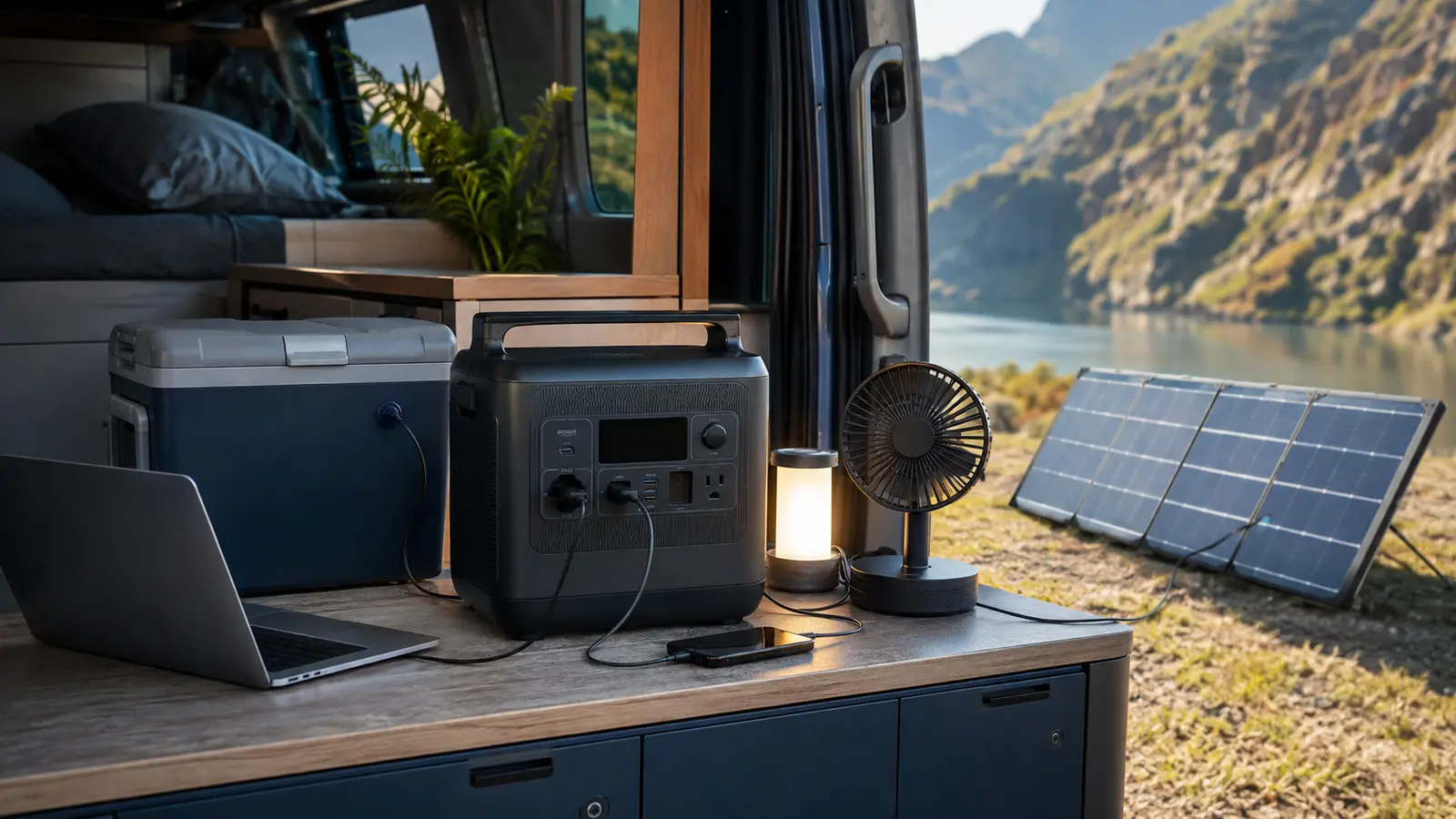
The right solar generator is not simply the model with the biggest watt number on the box. You need enough inverter output to start and run your appliances, enough battery capacity to cover the energy they use, and enough charging input to refill that battery in the time and sunlight available.
Those are three different calculations. A unit can have a powerful inverter but a small battery, or a large battery but limited solar input. Both may disappoint if you buy by one specification alone.
This guide gives you a practical sizing method for camping, van travel, work sites, and basic home backup. It uses appliance labels and measured consumption rather than optimistic guesses. Product specifications and battery behavior vary, so treat the examples as planning illustrations and verify the limits of the model you are considering.
The Short Answer
To size a solar generator, complete these four steps:
- Add the running watts of appliances that may operate at the same time.
- Check the highest startup surge from a compressor, pump, or motor.
- Calculate the watt-hours each appliance uses per day.
- Divide the daily total by a usable-capacity factor, then add a reserve.
For a first estimate, use:
Required battery capacity (Wh) = daily energy use (Wh) ÷ usable-capacity factor
A conservative usable-capacity factor for initial planning is 0.80. For example, a 900Wh daily load requires about 1,125Wh of rated battery capacity before adding extra margin:
900Wh ÷ 0.80 = 1,125Wh
Then make sure the inverter’s continuous output exceeds your simultaneous running load and its surge rating can handle the largest startup event. Finally, confirm the solar or wall charging input is fast enough for your schedule.
Watts and Watt-Hours Are Not the Same Thing
This distinction prevents most sizing mistakes.
- Watts (W) describe power at a moment in time. They tell you whether the inverter can operate an appliance.
- Watt-hours (Wh) describe energy over time. They tell you how long the battery can operate the appliance.
A 60W refrigerator does not necessarily use 60W continuously. Its compressor cycles on and off. If it averages 25W across 24 hours, it uses about 600Wh per day. A 1,000W coffee maker may look more demanding, but ten minutes of use consumes only about 167Wh.
The formula is:
Energy (Wh) = power (W) × time (hours)
For devices used in minutes:
Energy (Wh) = power (W) × minutes ÷ 60
Step 1: Build an Appliance Inventory
List everything you expect the solar generator to power. Read the wattage from the appliance label, power adapter, manual, or manufacturer specification. When the label gives volts and amps but not watts, multiply them:
Watts = volts × amps
For variable or cycling devices, a plug-in energy meter provides better planning data than a single label rating. Test the appliance during normal use when practical. Charging losses, temperature, duty cycle, and power-station overhead mean real battery draw will be higher than an ideal calculation.
Use a table like this:
| Appliance | Running watts | Quantity | Hours per day | Daily energy |
|---|---|---|---|---|
| 12V cooler, measured average | 35W | 1 | 12 | 420Wh |
| LED lights | 8W | 3 | 4 | 96Wh |
| Laptop charging | 65W | 1 | 3 | 195Wh |
| Phones | 15W | 2 | 2 | 60Wh |
| Vent fan | 25W | 1 | 5 | 125Wh |
| Estimated daily total | 896Wh |
These figures are illustrative. Your cooler may cycle differently in hot weather, and a laptop does not always draw its adapter’s full rating. Measure important loads when possible.
Step 2: Calculate Simultaneous Running Watts
Battery capacity controls runtime, but the inverter still has to deliver enough power at any one moment. Identify which AC appliances could run together.
Suppose a campsite setup may operate a 700W coffee maker, a 60W laptop charger, and a 40W cooler at the same time. The combined running load is approximately:
700W + 60W + 40W = 800W
An inverter rated for exactly 800W leaves no useful margin. A model with at least 1,000W continuous output would be a more comfortable starting point, subject to the manufacturer’s port and temperature limits.
Do not add the wattage of every appliance you own if they will never run together. Load scheduling can reduce the inverter size you need. For example, turn off a small heater before using a kettle, or wait until the coffee maker finishes before operating another high-power device.
Step 3: Account for Startup Surge
Motors and compressors can draw substantially more power for a brief period when they start. Refrigerators, freezers, pumps, power tools, and some air conditioners are common examples.
Check the appliance documentation for startup or locked-rotor demand, then compare it with the power station’s surge rating and surge duration. A headline surge number is not always available for the same length of time, and some units use a voltage-reduction mode rather than supplying full rated AC output. Read the manual rather than assuming all “boost” features behave alike.
If a refrigerator runs at 120W but requires 600W briefly at startup, a 300W inverter may fail even though the normal load looks small. The battery may still have plenty of energy; the inverter is the limiting component.
Step 4: Convert Daily Use Into Battery Capacity
Add the daily watt-hours from your inventory. Then account for conversion loss, battery-management reserve, standby consumption, and imperfect conditions.
For a planning estimate:
Rated capacity = daily load ÷ 0.80
If your daily load is 896Wh:
896Wh ÷ 0.80 = 1,120Wh
A nominal 1,024Wh battery may be close, but it leaves little cushion if the cooler works harder or cloud cover slows recharge. A larger unit, an expansion battery, or deliberate load reduction may be more suitable.
For more than one day without dependable charging:
Required capacity = daily load × days of autonomy ÷ usable factor
Two days at 896Wh per day gives:
896Wh × 2 ÷ 0.80 = 2,240Wh
That does not mean you must carry one 2,240Wh unit. Some travelers prefer a modular system with an expansion battery, while others combine a smaller power station with frequent vehicle or solar charging.
A Quick Runtime Formula
To estimate runtime for a steady load:
Runtime (hours) = rated battery capacity (Wh) × usable factor ÷ appliance watts
Example: a 1,024Wh power station operating a steady 80W load at an assumed 80 percent usable factor:
1,024Wh × 0.80 ÷ 80W = 10.24 hours
The result is not a warranty of runtime. Anker’s published runtime guidance uses the same basic relationship while noting that conversion efficiency and actual operating conditions matter. Low loads can also be affected by inverter standby consumption, while heavy loads may reduce effective runtime through additional heat and conversion loss.
For appliances that cycle, use measured daily energy instead of dividing by the nameplate running watts.
Common Solar Generator Size Bands
Capacity labels are only a starting point, but these broad bands help narrow the search.
Around 250–400Wh
This class suits phones, cameras, LED lights, routers, small fans, and short laptop use. It is light enough for day trips and minimalist camping. It is usually not the best choice for multi-day refrigeration unless you recharge often and have measured a very modest load.
Around 500–800Wh
This range can support electronics, lights, a portable cooler, and occasional small AC loads for short trips. Check inverter output carefully; two batteries with similar watt-hours may have very different AC capability and solar input.
Around 1,000–1,300Wh
This is a flexible range for van travel, longer camping, communications equipment, and selected home-backup loads. A power station in this class may operate a refrigerator, router, lights, and device charging, but actual duration depends on compressor cycling and recharge access.
Around 1,500–2,000Wh
This class offers more breathing room for several essential loads, work equipment, or a longer period between charges. Weight increases quickly, so consider whether wheels, handles, or a modular battery are important.
Above 2,000Wh
Large or expandable systems are more appropriate for longer home backup, high daily energy use, and heavier mobile setups. They still have finite inverter and charging limits. A large battery does not automatically make continuous electric space heating, cooking, or air conditioning economical.
Size the Solar Array Separately
A battery tells you how much energy you can store. Solar input tells you how quickly you may replace it.
For a rough daily-energy estimate:
Solar array watts = daily energy use ÷ peak-sun-hours ÷ system factor
If you need 900Wh per day, expect four peak-sun-hours, and use a 0.75 planning factor:
900Wh ÷ 4 ÷ 0.75 = 300W of panels
That is an estimate, not a guaranteed harvest. Panel angle, shade, cloud, heat, wiring loss, controller behavior, and the power station’s input ceiling all affect production. The U.S. Department of Energy notes that real photovoltaic output depends on variables including irradiance, temperature, module design, and system configuration. PVWatts can provide a location-based production estimate for fixed systems and is useful as a reality check.
Before buying panels, verify all of the power station’s solar-input limits:
- Maximum input watts
- Allowed voltage range
- Maximum input current
- Connector type and polarity
- Series and parallel configuration rules
- Cold-weather open-circuit voltage margin
More panel wattage will not help if the power station clips input at a much lower limit. Incorrect voltage can also damage equipment. Use compatible cables and follow the manufacturer’s manual.
Example 1: Weekend Tent Camping
Assume the following daily loads:
- Two phones: 60Wh
- Camera batteries: 80Wh
- LED lighting: 60Wh
- Laptop: 180Wh
- Fan: 150Wh
Daily total: 530Wh
Battery estimate:
530Wh ÷ 0.80 = 663Wh
A roughly 700–800Wh unit provides a practical starting margin. If the trip lasts two days with no charging, the requirement becomes about 1,325Wh. If you bring a suitable solar panel and have dependable sun, you may choose less battery capacity, but weather risk should influence that decision.
The inverter only needs to cover the largest simultaneous load in this example, which may be well under 300W. Buying a 2,000W inverter would add cost and weight without improving energy capacity.
Example 2: Basic Home-Outage Loads
Consider a refrigerator using a measured 900Wh per day, a router at 12W for 12 hours, three 8W lights for five hours, and phone charging at 60Wh:
- Refrigerator: 900Wh
- Router: 144Wh
- Lights: 120Wh
- Phones: 60Wh
- Daily total: 1,224Wh
Battery estimate for one day:
1,224Wh ÷ 0.80 = 1,530Wh
The next check is the refrigerator’s startup surge. A station with adequate watt-hours but insufficient surge capacity may shut down whenever the compressor starts. Because refrigerator consumption changes with room temperature, door openings, food load, and age, a plug-in energy meter measured over 24 hours is valuable.
Solar charging may be limited during the same storm or winter weather that caused the outage. If outage resilience is the goal, include wall charging before the event, vehicle charging where safe and supported, or an approved alternative charging plan.
Example 3: Camper With a 12V Cooler
Suppose a measured cooler uses 500Wh per day, lights and fans use 180Wh, laptops use 240Wh, and phones use 60Wh. The daily total is 980Wh.
980Wh ÷ 0.80 = 1,225Wh
A station around 1,200–1,500Wh is a sensible starting range if you recharge daily. With a 400W array, four peak-sun-hours, and a 0.75 system factor, theoretical daily harvest is:
400W × 4 × 0.75 = 1,200Wh
The energy budget is close to balanced on a good day, but shade or poor weather can create a deficit. A larger battery can absorb production on strong days and bridge shortfalls, while energy conservation may be more cost-effective than carrying another battery.
Medical Devices Require Extra Caution
Do not size a power station for a CPAP, oxygen device, medication refrigerator, or other health-critical equipment from a generic internet wattage estimate. Use the exact device label and manufacturer guidance, confirm whether a heated humidifier changes consumption, and discuss backup requirements with the equipment provider.
Allow more reserve than you would for entertainment electronics. Verify the power station’s output type, automatic shutoff behavior, alarm behavior, and transfer function if relevant. A consumer power station should not be assumed to replace an approved medical backup system.
High-Heat Appliances Change the Equation
Electric heaters, kettles, hot plates, hair dryers, and air conditioners demand large amounts of power. Even when an inverter can run them, the battery may empty quickly.
A 1,500W space heater operating for one hour requires 1,500Wh before conversion losses. On a nominal 2,000Wh battery with an assumed 80 percent usable factor, the simplified runtime is only about 1.07 hours:
2,000Wh × 0.80 ÷ 1,500W = 1.07 hours
For camping, fuel-based cooking or heating equipment may reduce electrical demand, but combustion equipment introduces fire and carbon-monoxide risk. The U.S. Consumer Product Safety Commission warns never to operate fuel-burning generators indoors or in enclosed spaces. Follow every product’s ventilation and clearance instructions.
Charging Speed Matters as Much as Capacity
Ask how long the battery takes to recharge from each source you will actually use:
- AC wall outlet
- Solar panels
- Vehicle socket or alternator-compatible charger
- USB-C input, where supported
- Combined charging, if permitted
A 1,000Wh battery with only 100W of practical solar input may require most of a good day to refill. A similar battery accepting 500W can recover much faster when panel conditions allow. Manufacturer “full charge” times are usually measured under specified conditions; clouds, panel temperature, shade, cable length, and charging taper can extend them.
Check whether the unit supports pass-through operation while charging and whether the manual places limits on it. Also verify that its AC charging draw is appropriate for the outlet or campsite circuit.
Other Specifications That Affect the Choice
Correct watt-hours are necessary, but they are not the whole purchase decision.
Battery chemistry and cycle rating
Many current portable power stations use lithium iron phosphate batteries. Compare the manufacturer’s stated cycle test and remaining-capacity threshold rather than comparing cycle numbers without context. Battery life also depends on temperature, storage state of charge, depth of discharge, and charge rate.
Output ports
Count the AC outlets, regulated 12V outputs, USB-C Power Delivery ports, and USB-A ports you need. A 12V refrigerator may run more efficiently from a compatible DC outlet than through the AC inverter, but verify connector current limits.
Weight and portability
Capacity adds mass. A large station that remains in a garage has different design priorities from one carried between a vehicle and campsite. Check handle design, dimensions, weather resistance, and whether an expansion battery can be transported separately.
Safety certification and recalls
UL explains that UL 2743 covers portable power packs, including construction and performance considerations. Certification claims should be verified for the exact model, not assumed from a brand name. Search the U.S. Consumer Product Safety Commission recall database before buying used equipment and follow the manufacturer’s charging, storage, and temperature instructions.
Temperature limits
Lithium batteries have specified charging and discharging temperature ranges. Charging below the permitted temperature can damage some battery chemistries unless the system has appropriate protection. Do not leave a power station in a hot vehicle or expose a non-weatherproof unit to rain.
Mistakes to Avoid
- Buying by inverter watts while ignoring battery watt-hours
- Sizing from appliance nameplates without considering actual runtime
- Ignoring compressor or motor startup surge
- Assuming the full labeled battery capacity reaches AC outlets
- Treating maximum solar input as guaranteed all-day production
- Connecting panels without checking voltage, current, and polarity limits
- Planning around perfect sunshine with no reserve
- Expecting a small battery to run electric heating for long periods
- Using damaged batteries, cables, or connectors
- Operating combustion generators indoors as a charging workaround
Final Sizing Checklist
Before buying, confirm all of the following:
- Daily energy total in watt-hours
- Desired days of backup without charging
- Maximum simultaneous running watts
- Highest appliance startup surge
- Required AC and DC ports
- Solar-input voltage, current, and watt limits
- Realistic daily solar production for your location and season
- AC and vehicle charging times
- Battery chemistry, cycle test, and warranty
- Weight, weather protection, and operating-temperature limits
- Safety certification claims for the exact model
- A reserve for aging, poor weather, and unexpected use
Frequently Asked Questions
Is a 1,000W solar generator enough?
“1,000W” usually describes inverter output, not battery capacity. It may run appliances whose combined continuous draw stays below the limit, subject to startup surge. Runtime depends on the battery’s watt-hours. Compare both specifications.
How many watt-hours do I need for camping?
Add your measured daily loads and divide by a usable-capacity factor. Light electronics may fit within a few hundred watt-hours, while refrigeration, laptops, fans, and multi-day use can push the requirement above 1,000Wh. There is no reliable one-size answer.
Can a solar generator run a refrigerator?
Many can, but three conditions must be met: the inverter must handle continuous demand, its surge rating must start the compressor, and the battery must have enough watt-hours for the refrigerator’s measured daily consumption. Recharge access also matters.
How long will a 1,000Wh power station last?
Using an 80 percent planning factor, a steady 100W load has a simplified estimate of about eight hours. A 500W load has about 1.6 hours. Actual runtime varies with conversion loss, temperature, battery condition, and device behavior.
How much solar do I need for a 1,000Wh battery?
Panel size should be based on daily energy use, sunlight, and the station’s input limits—not battery size alone. Replacing 1,000Wh with four peak-sun-hours and a 0.75 system factor requires roughly 333W of panels, so a nominal 400W array could be a starting point.
Should I buy extra capacity?
Some reserve is useful for conversion loss, battery aging, cloudy weather, and unplanned loads. Extra capacity also increases cost and weight, so start with a measured energy budget and add margin deliberately rather than buying the largest model automatically.
The Bottom Line
The answer to “what size solar generator do I need?” comes from four numbers: simultaneous running watts, startup surge, daily watt-hours, and realistic recharge energy. Size the inverter for power, the battery for runtime, and the solar input for recovery.
Use appliance labels for an initial estimate, measure important loads where possible, and include a reserve for real conditions. That process produces a better result than relying on a vague product-size category or the largest number in an advertisement.
Sources and Further Reading
- U.S. Department of Energy — Solar Photovoltaic Technology Basics
- U.S. Department of Energy — Photovoltaic Performance and Efficiency Basics
- NREL — PVWatts Calculator
- Anker — Solar Power Generator Runtime Guide
- UL Solutions — Portable Power Pack Testing
- U.S. Consumer Product Safety Commission — Recalls
- U.S. Consumer Product Safety Commission — Carbon Monoxide Information Center
- U.S. Environmental Protection Agency — Used Lithium-Ion Batteries
Editorial note: Calculations in this guide are planning estimates, not guarantees. Confirm appliance demand, solar-input limits, operating temperatures, safety instructions, and certification claims in the documentation for the exact products you use.
Related guides: how solar generators work and portable power station basics.