
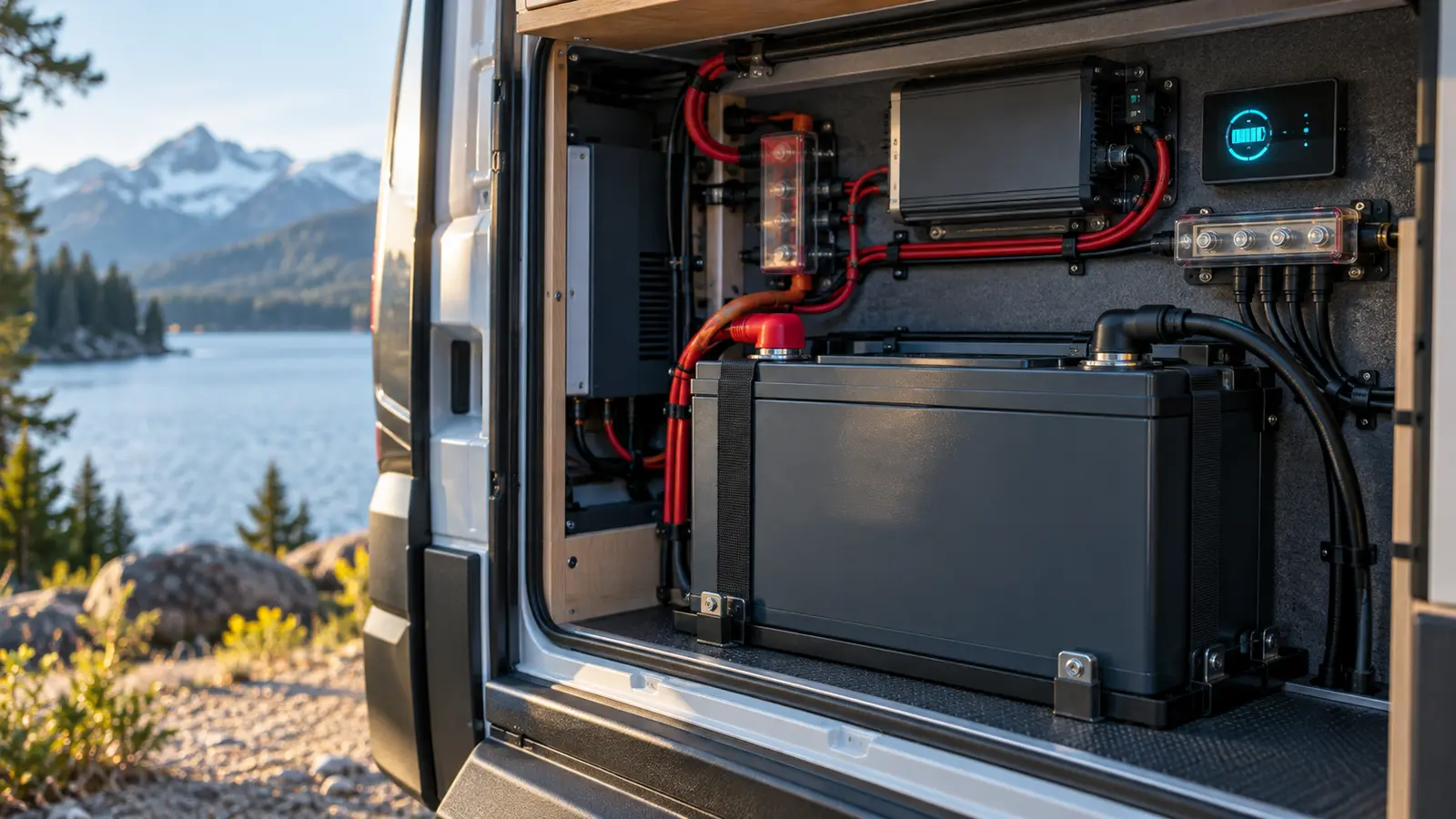
A 100Ah LiFePO4 battery is a useful building block for an RV or camper van because it stores roughly 1.28kWh in a package that one person can usually handle. That does not make every 100Ah battery interchangeable. The battery-management system, low-temperature behavior, physical case, communication features, current limits, warranty support, and charger compatibility can matter more than the amp-hour number printed on the label.
This guide compares current, documented options for different installations. The selections use manufacturer-published specifications available on September 7, 2026; they are not presented as personal bench tests. Prices are omitted because sales and bundles change frequently. Confirm the exact model page, manual, dimensions, terminals, warranty terms, and recall status before ordering.
Quick picks
| Best fit | Battery | Why it stands out |
|---|---|---|
| Best simple drop-in choice | Battle Born BB10012 | Established 12V 100Ah platform with an internal BMS and extensive documentation |
| Best value-oriented compact option | Renogy Core Mini 12.8V 100Ah | Compact case, 100A charge/discharge limits, and a simple feature set |
| Best cold-weather smart option | Renogy 12V 100Ah Pro Smart Heated | Self-heating, Bluetooth monitoring, and additional protection features |
| Best Group 24 fit | Epoch 12V 105Ah Essential | Group 24 case, heating and Bluetooth in a 22.1 lb package |
| Best integrated Victron system battery | Victron Lithium NG 12.8V 100Ah | Cell-level data and system integration when paired with the required compatible BMS |
There is no universal winner. A weekend van with a modest inverter needs a different battery from a four-season RV with a large alternator charger or a fully integrated monitoring system.
What 100Ah actually means
At a nominal 12.8V, a 100Ah LiFePO4 battery stores about:
12.8V x 100Ah = 1,280Wh
That is nameplate energy, not a promise that 1,280Wh will reach an AC appliance. An inverter consumes some power, cables have losses, temperature changes performance, and the BMS may stop discharge at its programmed limit. For planning, separate the battery’s stored energy from the usable energy delivered to a particular device.
A single 100Ah unit is often enough for lights, fans, water pump duty, phone charging, and careful refrigerator use. It can also support a laptop or a small inverter. It is not automatically enough for sustained electric cooking, air conditioning, or a large inverter simply because the BMS can supply a high current for a short period.
How these batteries were evaluated
The shortlist prioritizes criteria that affect an RV installation:
- Published continuous charge and discharge limits
- Low-temperature charge protection or integrated heating
- Physical dimensions, weight, and common battery-group fit
- Internal versus external BMS architecture
- Bluetooth or system-level monitoring
- Series and parallel permissions stated by the manufacturer
- Terminal style and installation orientation
- Documentation, warranty process, and service support
- Published cycle-life conditions rather than a number without context
Cycle-life claims should not be compared unless the end-of-life capacity, depth of discharge, temperature, and test rate are also comparable. A claim of 5,000 cycles to 80% capacity is not the same test as 4,000 cycles to 70%.
Best simple drop-in choice: Battle Born BB10012
Battle Born’s BB10012 is a familiar 12V 100Ah LiFePO4 design intended for RV, marine, and off-grid use. The company publishes a 100Ah rating and a 3,000-to-5,000-cycle range, and it provides a dedicated manual and installation resources.
The appeal is not a long feature list. It is a relatively straightforward battery with an internal BMS, a conventional form factor, and a support ecosystem that has been used in many mobile-power installations. For an owner replacing lead-acid batteries and wanting a documented, self-contained unit, that simplicity is valuable.
Best for
- Owners who want an established drop-in-style 12V battery
- Systems where an internal BMS is preferred
- Installers who value detailed manufacturer documentation
- Mild-weather use or installations with a protected, conditioned battery compartment
Watch before buying
The standard BB10012 should not be confused with Battle Born’s separate smart heated model. Verify which model includes heat and what its charging-temperature behavior is. Also confirm the exact current limits and charger settings in the current manual rather than copying values from an older forum post.
Best value-oriented compact option: Renogy Core Mini 12.8V 100Ah
Renogy’s Core Mini targets installations where space and a simple price-to-capacity proposition matter. The current US product page lists 12.8V, 100Ah, and maximum continuous charge and discharge currents of 100A.
A 100A BMS limit equates to roughly 1,280W at nominal battery voltage before wiring and inverter losses. That does not make it a comfortable match for every 1,200W AC load. Inverter surge, voltage sag, other DC loads, and the charger’s current all need to fit within the battery and bank limits.
Best for
- Compact weekend vans
- Simple 12V loads and moderate inverter use
- Buyers who do not need a heated or heavily networked battery
- Multi-battery banks designed within Renogy’s stated configuration limits
Watch before buying
“Mini” describes the case, not permission to ignore ventilation space, cable bend radius, terminal covers, and service access. Check the exact dimensions of the current SKU. If the van will charge below freezing, choose a model with documented protection or heating and design the compartment accordingly.
Best cold-weather smart option: Renogy 12V 100Ah Pro Smart Heated
The Renogy 100Ah Pro Smart adds self-heating and Bluetooth monitoring to the basic 100Ah format. That makes it more suitable for owners who camp in freezing weather and want battery status on a phone without adding a separate shunt immediately.
Heating is helpful, but it is not magic. An internal heater consumes energy and normally activates only inside a specified temperature and charging range. The charger must be able to supply enough power for the battery’s control logic and heating behavior. Read the activation thresholds and wiring instructions for the exact version.
Best for
- Four-season vans with a realistic sub-freezing charging risk
- Owners who want Bluetooth data for quick checks
- Systems that benefit from the Pro model’s published protection features
- A single-battery installation where visibility is especially useful
Watch before buying
Bluetooth state of charge can be useful, but a battery app does not replace correct system commissioning. Verify charge voltage, alternator-charger settings, fuse selection, cable sizing, and the BMS’s continuous and surge limits. For whole-system energy accounting, a properly installed shunt can still provide a clearer view of all current entering and leaving the bank.
Best Group 24 fit: Epoch 12V 105Ah Essential
Epoch’s 12V 105Ah Essential is slightly above the article’s nominal 100Ah class, but it belongs on the shortlist because it packages 1.34kWh, self-heating, and Bluetooth in a Group 24 case. Epoch lists a weight of 22.1 lb.
Group size is useful when replacing a battery in an existing tray, but it is not the only fit check. Terminal height, hold-down hardware, lid clearance, cable routing, and the manufacturer’s orientation rules still need to be measured.
Best for
- RV owners replacing a Group 24 battery
- Tight compartments where every inch and pound matters
- Cold-weather travelers who want integrated heat
- Owners who want Bluetooth without moving to a fully external BMS architecture
Watch before buying
Confirm the current maximum charge/discharge values and configuration rules in Epoch’s documentation. If two or more batteries will be paralleled, use equal-length interconnects or a busbar layout that promotes balanced current sharing.
Best integrated-system battery: Victron Lithium NG 12.8V 100Ah
Victron’s Lithium NG 12.8V 100Ah is designed as part of a coordinated Victron system. The battery provides cell-voltage and temperature data to a compatible external BMS. Victron lists IP65 protection and supports larger bank architectures within its documented series and parallel limits.
This is not a casual drop-in battery. The required BMS, compatible charging sources, system controls, and communication cabling are part of the design. That added complexity can be worthwhile in a premium installation where chargers, inverter/charger, monitoring, and battery protection are planned as one system.
Best for
- Integrated Victron electrical systems
- Installations where cell-level monitoring matters
- Larger banks with professional design and commissioning
- Owners who value coordinated charger and load control
Watch before buying
Budget for the complete required ecosystem, not just the battery. A Victron Lithium NG battery must not be treated as if it had the same standalone architecture as an internal-BMS drop-in. Follow the current battery and BMS manuals exactly.
Side-by-side decision table
| Battery | Nominal energy | Cold-weather feature | Monitoring | Architecture | Strongest fit |
|---|---|---|---|---|---|
| Battle Born BB10012 | About 1.28kWh | Verify standard versus heated SKU | System-dependent | Internal BMS | Simple documented upgrade |
| Renogy Core Mini | About 1.28kWh | Low-temperature behavior per exact manual | Basic/model-dependent | Internal BMS | Compact value build |
| Renogy Pro Smart Heated | About 1.28kWh | Self-heating | Bluetooth | Internal BMS | Four-season smart setup |
| Epoch Essential 105Ah | About 1.34kWh | Self-heating | Bluetooth | Internal BMS | Group 24 replacement |
| Victron Lithium NG 100Ah | About 1.28kWh | System-controlled per manual | Cell data through compatible BMS | External BMS required | Integrated premium system |
Published features can change between regions and revisions. Treat this table as a shortlist, then verify the exact SKU.
Will one 100Ah battery run an inverter?
Start with the AC load, inverter efficiency, and system voltage. A planning estimate for DC current is:
DC amps = AC watts / (battery voltage x inverter efficiency)
For a 1,000W AC load, 12.8V battery, and an illustrative 90% efficiency:
1,000 / (12.8 x 0.90) = about 87A
That is already close to a 100A continuous BMS limit before other DC loads and startup surge. It also calls for short, correctly sized battery cables and appropriate overcurrent protection. A 2,000W inverter can be attached only when the complete bank, BMS, busbars, cables, fuse, disconnect, and inverter manual support the expected current. Often that means multiple batteries or a higher-voltage system.
Cold-weather charging is a design issue
LiFePO4 charging below the manufacturer’s minimum temperature can damage cells. Solutions include:
- A BMS that blocks charging at low temperature
- A heated battery with documented activation behavior
- A conditioned and insulated battery compartment
- Charger control that stops charge sources when the battery is too cold
Discharging may be allowed at temperatures where charging is not. Do not assume one threshold covers both. Victron’s published Lithium Smart documentation, for example, identifies a default minimum allowed-to-charge temperature of 5°C for that specific product; other brands and models use different limits.
Charging-system compatibility
A lithium upgrade is a system project, not merely a battery swap. Check:
- Alternator charging: A DC-to-DC charger can limit current and apply the intended lithium profile. Direct alternator connections can overwork some alternators or provide poor control.
- Solar controller: Confirm the voltage set points and whether temperature compensation should be disabled for the chosen lithium profile.
- Shore charger or converter: Older lead-acid converters may not reach or hold the recommended profile.
- Inverter/charger: Program bulk, absorption, float, low-voltage shutdown, and charge-current limits using the battery maker’s instructions.
- All-source maximum: Solar, alternator, and shore charging can operate together. Their combined current must remain within the bank’s charge limit.
How to compare warranties without being misled
Read the warranty document, not just the number of years. Look for:
- Whether coverage is full replacement or prorated
- Registration requirements
- Transferability to a second owner
- Exclusions for low-temperature charging, water, overcurrent, or improper installation
- Shipping responsibility and service location
- Required proof of purchase and diagnostic information
A long warranty has limited value if the installation violates the manual or shipping a heavy battery is impractical.
One battery or two?
Two matched 100Ah batteries in parallel provide roughly 2.56kWh of nameplate energy and may share inverter and charging current. That can be more flexible than one 200Ah case because each battery is easier to lift and one can sometimes be isolated for service. The tradeoffs are twice as many terminals, interconnects, BMS units, and opportunities for unequal current sharing.
Use a documented parallel-bank layout. Positive and negative system takeoffs should create equivalent resistance through each battery, or connect through properly rated busbars with equal-length branch cables. Both batteries should be the same approved model, similar age, and at a compatible state of charge before connection. A manufacturer may also limit the total number of parallel batteries.
One 200Ah battery reduces connections and can provide coordinated monitoring, but it is heavier and may be harder to fit or replace. Compare the complete bank architecture rather than assuming two labels are automatically better than one.
Installation checklist
- Secure the battery against vehicle movement in every direction
- Cover positive terminals and protect cables from abrasion
- Place the main fuse close to the battery as required by the design and applicable standard
- Size the fuse to protect the conductor, while remaining within equipment limits
- Use a battery disconnect with the correct DC rating
- Torque terminals to the manufacturer’s value with a calibrated tool
- Support heavy cables so they do not load the terminals
- Confirm cable, lug, busbar, fuse, and switch ratings for expected fault current
- Commission every charger before normal use
- Recheck torque and temperature after initial loaded operation if the manual permits
RV electrical work can create fire, shock, and battery-fault hazards. The exact equipment manuals, applicable code, and a qualified RV electrical professional take priority over a general article.
Frequently asked questions
Is 100Ah of lithium enough for a camper van?
It is enough for many light systems, especially with daily driving or solar recovery. Build a watt-hour budget for the refrigerator, lights, fans, water pump, electronics, and inverter loads. If the daily total approaches the battery’s practical usable energy, add charging margin or more capacity.
Can I replace a 100Ah lead-acid battery with 100Ah LiFePO4?
The lithium battery usually provides more practical usable energy and less weight, but it is not always a direct electrical replacement. Verify the charger, alternator strategy, wiring, fusing, mounting, temperature limits, and battery monitor.
Can I parallel two different 100Ah batteries?
Avoid mixing different models, ages, capacities, or states of health unless the manufacturer explicitly permits it. Use the same approved model and follow its bank-size and wiring instructions.
Do I need a heated battery?
You need a cold-weather plan if the battery may be charged below its permitted temperature. Integrated heat is one solution; controlled charging and a conditioned compartment are others.
How should an old lithium battery be disposed of?
The US Environmental Protection Agency says lithium-ion batteries should not go in household trash or curbside recycling. Isolate the terminals and take the battery to an appropriate separate collection or household hazardous-waste program.
Final recommendation
Choose the BB10012 when simplicity and established documentation lead the decision. Choose the Renogy Core Mini for a compact, straightforward build; the Renogy Pro Smart Heated or Epoch Essential for cold-weather features; and Victron Lithium NG when the entire electrical system is being designed around a compatible external BMS ecosystem.
The best 100Ah LiFePO4 battery is the one whose current limits, low-temperature behavior, architecture, and support match the rest of the van—not the one with the loudest cycle-life number.
Sources
- Battle Born BB10012 product page: https://battlebornbatteries.com/products/100ah-12v-lifepo4-deep-cycle-battery
- Battle Born BB10012 manual: https://battlebornbatteries.com/blogs/product-resources/bb10012-bb1002h-manual
- Renogy Core Mini 100Ah: https://www.renogy.com/products/core-mini-12-8v-100ah-lithium-iron-phosphate-battery
- Renogy Pro Smart Heated 100Ah: https://www.renogy.com/products/12v-100ah-pro-smart-lithium-iron-phosphate-battery-w-bluetooth-self-heating-function
- Epoch 12V 105Ah Essential: https://www.epochbatteries.com/products/12v-105ah-heated-bluetooth-lifepo4
- Victron Lithium NG batteries: https://www.victronenergy.com/batteries/lithium-ng-batteries
- Victron low-temperature guidance: https://www.victronenergy.com/media/pg/Lithium_Battery_Smart/en/installation.html
- EPA used lithium-ion battery guidance: https://www.epa.gov/recycle/used-lithium-ion-batteries
Related guides: LiFePO4 battery basics and van electrical system planning.