
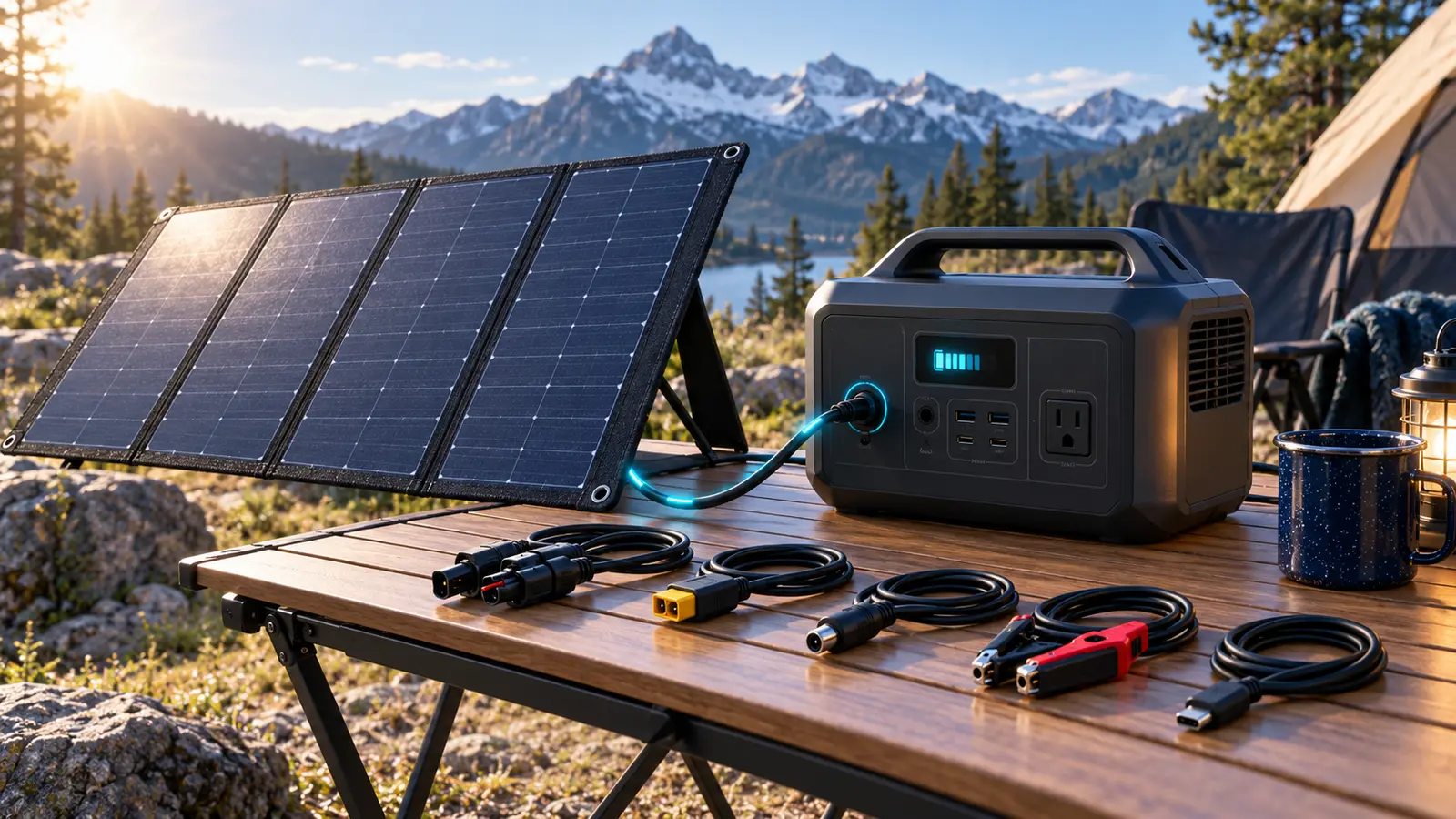
Choosing a solar panel for a portable power station is not a matter of matching brand names or buying the highest wattage that fits the budget. The panel array must remain inside the station’s solar-input voltage, current, and power limits. The connector and polarity must also match, and open-circuit voltage must stay safe on the coldest expected morning.
A plug that physically fits proves only that the plug fits. It does not prove electrical compatibility.
This guide explains the check in a repeatable order. Use the specification label and current manuals for the exact power station, panel, and adapter. Regional models can have different input ports and limits even when the product names appear similar.
solar panel for portable power station: The five checks that decide compatibility
| Check | Panel or array value | Station limit | Rule |
|---|---|---|---|
| Open-circuit voltage | Voc, adjusted for cold | MPPT maximum voltage | Must remain below the maximum |
| Operating voltage | Vmp | MPPT operating range | Should sit inside the range in useful sun |
| Short-circuit/current capability | Isc or Imp | Maximum input current | Understand clipping and connector/cable ratings |
| Array power | Total rated watts | Maximum solar input watts | Extra power may clip; voltage still cannot exceed the limit |
| Connection | Connector, polarity, cable | Input port and approved adapter | Must be mechanically and electrically correct |
Voltage is the hard boundary. Exceeding the station’s maximum input voltage can damage the input stage and may void warranty coverage. Extra available current is handled differently by different controllers, so follow the station manual rather than assuming all MPPT inputs behave alike.
Step 1: Find the station’s complete solar-input specification
Look for a line such as:
Solar input: 11–60V DC, 15A maximum, 500W maximum
Those three numbers answer different questions:
- 11–60V: the voltage window in which the controller can operate, with 60V as an absolute limit unless the manual states otherwise
- 15A maximum: the input-current limit
- 500W maximum: the controller’s maximum accepted solar power
Some stations have two solar ports, two MPPT ranges, or a shared car/solar input. Do not add port ratings unless the manual explicitly allows simultaneous use. Check whether an adapter consumes one input and whether the limits apply per port or to the entire station.
Step 2: Read the panel label
The four important panel values are:
- Voc: open-circuit voltage, measured with no load
- Isc: short-circuit current
- Vmp: voltage at maximum power
- Imp: current at maximum power
Rated power is approximately Vmp multiplied by Imp. A current EcoFlow NextGen 220W portable panel, for example, is published at 220W ±5W, with 21.5V Voc, 12.4A Isc, 18.4V Vmp, and 11.9A Imp. Those numbers—not “220W” alone—determine whether it belongs on a particular input.
Panel ratings are normally measured under standard test conditions. Real output varies with cell temperature, sun angle, shade, dirt, clouds, cable loss, and controller behavior. The US Department of Energy notes that field performance differs from nameplate conditions and is affected by operating temperature and system losses.
Step 3: Adjust open-circuit voltage for cold weather
Solar-panel voltage rises as cell temperature falls. An array that measures safely below the station limit on a warm afternoon can exceed it on a cold, bright morning.
For rigid panels, use the module’s Voc temperature coefficient and the lowest expected cell temperature. A simplified estimate is:
Cold Voc = labeled Voc x [1 + temperature coefficient x degrees below 25°C]
Use the coefficient as a positive magnitude in this planning equation. If a 22V panel has a 0.30%/°C Voc coefficient and the design temperature is -10°C, the change from 25°C is 35°C:
22 x [1 + (0.003 x 35)] = 24.31V
For two identical panels in series, estimated cold Voc becomes 48.62V. That may fit a 60V input but not a 40V input.
If the portable-panel maker does not publish a temperature coefficient, do not invent one. Ask the manufacturer or use a conservative configuration with substantial voltage margin.
Step 4: Understand series and parallel arrays
Panels in series
Series connection adds voltage while current stays approximately the same:
- Two 21.5V Voc, 12.4A Isc panels become about 43V Voc and 12.4A Isc
- Operating voltage also doubles
Series can reduce cable current and help an MPPT controller reach its operating range in weak light. Its main risk is excessive cold-weather Voc. Shade on one panel can also reduce the string, depending on bypass-diode behavior.
Panels in parallel
Parallel connection adds current while voltage stays approximately the same:
- Two 21.5V Voc, 12.4A Isc panels remain about 21.5V Voc but can provide about 24.8A Isc
Parallel can be useful when the station has a low voltage limit and a higher current allowance. It requires appropriate branch connectors and cables, and overcurrent protection may be required for larger arrays. If the array current exceeds the station’s limit, the station may clip, reject, or behave according to its design. The manual decides.
Do not combine mismatched panels casually
Different Vmp, Imp, chemistry, orientation, or shade conditions can waste output and complicate protection. Use identical panels when building a series or parallel portable array unless the equipment maker documents another arrangement.
Step 5: Check connector, polarity, and adapter rating
Common panel-side connectors include locking MC4-style connectors. Power stations may use XT60/XT60i, Anderson-style, DC barrel, aviation, or proprietary inputs. Names are not enough; barrel connectors with similar diameters can have different pin sizes or polarity.
Verify:
- Exact connector series and gender
- Positive and negative polarity
- Adapter voltage and current rating
- Cable wire size and length
- Whether the adapter is approved for the station
- Whether the station distinguishes car and solar inputs through a coded connector
Never reverse polarity “just to test.” Do not cut a cable while it is connected to an illuminated panel. A covered panel can still produce voltage, so follow safe-disconnection practices in the manuals.
Worked example: matching a 220W portable panel
Suppose a panel is rated:
- 220W
- Voc 21.5V
- Isc 12.4A
- Vmp 18.4V
- Imp 11.9A
The hypothetical station accepts 11–60V, 15A, and 500W.
One panel
One panel fits the voltage window, remains below the current limit, and is below the power limit. The connector still needs verification.
Two panels in series
Nameplate Voc is 43V and Vmp is 36.8V. Current remains 12.4A Isc. The configuration appears compatible at standard conditions, but cold Voc must be calculated. If adjusted Voc remains below 60V with a conservative margin, series may work.
Two panels in parallel
Voltage stays at 21.5V Voc, while Isc can reach about 24.8A. That exceeds the stated 15A input limit. Whether the station safely clips available current is product-specific. Without explicit manufacturer approval, series is the clearer candidate in this example.
Can you use a higher-wattage panel than the station rating?
Sometimes. “Overpaneling” means connecting an array whose rated watts exceed the controller’s maximum accepted power while keeping voltage and current behavior within documented limits. It can improve morning, winter, or cloudy output because panels rarely remain at nameplate power.
However, overpaneling is not permission to exceed voltage. It may also be prohibited by warranty terms or limited by the input’s short-circuit current rating. Get a clear answer from the power-station manufacturer for the exact model.
Realistic solar charging time
The common calculation is:
Solar charge hours = energy to replace / average power reaching the battery
If a 1,024Wh station needs 800Wh and the panel averages 150W into the station:
800Wh / 150W = 5.3 hours
That is 5.3 hours of equivalent output at the average—not simply 5.3 clock hours after sunrise. Charging slows near full on some systems, and the station may consume power while operating.
For daily planning:
Daily solar Wh = panel watts x peak-sun-hours x system factor
A 220W panel, four peak-sun-hours, and a 0.75 planning factor estimates:
220 x 4 x 0.75 = 660Wh per day
The 0.75 factor is an assumption, not a universal efficiency. Use measured results for the actual campsite when possible.
Shade matters more than many buyers expect
A narrow shadow across cells can reduce output disproportionately. Portable panels make repositioning easier, but they also move in wind and are often placed near trees, vehicles, chairs, or roof racks.
For useful output:
- Face the panel toward the sun and adjust it during the day
- Keep every section of a folding panel evenly illuminated
- Avoid casting a cable or handle shadow across cells
- Keep the surface reasonably clean
- Allow air behind the panel; hotter cells generally produce less voltage and power
- Secure the panel against wind without blocking airflow
Brand-matching versus third-party panels
A same-brand panel usually reduces connector uncertainty and gives the manufacturer a tested pairing. A third-party panel can be equally suitable when every electrical limit and connector detail is verified.
The case for same-brand equipment is convenience and support, not special electricity. The case for third-party panels is a wider choice of size, construction, weight, and cost. Keep screenshots or manuals showing compatibility at the time of purchase, especially if an adapter is involved.
Portable panel examples and what their labels teach
| Panel | Published key values | Compatibility lesson |
|---|---|---|
| EcoFlow NextGen 220W | 21.5V Voc, 12.4A Isc, 18.4V Vmp, 11.9A Imp | Current may be close to compact-station limits |
| Anker SOLIX PS200 bifacial | 200W; published 48V and 4.16A | Higher-voltage panels need careful maximum-voltage checks |
| Jackery SolarSaga 100 | Regional page lists 21.6V Voc, 6A Isc, 18V Vmp | Lower-current 100W class can be easier on compact inputs |
| Goal Zero Nomad 200 | High Power Port output published at 14–23V, up to 14A | Proprietary ecosystem/adapter details matter |
These values are examples from current official regional pages. Product revisions can differ. Use the label on the panel you will actually connect.
Compatibility checklist
- Photograph the station’s input label and model number.
- Download the current power-station manual.
- Record each MPPT input’s voltage range, maximum voltage, current, and watts.
- Record panel Voc, Isc, Vmp, Imp, and temperature coefficient.
- Calculate series Voc at the lowest design temperature.
- Calculate parallel current and check branch hardware.
- Confirm connector type, polarity, adapter, and cable rating.
- Check series/parallel and overpaneling permission in writing.
- Keep the array below every hard limit.
- Test first in good conditions while monitoring the station for errors, heat, or unstable input.
Common compatibility mistakes
- Matching only total watts
- Treating the MPPT operating maximum as a suggestion
- Using warm-weather Voc for a freezing climate
- Adding two ports together when the manual states a shared limit
- Buying a barrel adapter by appearance
- Reversing polarity
- Assuming an automotive connector can carry a panel’s full current
- Mixing panel models in one string
- Expecting nameplate output in shade or high heat
- Leaving a portable panel unsecured in wind or rain
Frequently asked questions
Can any solar panel charge any portable power station?
No. The panel or array must fit the station’s voltage, current, power, connector, and polarity requirements. Some stations also require a specific adapter or communication-coded cable.
Is a 200W panel too large for a 100W solar input?
It may be usable only if the manufacturer explicitly allows the available current/power and the array remains within voltage and short-circuit-current limits. The station will not accept more than its controller can process.
Can I connect solar panels while the station is powering appliances?
Many stations allow simultaneous charging and discharging, but total heat, bypass behavior, and port limits vary. Follow the manual and keep ventilation clear.
Why does a 200W panel produce only 130W?
Sun angle, clouds, cell temperature, shade, dirt, cable loss, controller limits, and battery state can all reduce input. Nameplate power is measured under defined test conditions, not promised in every campsite.
Is series or parallel better?
Neither is universally better. Series raises voltage and parallel raises current. Choose the layout that remains inside the station’s documented limits under the coldest and brightest expected conditions.
Bottom line
Start with the power station’s input specification, not the panel’s marketing headline. Check cold-adjusted Voc first, then operating voltage, array current, total watts, connector, polarity, and cable. When any limit is unclear, ask the station manufacturer for written compatibility guidance before connecting the array.
Sources
- EcoFlow NextGen 220W solar panel: https://www.ecoflow.com/us/new-220w-solar-panel
- EcoFlow 220W panel manual: https://manuals.ecoflow.com/us/product/new-220w-solar-panel?lang=en_US
- Anker 200W solar-panel compatibility guidance: https://www.anker.com/collections/200-watt-solar-panel
- Anker SOLIX PS200 published specifications: https://www.anker.com/ca/products/a24321a1
- Jackery guide to solar-panel specifications: https://www.jackery.com/blogs/knowledge/solar-panel-specifications
- Jackery SolarSaga 100 regional specifications: https://my.jackery.com/solar-panels/solarsaga-100w-solar-panel
- Goal Zero Nomad 200: https://goalzero.com/products/nomad-200-solar-panel
- Renogy series and parallel guide: https://www.renogy.com/blogs/learn-center/learn-series-and-parallel
- US Department of Energy PV performance guide: https://www.energy.gov/sites/default/files/2022-02/understanding-solar-photo-voltaic-system-performance.pdf
Related guides: how solar generators work and solar-generator sizing.
A solar panel for portable power station charging is compatible only when voltage, current, connector, and array layout remain within the station input limits.