
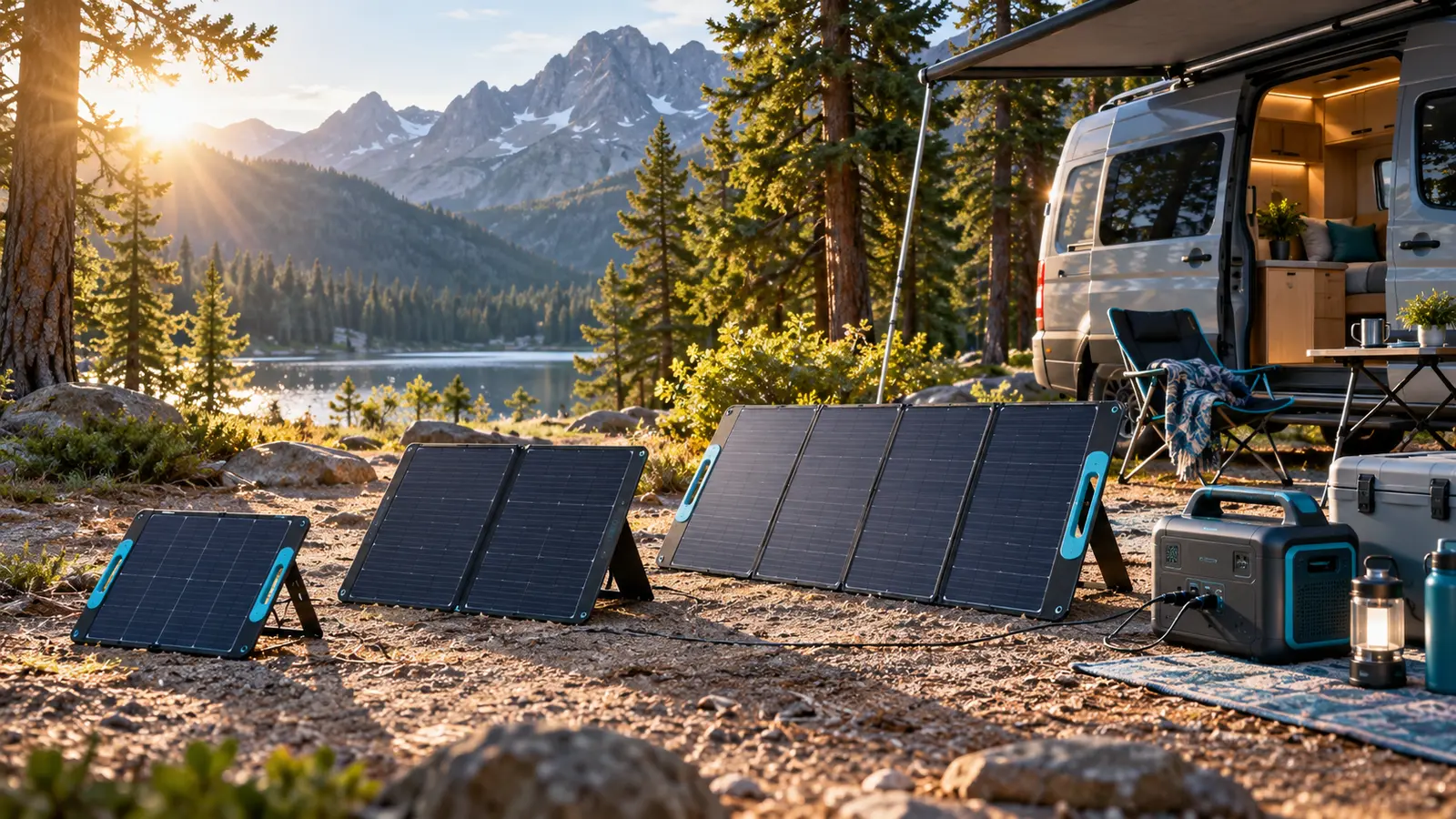
The best portable solar panels for camping are easy to carry, quick to aim, and electrically compatible with the battery or power station they charge. Rated watts matter, but so do open-circuit voltage, current, connector, folded dimensions, support legs, cable reach, wind stability, and weather rating.
This comparison uses manufacturer-published specifications available on September 7, 2026. It is a specification-based buying guide, not a claim that every panel was personally tested. Prices are omitted because discounting and panel bundles change quickly. Verify the exact regional SKU and current manual before buying.
best portable solar panels for camping: Quick picks
| Camping need | Recommended panel | Published reason |
|---|---|---|
| Best light-duty travel panel | Jackery SolarSaga 100 | 100W class, about 10.33 lb on the cited regional page, simple folding format |
| Best all-around 200W-class panel | EcoFlow NextGen 220W | 220W rating, 15.9 lb, IP68, documented electrical values |
| Best lighter 200W-class option | Renogy E.Flex 200 | 200W, about 13.89 lb, published 18.8V Vmp and 10.6A Imp |
| Best high-voltage 200W option | Anker SOLIX PS200 bifacial | 200W, 48V/4.16A published output, 10.6 lb, IP68 |
| Best robust ecosystem panel | Goal Zero Nomad 200 | 200W, 22 lb, 14–23V output range, established High Power Port ecosystem |
These panels do not belong on one simple performance ladder. The correct choice depends first on the receiving controller’s voltage and current limits.
How the panels were evaluated
- Rated watts and published Voc, Isc, Vmp, and Imp
- Folded and deployed size
- Carry weight
- Weather-resistance rating and connector exposure
- Kickstand and angle-adjustment design
- Cable and adapter requirements
- Compatibility with common power-station input ranges
- Manufacturer documentation and replacement-accessory support
- Practical watt-per-pound tradeoff
No panel earns a recommendation solely because it matches the brand of a power station. Same-brand bundles are convenient, but electrical specifications still control compatibility.
Best light-duty travel panel: Jackery SolarSaga 100
The SolarSaga 100 is suited to campers who prioritize a manageable folded panel over the fastest recharge. Jackery’s cited regional specification lists 100W rated power, 18V Vmp, 5.55A Imp, 21.6V Voc, 6A Isc, a weight of 10.33 lb, and IP65 protection.
At 100W, the panel is realistic for phones, cameras, lights, compact stations, and topping up during longer sunny days. It is less convincing as the only panel for a 1,500Wh or 2,000Wh power station unless daily consumption is low.
Best for
- Solo or weekend car camping
- Compact 300–700Wh power stations
- Lower current solar inputs
- Campers who value quick setup over maximum daily harvest
Limitations
A 100W nameplate does not mean 100W all day. Four peak-sun-hours and a 0.75 planning factor equal about 300Wh/day. Connector and cable details can differ by market or bundle, so confirm the panel supplied for the intended station.
Best all-around 200W-class panel: EcoFlow NextGen 220W
EcoFlow publishes unusually complete electrical data for its current NextGen 220W portable panel: 220W ±5W, 21.5V Voc, 12.4A Isc, 18.4V Vmp, and 11.9A Imp. The panel weighs approximately 15.9 lb and carries an IP68 rating.
That makes it a useful choice for car campers who need meaningful daily energy without moving to multiple rigid modules. Its current is high enough that it must be checked carefully against compact power stations. A station limited to 8A or 10A may clip or reject the panel depending on its design.
Best for
- 700–2,000Wh stations with compatible MPPT input
- Car camping and van trips where 16 lb is manageable
- Campers who want a published IP rating
- A one-panel system that can produce several hundred watt-hours in a good day
Limitations
IP68 does not make connected plugs, adapters, or the power station equally weatherproof. Keep the station and connections dry as required. The panel’s 12.4A Isc may exceed the input-current limit of some small stations.
Best lighter 200W-class option: Renogy E.Flex 200
Renogy’s E.Flex 200 regional page lists 200W, 21.6V Voc, 11.3A Isc, 18.8V Vmp, 10.6A Imp, approximately 13.89 lb, and IP65 protection. That is a useful power-to-weight balance for car camping.
The electrical profile resembles many nominal-12V folding panels, making it easier to pair with a broad range of MPPT inputs than some high-voltage portable designs. “Easier” does not mean automatic: check maximum current, connector, and polarity.
Best for
- Campers who want roughly 200W under 14 lb
- Power stations with compatible lower-voltage MPPT inputs
- Frequent repositioning during the day
- Moderate daily energy budgets
Limitations
The cited specifications come from an official regional page, so US connector and bundle details should be verified. IP65 does not imply safe immersion or permission to leave the system exposed indefinitely.
Best high-voltage 200W option: Anker SOLIX PS200 bifacial
Anker’s Canadian product page publishes 200W and 48V at 4.16A, with a 10.6 lb weight and IP68 rating. That high-voltage, lower-current profile is materially different from a typical 18–20V portable panel.
Higher voltage can reduce current-related cable loss and may suit stations with a wide solar-input window. It can also exceed the maximum voltage of a compact station. This panel belongs only with an input that explicitly accepts its voltage, including cold-weather margin.
The bifacial design can collect some light from the rear when the ground and setup allow it. Treat any bifacial gain as a site-dependent bonus, not guaranteed energy.
Best for
- Wide-voltage MPPT inputs
- Campers who want low carry weight in the 200W class
- Bright sites with reflective ground and a layout that exposes the rear surface
- Anker systems that list the exact panel as compatible
Limitations
Do not connect it to a low-voltage input merely because an adapter exists. Verify the exact regional model, output architecture, cable, connector, and station input. Foldable bifacial performance depends strongly on orientation and rear exposure.
Best robust ecosystem panel: Goal Zero Nomad 200
Goal Zero lists the Nomad 200 at 200W, 22 lb, and 28.2 x 22.3 x 2 inches folded. The High Power Port output is published at 14–23V with up to 14A.
The Nomad makes sense for base-camp users already invested in Goal Zero cabling and stations, or buyers who value the established folding-panel platform more than low weight. At 22 lb, it is the heaviest recommendation here.
Best for
- Vehicle-supported camps
- Goal Zero power-station owners
- Frequent base-camp setups where carry distance is short
- Users who prefer an established cable ecosystem
Limitations
Its current capability and proprietary connection path need to match the receiving device or approved adapter. The weight is difficult to justify for hikers or campers who move the panel repeatedly over long distances.
Published specification comparison
| Panel | Rated power | Published voltage/current | Weight | Weather rating |
|---|---|---|---|---|
| Jackery SolarSaga 100 | 100W | 21.6V Voc; 6A Isc | 10.33 lb | IP65 |
| EcoFlow NextGen 220W | 220W | 21.5V Voc; 12.4A Isc; 18.4V Vmp; 11.9A Imp | 15.9 lb | IP68 |
| Renogy E.Flex 200 | 200W | 21.6V Voc; 11.3A Isc; 18.8V Vmp; 10.6A Imp | 13.89 lb | IP65 |
| Anker SOLIX PS200 bifacial | 200W | 48V; 4.16A published output | 10.6 lb | IP68 |
| Goal Zero Nomad 200 | 200W | 14–23V; up to 14A | 22 lb | Verify manual |
Values are drawn from the cited official pages. Regional variants and later revisions can differ.
How many watts do you need?
Match the panel to daily energy, not the station’s battery capacity alone.
| Camping setup | Illustrative daily use | Sensible portable array class |
|---|---|---|
| Phones, camera, lights | 100–250Wh | 100W |
| Laptop, lights, fan | 300–500Wh | 150–220W |
| 12V fridge plus electronics | 500–900Wh | 200–400W |
| Larger base camp | 900Wh and above | 400W+ or multiple charging sources |
Use this planning formula:
Daily solar Wh = panel watts x peak-sun-hours x system factor
With four peak-sun-hours and a 0.75 factor:
- 100W panel: 300Wh/day
- 200W panel: 600Wh/day
- 220W panel: 660Wh/day
- 400W array: 1,200Wh/day
The factor includes a planning allowance for heat, angle, controller and cable loss, and imperfect conditions. Actual results may be higher or much lower.
Compatibility comes before brand
For every panel and station pairing, verify:
- Cold-adjusted panel or string Voc remains below maximum input voltage.
- Vmp falls inside the station’s MPPT range.
- Array current is allowed by the controller and cabling.
- Total watts do not violate manufacturer limits.
- Connector and polarity are correct.
- Series or parallel arrangement is approved.
Portable power stations sometimes share a port between automotive and solar charging. A coded connector or specific adapter may tell the station which mode to use. Use the approved cable.
Folding panels versus portable suitcases
Fabric-backed folding panels
They are thin, comparatively light, and easy to store behind a seat. Their many folds and flexible supports can be awkward in wind. Avoid carrying them by the output cable or closing them with dirt trapped against the cells.
Rigid solar suitcases
Two rigid framed modules joined by hinges are heavier but often easier to stand securely and cool from the rear. Some suitcase kits include a charge controller intended for direct battery charging. That controller may need to be bypassed—not double-stacked—when connecting to a power station with its own MPPT. Follow both manuals.
Portable does not mean backpackable
A 20-pound panel plus a 25-pound power station is a vehicle system. For foot travel, watt-hours carried per pound and the available charging time matter more than maximum power.
Weather ratings in plain language
An IP rating applies to the tested enclosure under defined conditions. It may not cover open connectors, adapters, cable junctions, fabric pockets, or another device in the system.
- Keep the power station in a dry, ventilated place.
- Elevate connections from wet ground.
- Do not connect or disconnect wet plugs.
- Dry and inspect the panel before folding for storage.
- Follow wind limits even when water resistance is strong.
Set up for more real energy
- Choose an unshaded location for the full charging window.
- Aim the panel toward the sun and adjust it around midday.
- Keep folding sections in the same plane unless the design says otherwise.
- Provide rear airflow to reduce cell temperature.
- Keep the cable run as short as practical.
- Secure the frame or kickstand against gusts.
- Wipe dust with the method allowed in the manual.
- Monitor input watts to identify shade or connector problems.
Do not place the panel where vehicles will cross its cable or where campers will trip on it. Do not shade the cells with rocks used as weights.
When a rigid roof panel is better
A portable panel is not automatically the best solar panel for every camper. A roof panel charges while parked briefly and is less likely to be forgotten. It may run hotter, be shaded by roof equipment, and cannot be moved into sun when the van is parked in shade.
Many vans benefit from both: a permanent roof array for daily recovery and a portable panel for longer stops. The controller architecture and total array voltage/current still need a proper design.
Durability details to inspect in person
Portable panels are unfolded, dragged, leaned, and repacked far more often than roof modules. Inspect the parts that marketing photos hide:
- Stitching and reinforcement around carry handles
- Hinge or fold lines that repeatedly flex
- Strain relief where the output cable leaves the panel
- Connector caps and storage pockets
- Kickstand attachment and adjustment points
- Edge protection around cell laminates
- Latches or magnets that keep the panel closed
- Clearance that prevents connectors from pressing into cells when folded
After each trip, look for cloudy laminate, deep creases, loose junction boxes, cracked connectors, hot discoloration, or cells that no longer lie flat. Stop using a panel with electrical damage. Store it clean and dry without heavy cargo on top.
How to compare value without using sale price alone
Calculate cost per usable camping watt only after compatibility. A cheaper 220W panel is poor value if the station clips it to 100W or if its folded size prevents regular use. Consider warranty shipping, adapter cost, cable extensions, setup time, and pounds carried.
For two compatible choices, estimate energy per travel day under the same assumptions. A 200W panel deployed for five useful hours may beat a 300W panel that is too awkward to unpack during lunch stops. Convenience is part of system output because equipment produces nothing while stored.
Also compare replacement cables and adapters. A lost proprietary lead can disable an otherwise excellent panel halfway through a trip, while a documented, readily available connector can be replaced locally. Carry caps and store the charging lead with the panel rather than loose in the van.
Buying checklist
- Calculate daily energy use in watt-hours.
- Choose a panel class that can replace that energy in local sun.
- Confirm station voltage, current, watt, connector, and polarity limits.
- Compare pounds and folded dimensions, not watts alone.
- Check deployed footprint and kickstand angle range.
- Read the IP rating and connector-weather instructions.
- Confirm cable length reaches a shaded, dry power-station location.
- Check regional warranty and service.
- Search for the exact model’s current manual and recall information.
- Inspect every connector and cell surface when the panel arrives.
Frequently asked questions
Is 100W enough for camping?
It can be enough for phones, cameras, lights, and a compact station. It is often undersized for a refrigerator plus laptop use unless energy consumption is low and sun is strong.
Is a 200W panel twice as fast as a 100W panel?
Only when the receiving device can accept the extra power and both panels experience similar conditions. Controller limits, shade, heat, angle, and battery state can narrow the difference.
Can a portable panel stay outside in rain?
Only within the exact manual and IP-rating limits. The power station and connectors may have lower protection than the panel. A rating is not permission to ignore weather or submerge equipment.
Are bifacial panels better for camping?
They can harvest rear-side light when elevated over reflective ground. If the rear is blocked or the site is dark, the gain may be small. Choose primarily from electrical compatibility and the front-side rating.
Can I use a different brand panel with my power station?
Usually, if voltage, current, wattage, connector, polarity, and cable requirements all match. Obtain written manufacturer confirmation when the manual is unclear.
Final recommendation
Choose the SolarSaga 100 for light daily demand, the EcoFlow NextGen 220W for a strong all-around specification set, the Renogy E.Flex 200 for a lighter lower-voltage option, the Anker PS200 when a compatible wide-voltage input suits its design, and the Nomad 200 for a vehicle-supported Goal Zero setup.
The right panel is the one that fits the station electrically and the trip physically. A perfectly compatible 200W panel that is easy to deploy will usually produce more useful energy than a cumbersome array left folded in the van.
Recheck those limits whenever either the panel or power station is replaced.
Sources
- Jackery SolarSaga 100 regional product page: https://my.jackery.com/solar-panels/solarsaga-100w-solar-panel
- EcoFlow NextGen 220W: https://www.ecoflow.com/us/new-220w-solar-panel
- EcoFlow NextGen 220W manual: https://manuals.ecoflow.com/us/product/new-220w-solar-panel?lang=en_US
- Renogy E.Flex 200 regional product page: https://au.renogy.com/products/renogy-200w-portable-solar-panel
- Anker SOLIX PS200 bifacial regional page: https://www.anker.com/ca/products/a24321a1
- Goal Zero Nomad 200: https://goalzero.com/products/nomad-200-solar-panel
- US Department of Energy PV performance guide: https://www.energy.gov/sites/default/files/2022-02/understanding-solar-photo-voltaic-system-performance.pdf
Related guides: solar-generator fundamentals and camping power stations.
The best portable solar panels for camping must fit the power station input limits, expected sunlight, carrying weight, setup space, and weather conditions.