
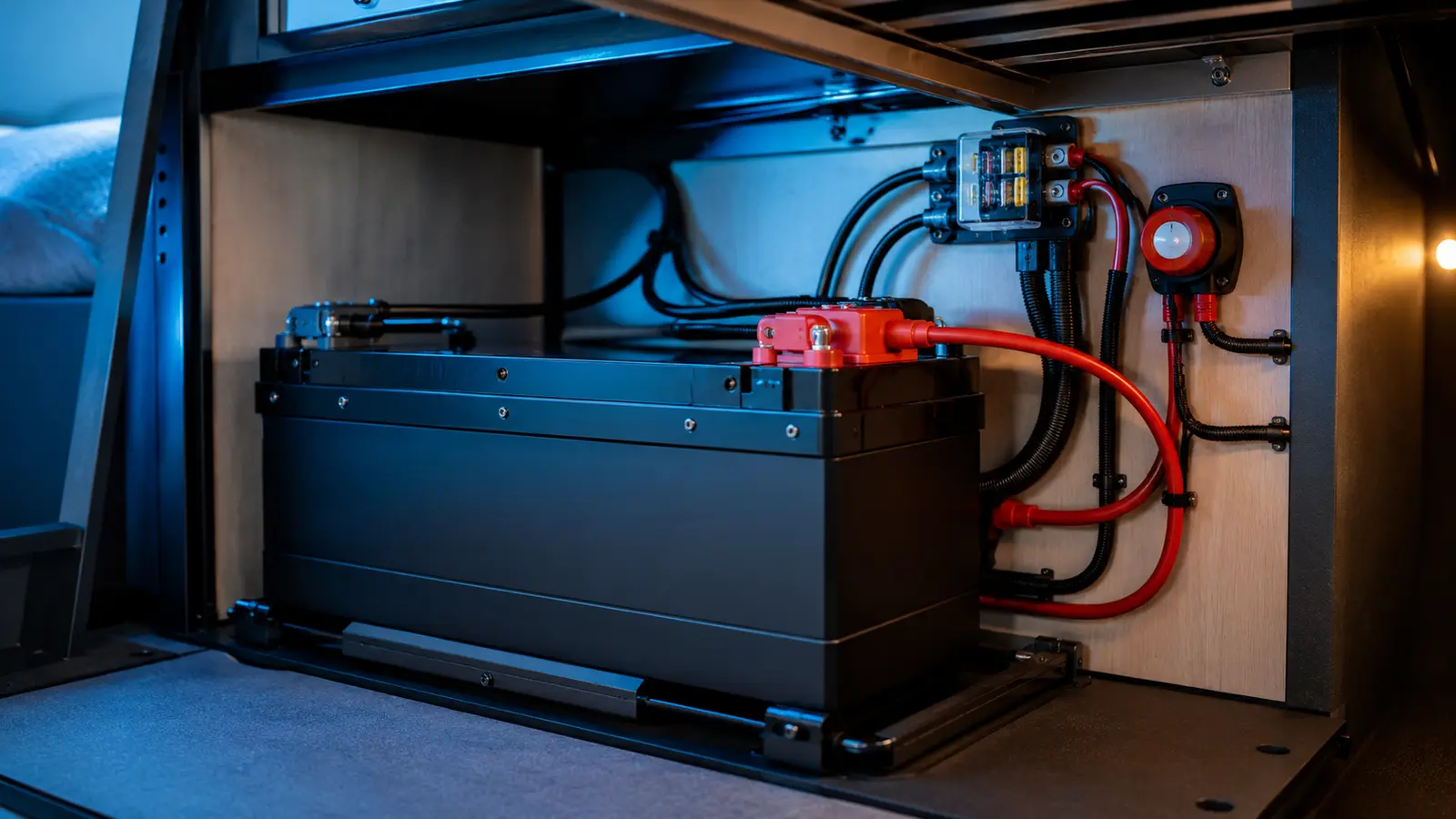
A LiFePO4 battery is a rechargeable lithium-ion battery that uses lithium iron phosphate as its positive-electrode material. The name is an abbreviation of its chemical formula. You may also see the same chemistry called LFP.
In camper vans and RVs, LiFePO4 batteries are commonly used as house batteries because they can deliver a relatively stable voltage, accept efficient charging, and provide many cycles when operated within the manufacturer’s limits. They are not automatic drop-in replacements for every lead-acid battery. Charging equipment, low-temperature behavior, current limits, wiring, protection, and system configuration all need to be checked.
lifepo4 basics: Key takeaways
- A typical LFP cell has a nominal voltage around 3.2V; four in series form a nominal 12.8V battery.
- The battery management system is essential, but it does not replace external fuses, correct cabling, or compatible chargers.
- Watt-hours—not amp-hours alone—make battery-energy comparisons clearer.
- Low-temperature charging limits are product-specific and must be respected.
- Cycle-life claims are meaningful only when depth of discharge, temperature, current, and end-of-life capacity are stated.
- At end of life, lithium-ion batteries require separate recycling or hazardous-waste collection.
How a LiFePO4 battery works
Like other rechargeable batteries, an LFP battery stores energy through reversible electrochemical reactions. The U.S. Department of Energy explains that ions move between electrodes through the electrolyte while electrons travel through the external circuit. Charging stores electrical energy as chemical potential; discharging releases it to the connected load.
A nominal 12V-class LiFePO4 battery is normally made from four 3.2V-class cells in series:
4 cells × 3.2V nominal = 12.8V nominal
That nominal voltage is a category value, not a fixed reading. Actual terminal voltage changes with state of charge, current, temperature, cell design, and whether a charger is active.
Many products place cells, a battery management system, terminals, and sometimes heaters or communications electronics inside one case. Others use an external battery management system. Read the wiring architecture for the exact battery; “built-in BMS” does not tell you its current rating, cold-charge behavior, communications support, or fault-reset procedure.
What does the battery management system do?
The battery management system, or BMS, monitors cell and pack conditions and can interrupt charging or discharging when a limit is crossed. Depending on the product, it may protect against high cell voltage, low cell voltage, excessive current, short circuit, and temperature outside an allowed range. It may also balance cells and report information to a display or charger.
The BMS is the final protective layer inside the battery, not a substitute for good system design. External conductors still need overcurrent protection. The inverter and chargers still need correct settings. A BMS shutdown under heavy load is not a normal control strategy; it is evidence that the load, state of charge, temperature, or system design has reached a limit.
When batteries are connected in parallel, the combined energy capacity may increase, but the approved bank size, cable arrangement, fuse method, communications, and current sharing remain manufacturer-specific. Never assume two batteries with similar labels can be mixed.
LiFePO4 voltage, amp-hours, and watt-hours
Amp-hours describe charge capacity. Watt-hours describe nominal energy and allow batteries of different voltages to be compared.
Watt-hours = nominal volts × amp-hours
A 12.8V, 100Ah LFP battery therefore contains:
12.8V × 100Ah = 1,280Wh nominal
That 1,280Wh is not a guaranteed amount at an AC outlet. The battery’s permitted discharge range, temperature, current, wiring loss, inverter efficiency, and low-voltage cutoff determine usable delivered energy.
This distinction matters when comparing a “100Ah” 12V-class battery with a 100Ah 24V-class battery. The second stores approximately twice the nominal energy because its voltage is about twice as high.
Why LiFePO4 is popular in vans and RVs
Useful voltage behavior
LFP batteries hold a relatively flat operating voltage through much of the discharge. Appliances and inverters can receive a steadier supply than they might from a lead-acid battery under a similar load. The same flat curve also means voltage alone is a poor state-of-charge gauge for much of the cycle; a properly configured shunt-based battery monitor is more informative.
Cycle life
Reputable manufacturers often publish cycle-life data in the thousands, but the test conditions matter. Depth of discharge, temperature, charge and discharge rates, storage, and the remaining-capacity threshold all influence the number.
For a concrete manufacturer-specific example, Victron’s published technical data for its 12.8V Lithium Battery Smart line lists at least 2,500 cycles at 80% depth of discharge, 3,000 cycles at 70%, and 5,000 cycles at 50%, measured to an 80% capacity threshold. Those figures describe that product and those conditions; they should not be applied to every LFP battery.
Charging efficiency
LFP can return a high proportion of the energy used to charge it. The same Victron technical sheet lists 92% round-trip efficiency for its product. Actual system efficiency will be lower after charge-controller, cable, inverter, and standby losses are included.
Space and weight
LFP systems can provide more usable energy for a given size and weight than many lead-acid arrangements. Exact comparisons vary greatly with battery construction, enclosure, BMS, heating, and the lead-acid type. Compare datasheets in watt-hours, pounds, dimensions, current rating, and permitted discharge—not from chemistry labels alone.
Important limitations
Low-temperature charging
Cold charging is one of the most important LFP constraints. Charging below the manufacturer’s minimum can permanently damage cells. The threshold is not the same for every product.
Victron, for example, specifies a +5°C to +50°C charging range for the referenced Lithium Battery Smart models and warns that charging below +5°C can cause permanent damage. Other batteries may use a 0°C limit, internal heating, or a BMS-controlled charge cutoff. Follow the exact datasheet and confirm how every charger behaves when the battery is cold.
Discharging is often allowed at lower temperatures than charging, but capacity falls in the cold. The same Victron 100Ah-class data lists 80Ah at 0°C and 50Ah at -20°C for its test conditions. Again, this is a product example, not a universal LFP curve.
If the van will freeze, plan battery placement, insulation, approved heating, temperature sensing, and charger control as one system. A heater consumes energy and must be wired and controlled according to its manual.
High-current limits
An LFP battery may hold enough energy for an appliance but still be unable to supply its current. Check the BMS continuous limit, peak-current duration, terminal rating, and parallel-bank rules.
For example, a 1,500W AC load through a 90%-efficient inverter would require roughly 139A at a 12V battery voltage:
1,500W ÷ 0.90 ÷ 12V ≈ 139A
A battery with a 100A continuous BMS limit would not be an appropriate single source for that planned load, even if the watt-hour capacity looked sufficient.
Charger compatibility
LiFePO4 charging profiles differ from lead-acid profiles. Equalization modes intended for flooded batteries can be inappropriate. Verify absorption voltage, float behavior, charge current, temperature compensation, restart behavior after BMS shutdown, and communications requirements for every solar, alternator, and shore charger.
“Lithium mode” is not enough information by itself because lithium chemistries and battery instructions differ. Program the equipment from the battery maker’s published values.
Upfront cost and repairability
LFP batteries often cost more at purchase than basic lead-acid batteries. A fair comparison should account for usable energy, expected cycles under stated conditions, charger changes, cold-weather equipment, warranty, and service options. A sealed battery with proprietary electronics may be difficult to repair even if the cells remain healthy.
LiFePO4 versus lead-acid
| Question | LiFePO4 | Lead-acid |
|---|---|---|
| Voltage under load | Relatively flat through much of discharge | Usually declines more noticeably with discharge and load |
| Cycle-life potential | Often high when operated within published limits | Varies widely by type and depth of discharge |
| Charging in freezing conditions | Commonly restricted; product-specific protection required | Some types can accept reduced charging below freezing under manufacturer guidance |
| State-of-charge from voltage | Difficult through the flat middle of the curve | Voltage offers more information after proper rest, though still imperfect |
| Maintenance | Sealed systems can be low-maintenance | Flooded types require more maintenance; AGM is sealed |
| Upfront price | Often higher | Often lower for basic options |
Avoid the slogan that every lead-acid battery has “only 50% usable capacity.” Permitted depth of discharge depends on battery type, target life, discharge rate, temperature, and manufacturer guidance. The sound comparison uses published performance at the same delivered-energy requirement and operating conditions.
How to size an LFP battery for a van
Start with a daily load audit in watt-hours. Then choose how many days the van must operate between reliable charging opportunities.
Suppose the daily total is 900Wh and the design should cover two days:
900Wh × 2 = 1,800Wh required at the loads
Next, allow for conversion loss, battery operating limits, temperature, and reserve. If much of the energy passes through an inverter, use documented inverter efficiency at the expected loads rather than a headline peak-efficiency number.
Finally, check power. List the loads that can operate at the same time and calculate battery current. Capacity determines how long the battery can run them; current rating determines whether it can run them at all.
The van electrical system beginner guide shows how this battery calculation connects to the inverter, solar controller, DC-to-DC charger, distribution, cable sizing, and overcurrent protection.
Before purchase, compare:
- Nominal watt-hours and permitted depth of discharge
- BMS continuous and surge current
- Maximum charge current
- Charge and discharge temperature ranges
- Low-temperature cutoff or heater behavior
- Series and parallel approval
- Terminal type and torque
- Required fuse, cable, and disconnect
- Communication compatibility with inverter and chargers
- Cycle-life test conditions
- Warranty, service path, and certifications
Installation and safety
Mount the battery securely and protect it from cargo, water, direct heat, and conductive objects. Provide the orientation and clearances required by the manual. Cover positive terminals and keep tools from bridging them.
A main fuse or suitable overcurrent device protects downstream conductors from battery fault current. Its type, interrupt rating, location, and size must match the battery system and cable. The BMS does not remove this requirement.
Use cables and lugs sized for current, length, installation conditions, and voltage drop. Follow specified crimping and torque procedures. Loose or poorly made high-current connections create resistance and heat.
If the battery has been deeply discharged or the BMS has opened, use the manufacturer’s documented recovery process. Do not jump around protection or apply an unknown charger to force a restart.
Stop using a battery that is physically damaged, swollen, leaking, unusually hot, smoking, hissing, or producing a new odor. Keep away and contact emergency services when there is a fire risk. Do not open a sealed enclosure unless the manufacturer provides an authorized service procedure.
Storage and end of life
Follow the manufacturer’s storage state-of-charge, temperature, inspection, and recharge interval. Disconnect parasitic loads when required; a tiny standby load can deeply discharge a battery over a long storage period.
The U.S. Environmental Protection Agency says lithium-ion batteries should not go into household garbage or curbside recycling bins. Take them to a separate recycling or household hazardous-waste collection location and protect terminals as the program directs. For a large vehicle battery, contact the manufacturer, retailer, or local hazardous-waste authority before transport.
Frequently asked questions
Is LiFePO4 the same as lithium-ion?
LiFePO4 is one lithium-ion chemistry. Other lithium-ion batteries use different electrode materials and have different voltage, energy-density, thermal, and charging characteristics.
Can LiFePO4 replace a lead-acid van battery?
It may replace a house battery after the solar controller, alternator charger, shore charger, inverter, wiring, fuses, temperature protection, and battery-monitor settings are checked. It should not be treated as an automatic starter-battery replacement.
Can a LiFePO4 battery be charged below freezing?
Only if the exact manufacturer permits it under the stated conditions. Many products prohibit charging below a defined temperature or use an internal heater and BMS control. Discharging limits are often different.
How long does a LiFePO4 battery last?
There is no universal cycle count. Compare published cycles at a stated depth of discharge, temperature, current, and remaining-capacity threshold. Calendar age and storage conditions matter as well.
Is a 100Ah LiFePO4 battery enough for a van?
A nominal 12.8V, 100Ah battery stores about 1,280Wh. Whether it is enough depends on daily watt-hours, reserve, temperature, charging, inverter loss, and peak current. Complete the load audit first.
Does the BMS replace a fuse?
No. The BMS protects the battery within its design, while fuses or breakers protect conductors and circuits. Both must be correctly specified.
Sources and references
- U.S. Department of Energy, “DOE Explains…Batteries”: https://www.energy.gov/science/doe-explainsbatteries
- Victron Energy, “Lithium Battery Smart — Technical Data”: https://www.victronenergy.com/media/pg/Lithium_Battery_Smart/en/technical-data.html
- Victron Energy, “Lithium Battery Smart — Operation”: https://www.victronenergy.com/media/pg/Lithium_Battery_Smart/en/operation.html
- Victron Energy, “Lithium Battery Smart — Installation”: https://www.victronenergy.com/media/pg/Lithium_Battery_Smart/en/installation.html
- U.S. Environmental Protection Agency, “Used Lithium-Ion Batteries”: https://www.epa.gov/recycle/used-lithium-ion-batteries
- UL Solutions, “Energy Storage System Testing and Certification”: https://www.ul.com/services/energy-storage-system-testing-and-certification
Editorial note: all performance numbers identified as Victron data are model-specific examples. Use the datasheet for the exact battery being considered.
Related guides: van electrical system guide and camper inverter sizing.
These LiFePO4 basics help RV owners compare usable capacity, charging limits, temperature protection, BMS behavior, and system compatibility.