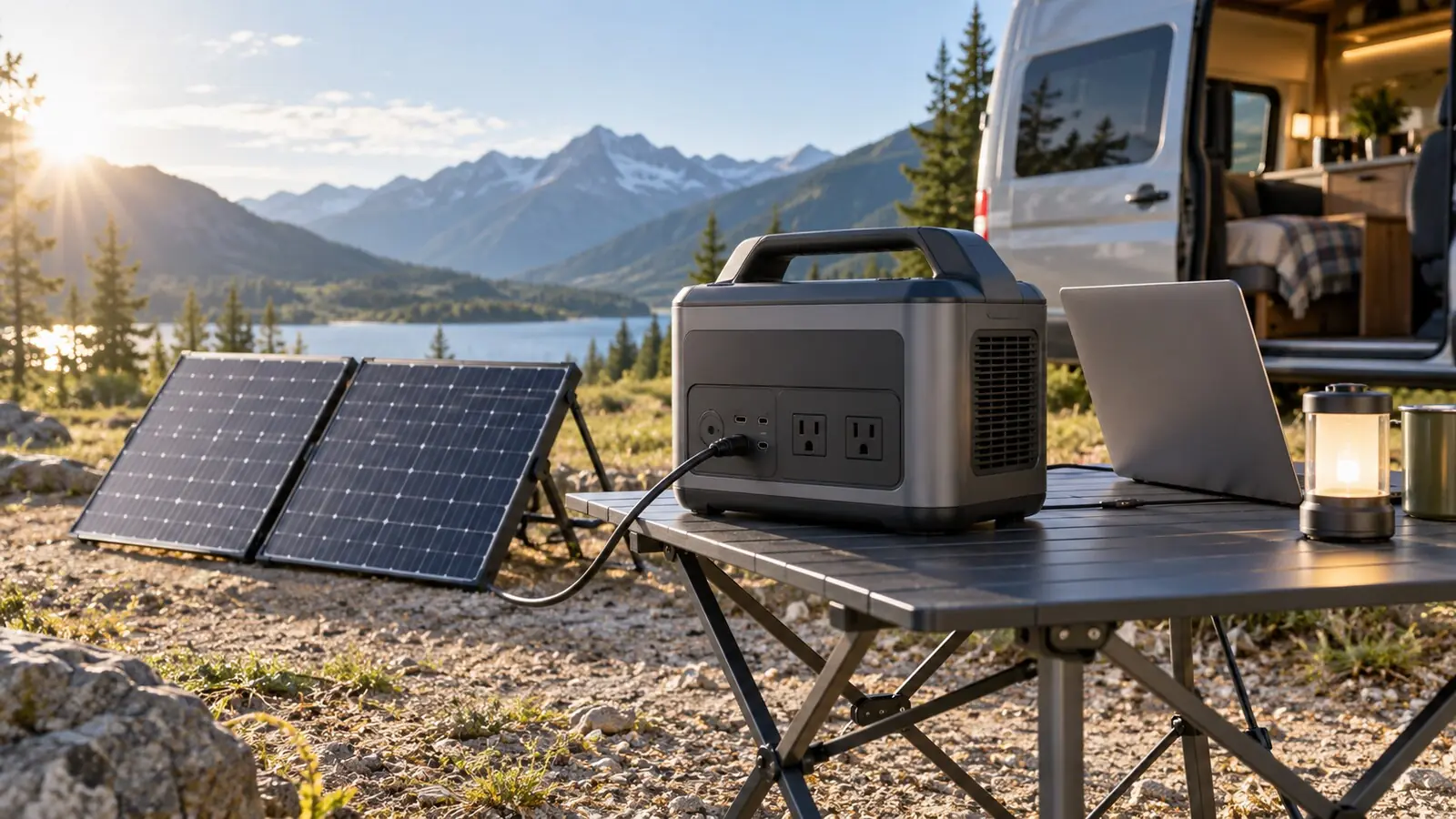
Buy a portable power station and solar panels as one electrical system, not two separate purchases. The battery has to cover your daily watt-hours, the inverter has to handle your running and starting watts, and the panels have to stay inside the station’s voltage, current and power limits in the coldest, brightest conditions.
A same-brand bundle is convenient because the connectors and supported setup are more likely to match. It isn’t automatically the best value or the best performer. A third-party panel can work fine when every spec and connector is checked against current manuals. This guide is about that buying decision. For the electrical detail of matching panels to a station, see our solar panel compatibility guide.
Size the station first
Write down each device’s daily watt-hours (watts × hours for steady loads, measured energy for cycling ones like fridges), then add inverter idle use and conversion losses. Divide by the fraction of rated battery energy you expect to reach your devices, and by the reserve you want to keep.
Example: loads total 850 Wh a day. If 85% of rated energy reaches the devices and you want 15% left over, 850 ÷ 0.85 ÷ 0.85 = about 1,176 Wh. That’s beyond a nominal 1,024 Wh unit for a full day with no recharge. It might still work if you use less, a DC output avoids inverter loss, or solar contributes while the loads run. Measuring decides.
Capacity is energy; output is power. A 2,000 Wh station can still shut off if its inverter is rated below a device’s running or starting watts, so add up what can overlap and check motor or compressor surge. Treat “boost” or “power lifting” modes carefully: they may not give normal voltage and can be meant only for simple resistive heaters. USB-C and regulated 12V DC outputs avoid AC conversion for compatible devices, but a car-style socket may be limited to 10 A or less.
What matters on the solar side
- Voltage. The station has a PV voltage window and an absolute maximum. Panel voltage rises as it gets colder, so add up the series panels’ open-circuit voltage and correct it for the lowest temperature. Never design right up to the station’s maximum.
- Current. Parallel strings add current. A station may accept high wattage at higher voltage yet limit current at lower voltage. Compare the array’s total short-circuit and operating current with the manual.
- Wattage. The advertised solar input is a ceiling, not guaranteed harvest. Angle, cloud, shade, heat, dirt and cable loss all cut it. Only oversize the array if the maker’s documentation allows it.
- Connector and polarity. XT60, DC barrel, Anderson-style and proprietary plugs all exist, and look-alikes can have different polarity or pin functions. Use the official cable or verify the pinout, voltage, current and wire size.
Our solar charge controller calculator can help with the voltage and current arithmetic.
How long will solar take to recharge it?
Divide the watt-hours to replace by the average solar watts. If you need to replace 900 Wh and the display averages 300 W over the useful charging window, that’s about three hours. If your loads draw 100 W at the same time, only about 200 W net reaches the battery and it becomes 4.5 hours. Panel nameplate power isn’t average input. NREL’s PVWatts and the Department of Energy’s solar material show how location, weather, orientation, temperature, shade and system losses change production. A portable panel can be re-aimed, but output still moves minute by minute.
Panel formats
- Folding portable panels pair quickly with a station and can be moved out of shade. Check packed size, weight, stand stability, cable length, water resistance and how long they take to deploy. Secure them against wind and theft.
- Rigid panels are often the best watts per dollar and suit fixed roof or rack mounting. You’ll need to plan mounting, cable entry, fusing, disconnects and vibration. A household panel’s higher voltage helps cable efficiency but may exceed a small station’s limit.
- Flexible panels help on curved or weight-sensitive surfaces. Look at heat, adhesive, bend radius and drainage. “Flexible” doesn’t mean it can be folded over and over.
For camping-sized options, see our portable solar panel comparison.
Bundle or separate panels?
A same-brand bundle usually includes a supported adapter and panel count, the manual may show exact configurations, and any warranty conversation involves fewer parties. The tradeoffs can be a higher price per watt, proprietary cables, limited panel sizes and less freedom to expand. Check whether the supplied panel can actually reach the station’s advertised maximum solar input, because many bundles include a smaller panel for portability. Also confirm the bundle is right for your region: connectors, outlets, charging cables and certifications change by market.
Third-party panels can improve roof fit or value, but you take on the compatibility check. Fill in this worksheet before connecting anything:
| Specification | Station limit | Your array |
|---|---|---|
| Cold-corrected series Voc | ___ V max | ___ V |
| Operating Vmp | ___ V range | ___ V |
| Total Isc | ___ A max | ___ A |
| Total Imp | ___ A max | ___ A |
| Array nameplate power | ___ W allowed | ___ W |
| Connector and polarity | required | verified |
If the manual doesn’t publish a current limit or supported configuration, ask the manufacturer. A plug that fits doesn’t prove it’s safe.
A quick configuration example
Take two identical 200 W panels with Voc 24 V, Vmp 20 V, Isc 10.8 A and Imp 10 A. Wired in series, you get Voc 48 V and Vmp 40 V with the current unchanged. In parallel, voltage stays at 24 V (Vmp 20 V), but Isc becomes 21.6 A and Imp 20 A. A station with a 60 V maximum and a 15 A input limit may accept the series layout and reject the parallel one. A station with a 30 V maximum and a 25 A limit may favor parallel. Wattage alone can’t tell you which. And the series Voc still needs the cold correction.
Four stations to compare
| Model | Capacity | AC output | Solar input |
|---|---|---|---|
| EcoFlow DELTA 3 series | 1,024 Wh | 1,800 W | Depends on variant |
| Anker SOLIX C1000 Gen 2 | 1,024 Wh | 2,000 W | Up to 600 W |
| Jackery Explorer 2000 v2 | 2,042 Wh | 2,200 W | Check solar ports and combinations |
| BLUETTI AC200L | 2,048 Wh | 2,400 W | Up to 1,200 W |
Before ordering, check which DELTA 3 variant you’re looking at (Classic, Plus or other), the 60 V and current requirements for your exact Anker configuration, whether Jackery’s parallel adapters are included or sold separately, and the product status and expansion compatibility of the BLUETTI in your region.
Three sizing examples
- Phones, camera batteries and a laptop. 350 Wh a day, peak 140 W. A 500 Wh-class station could work after losses and reserve, and a 100 to 200 W portable panel may replace the day’s use in good conditions. Prioritize USB-C output and a panel that packs safely over a big inverter.
- Fridge and remote work. A fridge at 650 Wh a day, two laptops and network gear at 500 Wh, lighting at 100 Wh: 1,250 Wh total. A 1,024 Wh station is unlikely to cover a full unrecharged day, so a roughly 2 kWh model or a dependable daily recharge plan is the stronger shortlist. Our refrigerator guide shows how to size for the fridge itself. A 400 to 600 W array helps, but work out net harvest after daytime loads.
- RV with short high-power use. Daily energy may be moderate while a coffee maker, microwave or induction hob pushes simultaneous power over 1,500 W. Pick the inverter from peak use and the battery from watt-hours. Rules like “never run the microwave and kettle together” can avoid a bigger station, as long as everyone follows them. See solar generators for RVs.
Cables, setup and safe use
- Long solar leads create voltage drop and heat. Use the maker’s cable guidance and protect cables from traffic, doors, sharp edges, hot surfaces and standing water.
- Don’t coil a heavily loaded extension cable tightly, and don’t unplug a connector that isn’t rated for breaking load while current is flowing. Use the approved disconnect sequence.
- Keep the station dry and ventilated, inside its temperature limits. Not in an engine bay, a sealed box, direct midday sun or a wet tent vestibule.
- Never backfeed home or RV wiring. Use a listed transfer method installed for the application. And remember a lit panel makes voltage even with the station off.
- Test before a trip or emergency: run the real loads, note peak and daily watt-hours, check low-load timeouts, and practice packing and deploying the panels.
When to return a bundle instead of adapting it
Don’t build a chain of polarity changers, splitters, barrel adapters and extension leads just to make a mismatched panel connect. Each joint adds resistance, weather exposure and a place to make a wiring mistake, and no adapter makes a panel acceptable if its cold Voc or array current is over the station’s limit. Return or exchange the bundle if the panel can’t be safely connected, the station’s input is too small for the recharging you were promised, the outlets are wrong for your region, or the maker can’t provide a current manual. It’s far better to sort that out before the return window closes than to troubleshoot heat or shutdowns in the field.
Comparing bundle value
Compare what’s actually included: station, panel wattage, expansion battery, adapters, extension cable, carrying case and warranty. A discounted bundle with a panel too small to restore your daily use can cost more once you add the missing panels and cables. Check return terms before you open or mount anything, since panels and batteries can have different shipping rules. And think about how it travels: panels, cables and stands need protected storage that doesn’t block exits or become loose cargo. A panel that’s too awkward to set up won’t deliver its theoretical energy, and a smaller array that gets used every day can be the better choice.
Buying checklist
- Measure daily energy and simultaneous power.
- Choose battery capacity with conversion loss and reserve.
- Confirm continuous and startup output.
- Match cold-corrected PV voltage.
- Match total array current and allowed wattage.
- Verify connector, polarity and cable rating.
- Estimate recharge with average, not nameplate, solar input.
- Compare portable, rigid and flexible panels for your use.
- Confirm warranty and service if you mix brands.
- Do a full-load, full-day trial.
Common questions
Will a 200 W panel charge a 1,000 Wh station in five hours?
Only on paper. Average input is usually below nameplate, and the station may taper near full. Divide the watt-hours to replace by measured average input, not panel rating.
Can I mix panels from different brands?
Only after checking voltage, current, connector, polarity and the station’s rule for mixed modules. Unequal panels can pull a string or parallel group away from its best operating point. Separate trackers, if the station has them, may be a better design.
Can panels stay connected overnight?
Many systems are designed for it, but follow the station and panel manuals. Protect connectors from water and strain, and secure portable panels. Disconnect in the approved order before maintenance.
Can the station charge and discharge at once?
Many can, within limits, but pass-through behavior, heat and combined power vary. Read the manual, and use net input (solar minus active loads) when estimating recharge time.
Does an expansion battery need more panels?
It adds storage but not necessarily more solar input capability. If the PV limit is unchanged, a bigger system just takes longer to recharge. Balance storage with daily recovery.
The takeaway
Start with the power station’s manual, then choose panels. A bundle is the easiest route when its capacity, output and panel wattage match your measured needs. A carefully verified third-party array can improve roof fit or value. Either way, voltage and current limits are hard limits, and an adapter being available isn’t proof of compatibility. Not sure what size you need? Read what size solar generator you need, or start with what a portable power station is.
Sources: NREL PVWatts Calculator; U.S. Department of Energy: PV Performance and Efficiency; EcoFlow DELTA 3 series; Anker SOLIX C1000 Gen 2; Jackery Explorer 2000 v2 specifications; BLUETTI AC200L. Specifications can change by region and model.
Affiliate disclosure: Van Volt Pro may earn a commission from qualifying purchases made through affiliate links, at no additional cost to you. Commercial relationships do not change how we research or our advice to check current specifications.
Last updated: October 6, 2026. General educational information. Follow the manuals for your station and panels.