
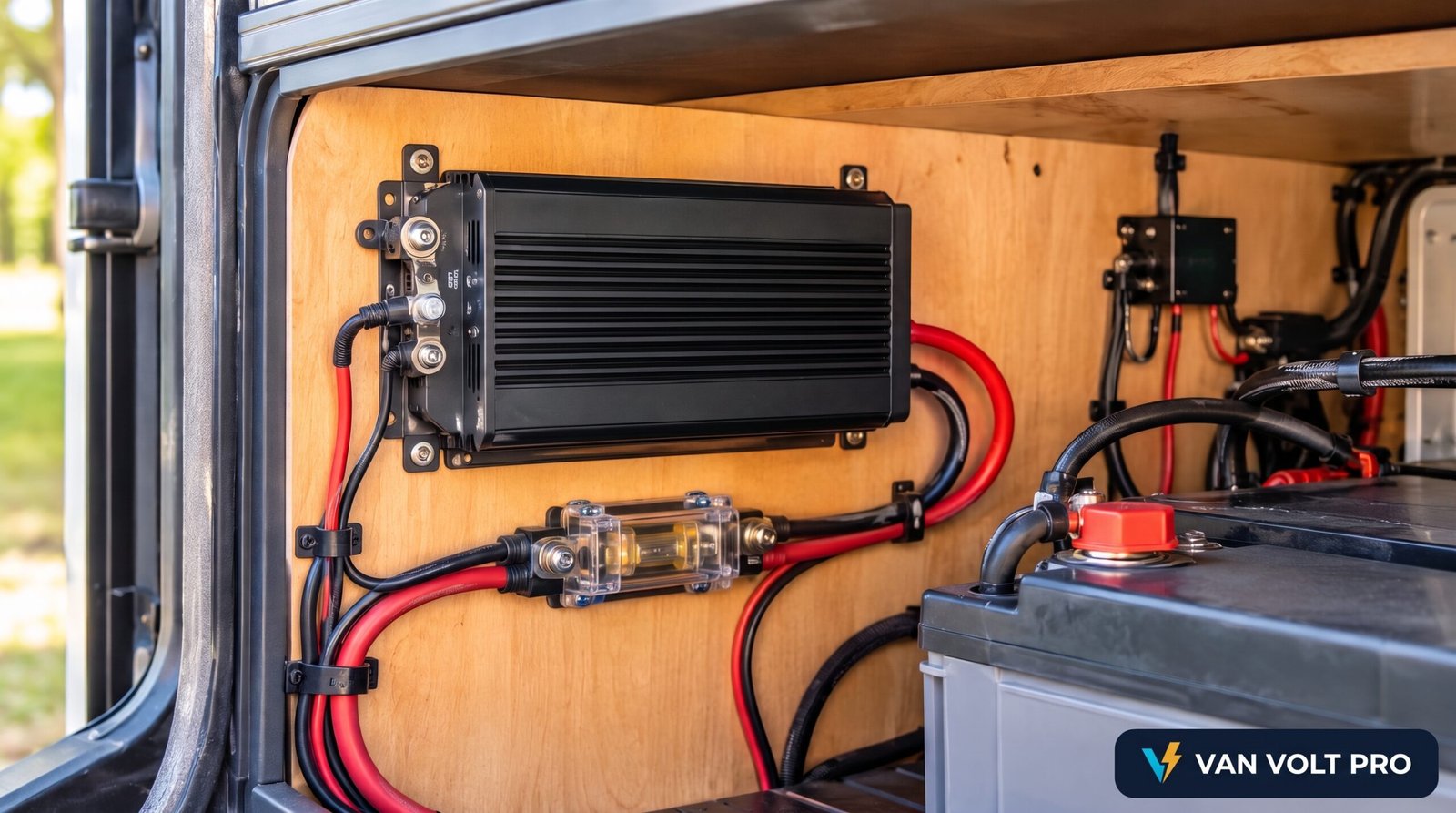
Quick Answer: Connecting a 12V LiFePO4 house battery straight to a vehicle alternator through a simple voltage-sensitive relay (VSR) or solenoid risks overheating the alternator and undercharging your lithium bank. A DC-to-DC charger for lithium batteries protects your alternator by capping current draw and boosts or bucks incoming voltage to the 14.2V–14.6V bulk and absorption profile that LiFePO4 cells require.
Why You Cannot Use a Simple Isolator with LiFePO4
Lead-acid batteries have high internal resistance, which naturally tapers down charging current as they fill. LiFePO4 batteries have very low internal resistance and accept maximum current almost all the way to full charge. When connected directly via an isolator, a depleted lithium bank can pull 80A to 150A continuously—even at idle when alternator cooling airflow is lowest—overheating stator windings and diodes.
Modern vans (Mercedes Sprinter, Ford Transit, and Ram ProMaster) also use ECU-controlled smart alternators. Under light load or deceleration recovery cycles, smart alternator voltage frequently drops to 12.6V–13.2V, causing a simple VSR to chatter open or stop charging altogether. A DC-to-DC charger isolates the two systems and delivers a steady charging curve regardless of engine RPM.
How to Size a DC-to-DC Charger for Your Alternator
- Check your stock alternator’s continuous limit: A safe rule of thumb is 30% to 40% of the alternator’s rated output, leaving headroom for headlights, HVAC, and engine electronics. For example, a 150A stock alternator safely supports a 40A–60A DC-to-DC charger.
- Match your daily driving habits: Multiply your battery capacity (Ah) by the percentage you typically replenish while driving, then divide by your average daily drive hours. A 200Ah bank drained by 50% (100Ah) over a 2-hour drive needs roughly a 50A charger—or a 30A unit if you drive 3.5 hours.
- Verify your battery BMS max charge current: Never exceed the continuous charge rating printed on your LiFePO4 battery’s datasheet (commonly 0.5C, or 50A for a 100Ah battery).
If you want exact numbers for your battery bank and drive time, use our DC-DC charger size calculator before buying hardware.
Common DC-DC Charger Sizes Compared
| Charger Size | Best For | Alternator Minimum | Typical Wire Gauge & Fuse |
|---|---|---|---|
| 18A–20A | Small 100Ah banks or older low-output alternators | 70A–90A | 8–10 AWG / 30A fuse |
| 30A | Most 100Ah–200Ah camper van builds | 100A–120A | 6–8 AWG / 40A–50A fuse |
| 40A | 200Ah–300Ah banks with regular driving | 130A–150A | 6 AWG / 50A–60A fuse |
| 50A–60A | Large 300Ah+ lithium banks & heavy-duty alternators | 150A–220A+ | 4 AWG / 70A–80A fuse |
Wiring, Wire Gauge & Fuse Placement
Route a dedicated positive cable from the starter battery (or vehicle jump post) to the DC-to-DC charger input, and another from the charger output to your house battery busbar. For the negative return, running a dedicated negative cable directly back to the starter battery or a clean chassis ground lug rated for the full amperage prevents voltage drop—especially on unibody vans.
If your van has a smart alternator, connect the charger’s ignition or D+ signal terminal to an ignition-switched 12V source so it only charges when the engine is running. Per ABYC E-11 standards, install an appropriately sized fuse (MIDI, MEGA, or ANL) within 7 inches of both the starter battery positive terminal and the house battery positive terminal. Always check our 12V wire gauge calculator for your exact round-trip cable length.
Common Mistakes to Avoid
- Undersized cables: Thin wire creates voltage drop, forcing the charger to pull higher input amps and run hotter.
- Mounting in unventilated cabinets: High-efficiency units still shed heat; mount vertically with airflow clearance or choose a high-efficiency buck-boost model.
- Skipping low-temperature cutoffs: Never charge LiFePO4 below 32°F (0°C) unless your battery has internal heating or the charger uses a temperature sensor to disable charging.
Frequently Asked Questions
Can I charge a 200Ah LiFePO4 with a 30A DC-to-DC charger?
Yes. A 30A charger delivers 30Ah per hour of driving, so replenishing 50% of a 200Ah bank (100Ah) takes roughly 3.3 hours of drive time while keeping alternator stress low.
Do I need a DC-to-DC charger if I already have solar?
If you camp in wooded areas, travel in winter, or run high-draw appliances like induction cooktops, a DC-to-DC charger provides reliable backup charging whenever you drive.
Will a 60A DC-to-DC charger drain my starter battery?
No, when wired properly with an ignition/D+ trigger or configured with engine-shutdown voltage detection, the charger turns off automatically as soon as the engine stops.
Sources: Victron Energy Orion-Tr / Orion XS documentation; ABYC E-11 AC and DC Electrical Systems on Boats.