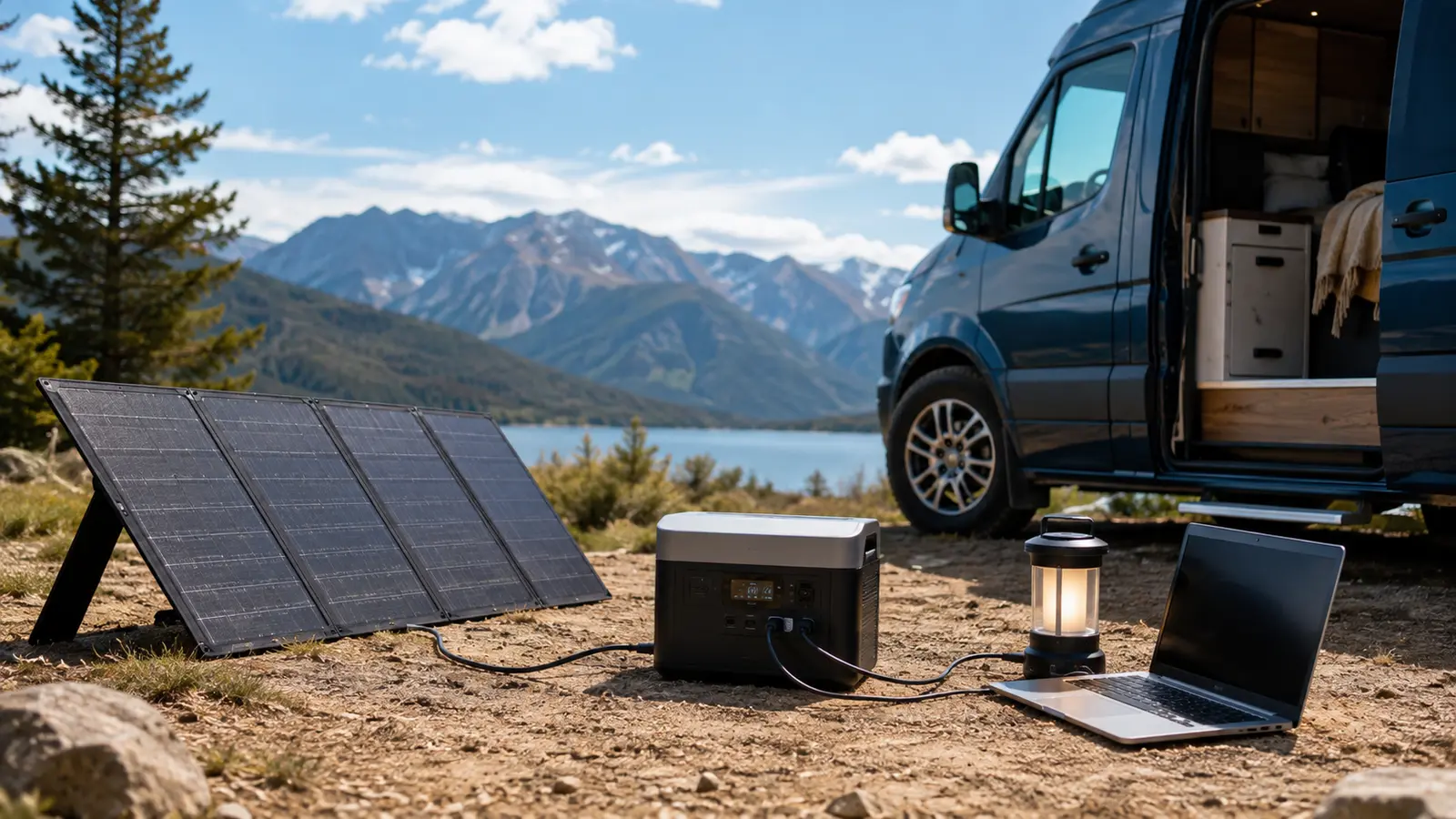
A solar generator turns sunlight into DC electricity, regulates it through a charge controller, stores it in a rechargeable battery, and hands it out through DC ports or an AC inverter. In consumer products, “solar generator” almost always means a portable power station sold with, or built to accept, solar panels.
It isn’t a generator in the gasoline sense. There’s no engine and no fuel. The battery runs your devices, and the panels slowly put back some or all of the energy you used. The path looks like this:
Sunlight → solar panels → charge controller → battery → DC outputs or inverter → your device
If you’re deciding what to buy, start with what a portable power station is. For a fixed van install, see the van electrical system guide and van solar basics.
The short version
- Panels make DC power, not steady household AC.
- The charge controller keeps panel power inside what the battery can accept.
- Battery watt-hours (Wh) tell you how much energy is stored. Inverter watts (W) tell you how much AC power you can draw at once.
- Charge time depends on the power actually coming in, not the panel’s nameplate wattage.
- Solar output swings with shade, heat, dirt, sun angle, weather and season.
- There’s no exhaust at the point of use, but it’s still a lithium battery and needs sensible safety habits.
The four stages
1. Panels turn light into DC electricity
Solar cells absorb light and produce current. Many cells make a panel, and the label lists its rated power, open-circuit voltage, operating voltage, short-circuit current and operating current, all measured under lab test conditions. Real output changes constantly. A flat panel on a van roof can’t stay pointed at the sun, and clouds, shade, dirt, heat and the season’s sun angle all cut production. The U.S. Department of Energy lists temperature, partial shading and soiling as key factors in photovoltaic performance.
2. The charge controller regulates it
The controller sits between panels and battery and keeps incoming voltage and current inside a charging process the battery accepts. Many portable systems use MPPT (maximum power point tracking), which finds the panel’s best operating point and converts that power into a battery-friendly charging voltage.
The controller has hard limits. A panel or series string must never exceed its maximum open-circuit voltage, and that includes the extra voltage panels make in cold weather. Input current and power have limits too. A connector adapter doesn’t make an incompatible panel safe. Our compatibility guide shows how to check.
3. The battery stores the energy
Many current solar generators use lithium iron phosphate (LiFePO4) or another lithium-ion chemistry. Capacity is shown in watt-hours, but 1,024 Wh is nominal stored energy, not guaranteed AC energy at the outlet. Conversion loss, standby use, temperature, load size and the shutdown threshold all change what reaches your appliance. The battery management system (BMS) watches the cells and can cut power if voltage, current or temperature goes out of range. It’s important protection, but you still need to follow the manual and stop using a damaged or abnormally hot unit.
4. Outputs deliver DC or AC
USB ports and regulated 12V outputs power compatible DC devices directly. For household-style outlets, an inverter converts battery DC into AC. The inverter has a continuous watt rating and may have a higher short surge rating, and the battery and BMS must be able to supply the current it needs. A big watt-hour number doesn’t mean the outlets can deliver unlimited power.
| Spec | What it tells you |
|---|---|
| Battery capacity (Wh) | Roughly how much energy is stored |
| Continuous AC watts | How much AC power it can supply steadily |
| Surge watts and duration | Whether a brief startup demand may be supported |
| Solar input voltage range | Which panel or string voltages are accepted |
| Solar current and power limits | How much array current and power it can safely use |
| AC or DC charge rate | How fast it can refill under stated conditions |
What happens when you plug something in
Say you plug in a 100 W AC appliance. The inverter pulls DC from the battery and converts it, and because the electronics use some energy too, the battery supplies more than 100 W. The display’s output watts, time remaining and percentage are calculated estimates that shift when the load changes. A planning formula:
Estimated runtime = battery Wh × usable-energy factor ÷ appliance watts
With a 1,024 Wh battery, a 100 W load and an illustrative 0.80 factor: 1,024 × 0.80 ÷ 100 ≈ 8.2 hours. That 0.80 isn’t a universal spec. A maker’s tested AC output or efficiency curve is better evidence. Very small AC loads can be inefficient because the inverter’s own use is a bigger share, and high loads add heat and voltage drop. For cycling appliances like fridges, estimate energy over a full day, and use a plug-in energy meter before you buy if you can.
How long does solar charging take?
The ideal arithmetic is energy to replace (Wh) ÷ charging input (W). If a 1,024 Wh battery needs a full refill and the controller actually receives 200 W, that’s 1,024 ÷ 200 ≈ 5.1 hours. In practice it takes longer. Input power varies, conversion loses some energy, the battery tapers its charge near full, and any connected loads use energy at the same time. A 200 W panel rarely delivers 200 W for five straight hours on a mobile setup.
When a product page gives a solar charge time, look at the assumptions: total panel wattage and wiring, season, location and weather, starting and ending charge, whether devices were running, the controller and battery current limits, and whether the figure was measured or estimated. A station that accepts 500 W of solar doesn’t charge any faster on a roof that only fits 200 W. And connecting panels past the input’s voltage or current limit is never a valid way to speed it up.
Can it charge while powering devices?
Many can, but implementations differ. If input is lower than output, the battery still drains even in full sun, and some modes get restricted at high temperature. Don’t treat pass-through as an uninterruptible power supply. Transfer time, grounding, outlet behavior and maximum combined power vary. For medical equipment or anything that can’t tolerate interruption, use equipment approved for that purpose and verify the whole backup design.
Solar generator vs gas generator
| Solar generator | Fuel-powered portable generator |
|---|---|
| Stores electricity in a battery | Makes electricity while an engine burns fuel |
| Quiet at the point of use | Engine and exhaust noise |
| No exhaust while running | Carbon monoxide and other exhaust |
| Limited by stored energy and charging | Limited by rated output, fuel, maintenance and duty cycle |
| Indoor use only as its instructions allow | Must never be used indoors or in an enclosed space |
A battery unit suits electronics, lighting, communications and modest appliances when its capacity and output fit the job. A fuel generator can support more sustained energy if you have fuel, but the carbon monoxide danger is severe. The U.S. Consumer Product Safety Commission says to run fuel-burning portable generators only outdoors, at least 20 feet from a home, with exhaust pointed away. Never run one inside a van, garage, house, tent or shed.
How to size one
Energy: how long must it run? Build a daily watt-hour budget: watts × hours for each device, then add them up. Use measured data for fridges and variable loads, add an efficiency allowance, and decide how many low-sun days the battery should cover. Our guide to what size solar generator you need walks through it.
Power: what runs at once? Add running watts for everything that can be on together and note startup surges. The inverter’s continuous output, surge behavior and any outlet-group limits must all support the plan. High-power heating can empty a portable battery fast even when the inverter can start it. A 1,200 W hot plate for 30 minutes uses an ideal 1,200 × 0.5 = 600 Wh before inverter loss, which could be most of a nominal 1,024 Wh battery. The inverter rating tells you if an appliance can run; battery energy tells you for how long.
Limits to know
- Solar is variable. Strong input at noon and little in morning shade. Plan from daily energy, not one peak reading.
- The battery is finite. When stored energy is gone, outputs stop until a source restores charge. A bigger inverter doesn’t extend runtime.
- Output ratings may be shared. USB, DC and AC ports can share group limits, so read the output table instead of adding every port’s printed maximum.
- Temperature matters. Charging can slow or stop when it’s too hot or cold. Keep vents clear, and don’t leave the unit in direct sun just because the panel needs sun; a cable lets the battery stay somewhere cooler.
- Expansion can be proprietary. Some systems only accept specific expansion batteries, solar connectors or cables, so include that cost and availability in the decision.
Safety, transport and recycling
Secure the unit during vehicle travel. Keep it dry unless it has a suitable environmental rating, leave ventilation space, and use approved charging accessories within the temperature and electrical limits. Stop using a unit that’s crushed, swollen, leaking, smoking, hissing, unusually hot or smells new. Don’t open the case or bypass the BMS, and in an emergency move away and call emergency services. At the end of its life, the EPA says lithium-ion batteries belong in separate recycling or household hazardous-waste collection, not household trash or curbside recycling, so follow local instructions for protecting terminals and transporting a large battery.
Common questions
Does a solar generator work at night?
Yes, if the battery was charged and has energy left. The panels do nothing useful at night; the battery supplies the load.
Can it power a refrigerator?
Yes, if the inverter handles the fridge’s running and startup demand and the battery stores enough usable watt-hours. Measured daily consumption matters more than the label’s maximum watts. See our fridge sizing guide.
Can panels connect straight to a battery?
Not in a normal portable system. Use the approved solar input and charge controller. A direct connection can overcharge or damage the battery and bypasses regulation and protection.
Is it silent?
There’s no engine, but cooling fans and electronics can make noise, especially during fast charging or high output.
Will a 200 W panel charge a 1,000 Wh battery in five hours?
Only in ideal arithmetic at a steady 200 W with no losses or loads. Real panel output varies and charging isn’t perfectly efficient, so expect longer.
Watts or watt-hours?
Watts measure the rate of power. Watt-hours measure energy over time. Check watts to see if something can run, and watt-hours to estimate how long.
Still comparing options? Our solar generator vs portable power station explainer clears up the names, and the power station guides collect the rest.
Sources: U.S. DOE: Solar Photovoltaic Technology Basics; U.S. DOE: Inverters and Grid Services Basics; U.S. DOE: PV System Design and Energy Yield; U.S. DOE: DOE Explains Batteries; Victron Energy: SmartSolar MPPT Introduction; U.S. CPSC: Carbon Monoxide Information Center; U.S. EPA: Used Lithium-Ion Batteries.
Last updated: October 6, 2026. Runtime and charge-time figures are estimates. Recalculate them for your exact product, appliance, location and conditions.