
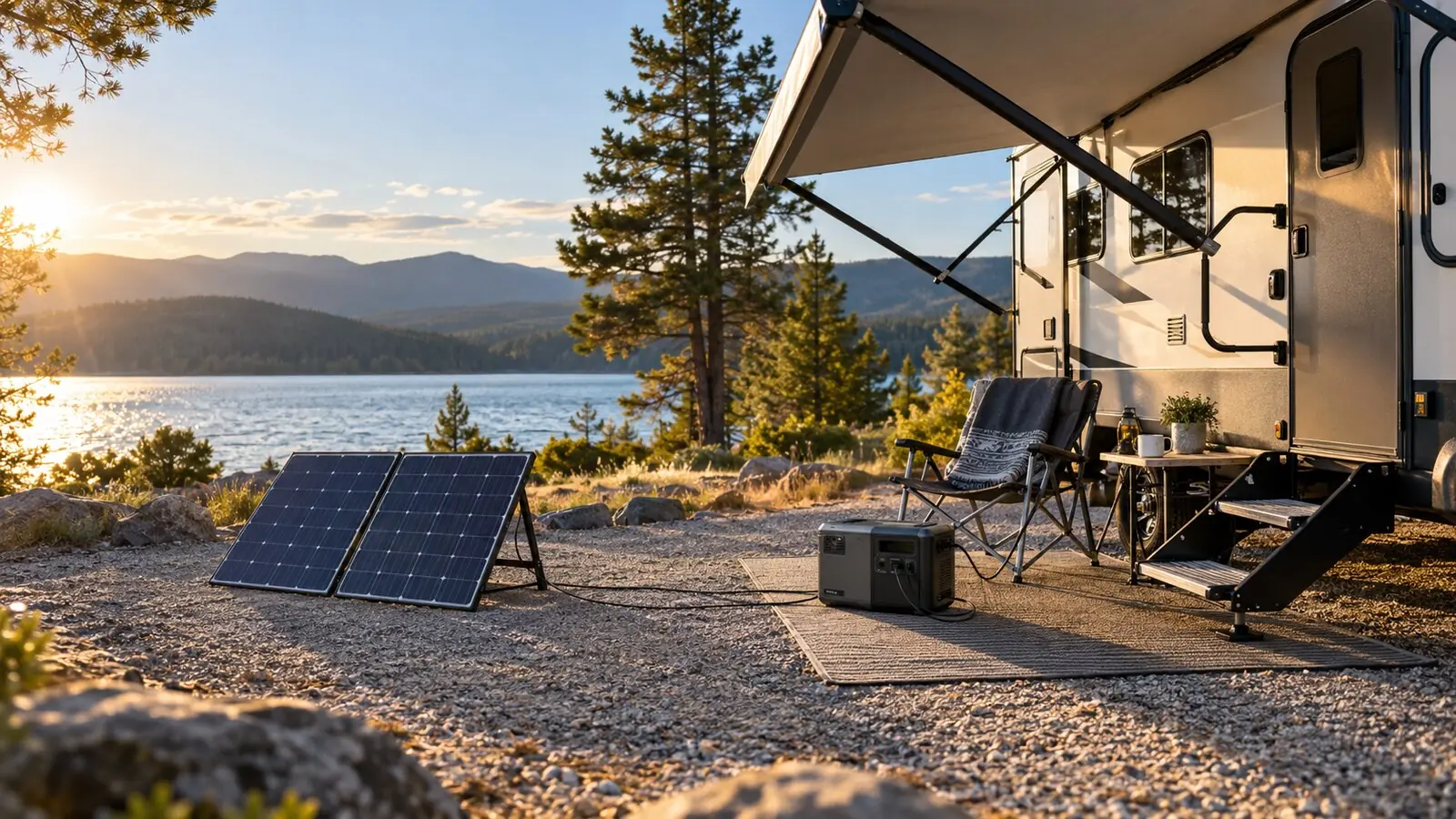
The best solar generator for an RV is the smallest system that can start your appliances, cover their measured daily energy, take in enough solar and other charging to refill, and connect to the RV without unsafe backfeeding. For basic electronics and a fridge, a 1 kWh-class station may be enough. Regular use of a microwave or coffee maker usually points toward 2 kWh and 2,000 W or more. Air conditioning and electric water heating need a bigger, carefully designed system.
“Solar generator” normally means a portable power station sold with, or used with, solar panels. The battery doesn’t generate anything; the panels, the grid or the vehicle charge it. So compare the station and the panels as one system. We look at four current examples below by their published specs. We haven’t tested them, and there’s no universal winner.
Decide what it will power
- Portable accessory power. The station runs things plugged straight into it, such as laptops, a portable fridge and camera batteries. It isn’t connected to the RV’s panel.
- Selected RV loads. The station feeds an approved RV inlet or transfer arrangement so existing circuits come alive. That brings in grounding, neutral, shore cords, transfer switching, converter/charger loops and power limits, so be careful.
- Primary off-grid system. The station and expansion batteries replace or supplement a house bank, inverter/charger and solar controller. Check that the ecosystem supports your DC loads, alternator charging, serviceability and a fixed installation.
Never plug a power station into an RV receptacle or household outlet to backfeed circuits. Use only a connection method that the RV, station and transfer-equipment makers all allow.
Build a 24-hour energy budget
For each device, note watts and hours per day. Use measured watt-hours for cycling loads like fridges, and add inverter idle draw plus the energy used by displays, routers and controls. A sample day:
| Load | Planning energy |
|---|---|
| 12V refrigerator | 600 Wh |
| Lighting and fans | 180 Wh |
| Laptops and phones | 300 Wh |
| Water pump and controls | 70 Wh |
| Short kitchen-appliance use | 350 Wh |
| Total | 1,500 Wh |
Assume 85% of the rated battery energy reaches your loads, and keep a 15% reserve: 1,500 ÷ 0.85 ÷ 0.85 = about 2,076 Wh. That makes a 2 kWh-class unit a reasonable shortlist. Plug in your own measured numbers. A gas stove and DC laptop charger can lower the need; an induction cooker or electric heater can raise it sharply. Try different days in our power system simulator.
Check continuous and surge output
Add up what could run at the same time. The fridge may restart while the microwave is on. Compare the total with the station’s continuous pure-sine-wave rating, then check motor and compressor startup against the maker’s surge information. “Power lifting” modes aren’t the same as normal rated output. Some lower the voltage to keep a resistive appliance going, which can be wrong for electronics and motors.
RV air conditioners need their own calculation. A station that starts the unit once in mild weather hasn’t shown it can cool all day. Measure watt-hours and test in demanding conditions.
Compare solar input the right way
Solar input has a maximum wattage, but voltage and current limits matter just as much. Check the station’s allowed PV voltage range and maximum current, calculate cold-corrected open-circuit voltage for panels in series, and add up short-circuit current for parallel strings. A station advertised at 600 W solar input doesn’t necessarily accept any 600 W array. Six 100 W panels can exceed the voltage limit in series or the current limit in parallel, depending on their specs. Use the maker’s configuration guide and approved connectors, and see our solar panel compatibility guide.
To screen recharge time, divide battery watt-hours by effective solar watts. A 2,000 Wh station getting an average 450 W after losses in strong sun comes out to about 4.4 hours. Real charging may slow near full, clouds and shade cut the input, and loads use energy at the same time. Think in ranges.
Four models to compare
| Model | Capacity | AC output | Solar input | Notes |
|---|---|---|---|---|
| EcoFlow DELTA 3 series | 1,024 Wh | 1,800 W | Varies by variant | LiFePO4; expansion depends on model |
| Anker SOLIX C1000 Gen 2 | 1,024 Wh | 2,000 W | Up to 600 W | 10 ms UPS switching |
| Jackery Explorer 2000 v2 | 2,042 Wh | 2,200 W | Check exact limits | LiFePO4; pure sine wave |
| BLUETTI AC200L | 2,048 Wh | 2,400 W | Up to 1,200 W | Expandable; check current availability |
1 kWh class: DELTA 3 series and SOLIX C1000 Gen 2
These suit electronics, an efficient fridge and occasional higher-power devices when daily energy stays modest. With the DELTA 3 series, check the exact variant, since Plus, Classic and others differ in input, ports, transfer behavior and expansion, and look at how the 12V output is rated if you’ll run RV DC devices from it. The C1000 Gen 2 gives more AC headroom than many 1 kWh models, but capacity is still what limits runtime: a 1,500 W appliance drains a 1,024 Wh battery quickly.
2 kWh class: Explorer 2000 v2 and AC200L
This is a more comfortable size for a fridge plus daily electronics or short appliance use. The Explorer 2000 v2 is the straightforward option; check solar input details, the number of outlets in your region, weight and whether you can secure it for travel. The AC200L has high solar input and expansion, which helps if you have room for a compatible array. Product status changes by region, so check availability, warranty support, expansion-battery part numbers and the exact PV voltage and current window before ordering panels.
Roof panels or portable panels?
Roof panels charge while you drive or sit in the sun with no daily setup, but roof space, orientation, vent shade and heat limit them. Portable panels let the RV stay in shade while you aim the panels at the sun, but they need storage, setup, security, wind management and protected cable runs. Long, thin extension cables waste energy, so use the size and length your station’s maker allows. Many owners do both: a smaller roof array for steady charging and a portable panel for mixed-shade campsites.
Vehicle and shore charging
- 12V accessory socket. Slow, limited by its fuse, and it can take many hours to refill a big station. Never fit a bigger fuse to speed it up.
- Alternator chargers. Faster, but they need correctly sized cable, protection at both ends, an alternator-capacity check, ignition control and thermal planning.
- Fast AC charging. Handy at home or on shore power. If the outlet, extension cord, generator or campground connection can’t support the maximum input, reduce the charge speed in the app.
RV connection traps
- Converter loop. If the station powers the RV’s shore inlet, the RV converter may try to charge the house battery from it, wasting energy or creating a loop. Switch off or isolate the converter as the documented design requires.
- Grounding and bonding. Neutral-ground bonding and ground-fault protection differ between shore power, generators, inverters and portable stations. If an RV protection device reports an open ground or a fault, don’t defeat it with an improvised plug. Ask the equipment makers or a qualified RV electrician for an approved fix.
- Placement. Keep the station ventilated and restrained for travel. Don’t leave it in direct sun, near propane equipment, in a wet bay or where cargo can damage ports and cables.
How your travel pattern changes the answer
- Weekend camps, full charge before you leave. Capacity and portability matter more than maximum solar input. A 1 kWh system can work after a measured trial, and a 200 W portable panel may stretch the trip.
- Long boondocking stays in open sun. Daily energy balance is the real test. A 2 kWh station with a single 100 W panel has plenty of storage and not enough recovery. Compare average net solar watt-hours, not the maker’s fastest AC charge time.
- Driving most days. Vehicle charging can matter as much as solar. Record the hours you expect to drive and the net charge current, and add it to the budget.
- Hot-weather travel with air conditioning. This is a high-energy case. Measure the AC over a hot day, including startup and cycling. Portable panels often can’t harvest enough for continuous cooling, so a generator, shore power or a bigger permanent system may be needed.
A full worked example
| Load | Energy |
|---|---|
| Refrigerator | 650 Wh |
| Fans and lighting | 220 Wh |
| Computers and phones | 380 Wh |
| Water pump and controls | 80 Wh |
| Microwave and coffee maker | 420 Wh |
| Inverter and system overhead | 180 Wh |
| Total | 1,930 Wh |
A 2,042 Wh station isn’t a full-day solution under this profile. At 85% delivered energy it offers about 1,736 Wh before any reserve. Now add 600 W of panels that average 380 W for four useful hours after conditions and losses: 380 × 4 = 1,520 Wh. The day’s total use is 1,930 Wh, so the system finishes the day roughly 410 Wh short, before conversion losses and before reserve. That’s the point of doing the budget before you buy. You’d need to trim loads, add panels or capacity, or plan alternator or shore charging to close the gap.
Easy-to-miss features
- Inverter idle draw. With AC on around the clock, overhead can use a big share of a small battery. Use DC outputs where you can, and check low-load timeout settings so a fridge’s off cycle doesn’t switch the output off.
- Regulated 12V output. RV fridges and routers may expect a steady 12V. Check the DC voltage, continuous current, connector and any auto-off timer. Don’t assume a 12V socket can feed an RV fuse panel.
- Expansion batteries. Check whether the extra pack charges and discharges together with the station, has its own display, and works with every charging source. Include cables and storage space in the plan.
- Water and dust. Most stations aren’t made for rain. A panel may be weather resistant while its connector box, adapter or the station isn’t.
Buying checklist
- Measured daily watt-hours and simultaneous watts.
- Compressor and motor startup compatibility.
- Reserve you want, and days between reliable charging.
- PV voltage, current and wattage compatibility.
- Roof and portable panel storage space.
- AC and vehicle charge times from sources you’ll actually have.
- Required 12V outputs and connector ratings.
- A safe, approved method for any connection to RV circuits.
- Expansion, warranty and service availability.
- Weight, tie-down, ventilation and temperature range.
Common questions
Can a solar generator replace an RV house battery?
It can supply selected loads or a documented inlet arrangement, but many stations aren’t a drop-in replacement for an existing 12V distribution system. Check DC output, converter loop, alternator charging, grounding, transfer and whether permanent mounting is allowed. An integrated RV power kit may suit a primary system better.
How many panels should I buy?
Start from the station’s voltage and current limits and your daily energy balance. More nameplate watts only help when the layout is compatible and you have unshaded space. Try several series and parallel layouts, and keep cold Voc below the absolute limit with margin.
Is a 2,000 W station enough for a microwave?
Many microwaves draw more input power than their cooking-output label suggests. Check the nameplate. A 2,000 W inverter may run it, but battery capacity decides how often. Test the exact combination without other high-power loads.
Can the station live in a storage bay?
Only if the manual allows that orientation and environment and the bay has the required ventilation, temperature control, dryness, service access and travel restraint. Heat can cut charging or output and speed up aging.
Should panels stay connected in storage?
Follow the station and battery storage instructions. Staying at a full charge for long periods may not be ideal, and a covered panel or indoor storage changes behavior. Never leave a portable array deployed unattended.
Do a 48-hour trial
Run the actual fridge, lights, electronics and planned appliances for 48 hours. Record energy by load where possible, the station’s percentage morning and evening, solar watt-hours, vehicle charge, peak AC watts, ambient temperature and any alarms. Repeat on a cloudy day or simulate low solar. That tells you whether the system is resilient, not just whether it works in ideal sun. If your RV already has a house battery, decide which system owns each load and charging source. Two half-integrated battery systems can cause confusing grounds, charging loops and shutdowns, and a documented separation is better than plugging things together mid-trip.
The takeaway
For light RV use, consider a 1 kWh station only after measurement shows it covers a day with reserve. For a fridge plus regular AC appliances, a 2 kWh-class unit is often the more realistic shortlist. If air conditioning, electric cooking or several days of autonomy are central, you’re past product shopping and into designing a complete energy system with solar, alternator, shore power, distribution and a professional review. Our RV solar kit buying guide and solar generator vs portable power station explainer help with the next step.
Sources: EcoFlow DELTA 3 series; Anker SOLIX C1000 Gen 2; Jackery Explorer 2000 v2 specifications; BLUETTI AC200L; Victron Energy: Recreational Vehicle Systems. Specifications can change by region and model.
Related guides: best portable power station for a refrigerator, what size solar generator do you need, solar charge controller calculator.
Affiliate disclosure: Van Volt Pro may earn a commission from qualifying purchases made through affiliate links, at no additional cost to you. Commercial relationships do not change how we research or our advice to check current specifications.
Last updated: October 6, 2026. General educational information. Have any connection to RV circuits reviewed by a qualified RV electrician.